Episode Transcript
[00:00:00] Speaker A: Foreign.
[00:00:07] Speaker B: The City the Baba Podcast where we bring together top actors in the Smart City arena, sparking dialogues and interactions around the stakeholders and themes most prevalent for today's citizens and tomorrow's generations.
I am your host Tamlyn Shimizu and I hope you will enjoy this episode and gain knowledge and connections to accelerate the change for a better urban life.
Smart in the City is brought to you by BABLE Smart Cities. We enable processes from research and strategy development to co creation and implementation. To learn more about us, please visit the BABLE platform at BABLE Smart Cities EU so hello everyone and welcome back to another episode of Smart in the City.
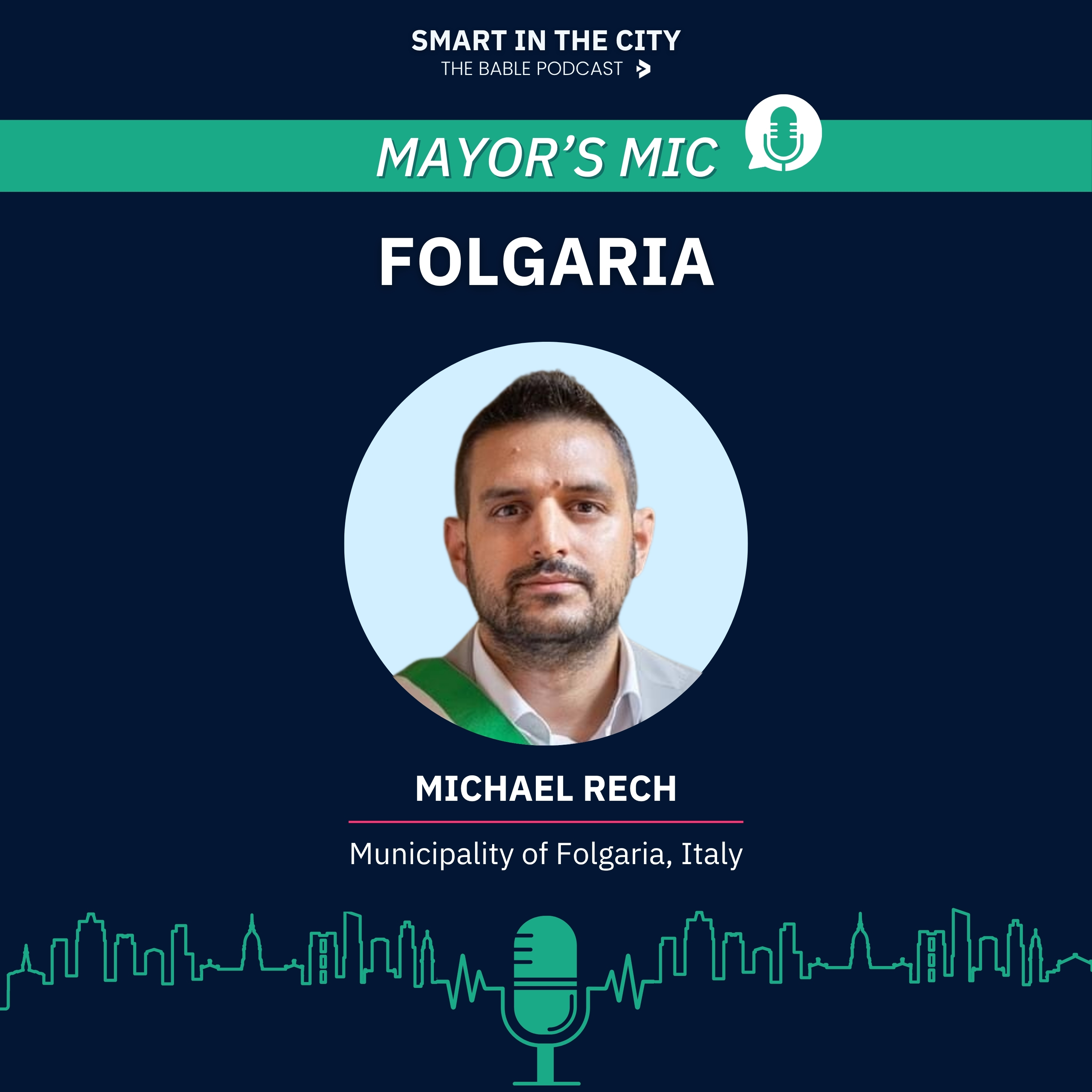
I am traveling virtually today to a beautiful region in Italy, actually one of my favorite regions, I have to say, in the north. So without further ado, I would like to introduce Michael Re, the mayor of the town of Faria, a town located in the Italian Alps. So welcome to the podcast, Michael.
[00:01:12] Speaker A: Thank you and hello to everybody.
[00:01:15] Speaker B: Thanks for coming on. I like to get us started with a little bit of a teaser, get us warmed up into the flow of things.
Learn a little bit more about where you're coming from.
The teaser I have for you today is if you have a fun fact, or maybe a very little known fact about Folgaria.
[00:01:34] Speaker A: Yeah, you have to know that Folgaria is not just a mountain community. It's a place with a very deep tradition of self governance. Already in the 13th century, the local community had its own rules and strong sense of autonomy and within a feudal system.
What I find most meaningful is that this spirit is still alive today and it's part of our culture. We also have a Cimbrian roots from the very long time ago and from the end of the First World War. We were Austrian before Austrian Empire and now we are Italian. That's why my surname is Re and it's not like a very famous Italian surname.
[00:02:24] Speaker B: Yeah, it sounds more German. Austrian I assume.
Yeah, absolutely.
I love the little history lessons I also get within the podcast. So thanks for letting us know.
I also want to know a little bit more about you as a person.
What is your background? What led you into this role today? Why did you want to be mayor of Agaria?
[00:02:47] Speaker A: Well, from a very young age I always imagined myself working for my community and I have to say I always think about a role of leadership and that's why I'm the mayor now and that's what's happened later in the last years. I have been involved in the highest level of local administration since 2009 at that time I was one of the youngest public officials in Italy and certainly the youngest in my region, Trentino Alto Adige. Over the years after, I've taken different roles in my area and also in the region. And since 2019, I have the honor of serving as mayor of Bulgaria. Alongside this, I've become a local ambassador for the European Union, also for the climate pact. And I'm so involved in the climate reality project from Al Gore, the former Vice President of United States States. At the same time, my family and I, we run a business in the touring sector, like restaurants on the ski slopes and we have a hotel and a shop in the city center. And this business keeps me closely connected to the local economy and the everyday realities of my area.
[00:04:14] Speaker B: Really interesting background and also interesting work in climate. I think we'll dig into that a little bit as well. I want to learn more about how you're approaching it.
When I want to kind of paint the picture a little bit of Fogarias. For people who haven't ever heard of it before, it is quite small.
Maybe you've, if you've traveled a lot in the Dolomites or the Alps in Italy, maybe you've passed through or gotten the chance to even stay for a little bit on holiday. But for those they're picturing maybe, you know, a beautiful mountain place, which I'm sure it is.
What does the day to day reality for the municipality really look like though?
[00:04:55] Speaker A: Yes, as you were saying, it's a beautiful place and we are really proud of that. But everyday life is quite complex. We have to manage service for residents and deal with the challenges of the montane area. And at the same time we have to welcome, and we are proud to welcome a lot of visitors. We have like 2 million visitors a year. So it's quite a big, big place in Italy and on the Dolomites. And this is a constant balance, especially because our population changes a lot between the seasons.
We are usually 3,000 residents and we go up to 30,000 people staying in our hotels, in our, in our homes. And I have to say, and you have to know that competition in the touring sector is extremely intense and it's going over and over. And the stability of a little economic system like ours depends on just a few decisions and a few people.
In short term. You can never afford to relax in Folgaria and in places like that.
[00:06:07] Speaker B: Yeah, it's really interesting the different dynamics places like yours have that have a low population but, but such high tourism and how you manage that one area also that you mentioned that you're quite heavily involved in is in climate action. And I'm really curious to understand how you move from, you know, these big maybe climate goals into everyday climate actions in your municipality as well.
[00:06:36] Speaker A: Well, 50% of our tourist tourism economy is from the winter.
So snow is quite related to climate change.
And in a small municipality, in a small city like ours, climate action is not only about big strategy like at the national level or European Union, but it's about everyday choice. It means improving energy efficiency in our public buildings and they are a lot managing water resources very carefully and making sustainability mobility option for more accessible for tourists and people living here all year round. Every decision we make and we take has to consider both environmental impact and practically things.
So that is like very complex, but we are managing that.
[00:07:31] Speaker B: Yeah, I want to dive into that in a little bit more depth as well because this is one of the biggest challenges when you're talking about climate and these climate actions is balancing climate action and goals with, you know, short term local pressure, the economy, what your residents are really demanding on an everyday basis.
So how do you actually practically balance this tension?
[00:07:54] Speaker A: This is a constant challenge. Local administration must respond to immediate needs, but also plan for, for long term vision. And this is politics. This is everyday job for a mayor and all the team working with me.
[00:08:12] Speaker B: Yeah, absolutely.
Maybe just a short follow up on that.
I'm wondering for the residents, do you find that the residents in Bulgaria are also quite passionate about the climate topics? Have you gotten a lot of support for this climate action?
[00:08:30] Speaker A: I have to say that every day and every year from the people, the people are asking us to do more. And also our clients, tourism nowadays they ask a lot to be very climate friendly and sustainable. So this is not only our decision, but it's the market decision. And if you want to win election and also to do really good your job, you have to improve our, your politics in, in climate and natural management?
[00:09:13] Speaker B: Yeah, yeah, absolutely. I see that a lot in especially these kind of mountain communities as well that where you're really connected with nature and you want to preserve that. Right?
I, I want to dive into a little bit deeper into a specific project. Because you mentioned energy efficiency in public buildings.
Can you outline that a little bit more in detail and also tell me what those building upgrades have taught you about kind of the real savings versus the real difficulties when we come to energy efficiency in buildings?
[00:09:45] Speaker A: Well, first thing to say is that small municipalities, small cities, there is often no dedicated energy manager or no energy office.
So the first challenge is simply Knowing where energy is being used, how much, when and how, you have to know before to act.
This spot puts local decision makers like me in a difficult position. And energy efficiency often remains more a theoretical concept than a concrete result.
So you have to know and act. Okay? The second issue, at least in the Italian public administration, is that achieving real results, both in terms of cost savings and environment impact, requires a full process. You need to design the project tender and assign the works, complete them on time and not very late, and then manage the public proper. The buildings properly is not enough just to invest in best materials, on best or in best technologies.
What really makes the difference is the management, monitoring and control.
So what we have done in the last few years and what we are still doing, and what we need to do more, is defining the most energy intensive buildings we have, like ice skating place, very big swimming pools and something like this, carrying out energy assessments and defining project to improve their efficiency.
Now, as the works are gradually being completed, we are focusing much more on energy management and real time monitoring of these buildings. Solar panels, heat pumps and home automation, like technological automation, are extremely important, but they need to be properly managed, management and monitored. Otherwise the risk is ending up with inefficiencies that are the same or even worse than before the efficiency project.
So management is the real key of the, of the efficiency managing. Okay?
[00:12:30] Speaker B: Yeah, absolutely. I think your approach makes a lot of sense for the small municipalities as well. And those challenges that you have that you don't have a dedicated team to this, and how do you really practically manage this, right. In a small municipality?
Another priority that you've outlined is on water infrastructure.
I'm wondering what, what made that area stand out? Why are you tackling that now? Maybe you can also explain a little bit more about your approach there.
[00:12:58] Speaker A: Well, water is so important everywhere. Okay. But in Folgaria we need to clarify that this is a place, a village on the mountain, but is a karst mountain. So water is going down very, very low. Okay. So this means we often have to pump water up from the valley. So we take the water from the valley up to the mountain with an elevation difference of several hundred meters. So it's like 1,000 meters of difference.
Unlike 99%, I have to say, of alpine location. Water is not naturally on, on the top of a mountain.
And so it does not simply flow down to homes by gravity. So we need to spend a lot of energy to pump it up. This result is a relatively high energy cost right from the source. So we start with a lot of energy, even in the purely theoretical and unrealistic case of having zero water losses. Because we have a big like water system and we have like 20% of water losses on the way we like we deliver the water to homes and buildings.
Just to give you an example, during the recent energy crisis and the draw of 2022, 2023, our annual cost for pumping water increased from about 800,000 Euro per year to more than 2 million Euro per year. So it's like three or four times more this because of the drought and of course the much more expensive cost of energy.
For this reason, we are investing heavily in the maintenance of the pumps and the pipelines to reduce waste as much as we can.
At the same time, we are installing new solar systems so we can really more use our energy we produce ourselves.
And another key element is our automated remote control system for the water network, which allows us to monitor lifetime the system and we can intervene in real time so we can manage to move water from one place to another.
Like to spend less energy.
[00:15:40] Speaker B: Yeah, makes a lot of sense, this management in real time as well.
Another topic that I'm quite curious to hear your thoughts on is on mobility. We have a lot of guests who talk about like urban mobility and these types of things. I think your context is a bit different. Anybody who's, you know, driven through any of the small mountain towns in Italy kind of understands small roads, different mobility challenges that you have.
Can you talk a little bit about what a realistic low impact mobility strategy looks like for a town like yours?
[00:16:14] Speaker A: Yeah, well, providing a public transport system in a mountain destination like Folgaria is not so easy. It's not easy at all. I have to say.
We go, as I was saying before, from around 3,200 residents to 30,000 people during peak season.
Those 3,200 residents are spread across 33 villages. So Folgaria is not just a big city, but we have 33 villages.
And so the people are located very spread around my territory, several kilometers apart and very different. Also altitude from about 500 meters on the sea level to 1600. So you have to think you have to move a little amount of people in a very big area and also with different altitude on the sea level, then during the tourist season, we effectively become a city, a big city. I have to say to respond on this, we would need millions of euros that we simply don't have. And at the same time, user often expect a free or a very low cost service.
So usually people don't want to pay public Transport or pay very little. So you need a lot of money, you don't have it and people don't give to you this money.
So for the residential side, we are moving forward on an on demand transport system. So it's a shuttle that can be booked via an app, allowing people to move just when they need it. And meanwhile we reduce our cost and emission and responding to mobility needs in a more tailored way. So not like a very big system but on demand and is much more tailored for the tourism side and through traffic thing. We are implementing pedestrian area every, every year, more limited traffic zones and access fees to some like very crowded places. So to reduce traffic as well as increasing parking costs in some area to avoid over tourism. So we try to put cars and traffic out away the villages and the main places and to bring people in the center with like buses, public transport and something and something like this.
On mobility, we have also started a dialogue with the region, region Trentino, which will soon lead to a new master plan for our territory.
Without forgetting the real importance of walking and cycling routes.
One interesting aspect of Folgaria is that in a few years, I think 20, 28, all or our 33 villages will be connected by a dedicated pedestrian and cycling path.
So people could like move around trekking or with electric bike, which is like a very good way to do climate friendly mobility.
[00:20:00] Speaker B: Yeah, sounds good. I really like your approach with the on demand public transport as well. I think it makes a lot of sense and of course the focus people that come to the region are usually also quite active, I think. So the E bikes sound very appealing. I'm not so confident in my ability to do the regular bikes in the region, but E bikes sound great too.
I want to now now kind of dig into a little bit more of in general in a holistic way. What are your challenges that you're facing?
For example, you're a small municipality, you have limited resources as we already mentioned, you know, not a dedicated energy team, et cetera. Small municipalities are typically expected to do a lot, but you don't have all the tools to match. Does that kind of ring true to you? How do you view that?
[00:20:52] Speaker A: Yeah, this is often the case.
Small municipalities are asked to address complex challenges with limited resources under the administrative capacity. This makes cooperation, partnership and access to the external founding absolutely crucial. You have to work in cooperation.
Instead you fail.
[00:21:16] Speaker B: Yeah, absolutely.
And I wanted to ask you as well.
One benefit of being small is also you tend to move a little bit faster than some of the bigger places. But I know it's still a challenge to accelerate these things.
So when you're trying to move, okay, you have commitment, you have a great idea, you have commitment, and now you got to move to implementation.
What it, from your experience, really slows down things the most.
[00:21:45] Speaker A: In Italy, the main barriers are bureaucratic complexity, limited financial resources. I have to say, if I have to say, Tarantino region is quite like, good, we have financial resources, but we have to say national situation is quite complex. And sometime we have to admit a lack of technical capacity. In the small municipality, we have to simplifying the procedure and ensuring more stable funding. And this would make a significant difference and allow us to move faster.
So in my experience, the biggest challenge is not the lack of ideas or even the lack of commitment, is the complexity of turning those ideas into reality.
What really slows down is a combination of bureaucracy, limited financial resources, and the time it takes to move from planning to execution.
Especially in small municipality, we don't always have the internal capacity to manage this complex project quickly. And time is quite a key factor also in energy. You can't do efficiency in 10 years, you have to do it now, not in 10 years.
[00:23:14] Speaker B: Yeah, absolutely. I like your approach here because I think a lot of stakeholders, they do push out these timelines quite a lot, of course, due to bureaucracy, etc. And other challenges. But I really like the mindset of, no, we have to do it now, now's the only time we can do it. And pushing forward on that assumption, also, you can't do it alone, you have to do this with other partners as well. So I'm wondering what, what gives you the confidence that a collaboration will really help a municipality? Who are you working with? Can you kind of explain a little bit of your approach when it comes to collaboration?
[00:23:57] Speaker A: Well, sometimes collaboration is a loss of time. Okay. So for me, trust is built on a few key elements.
First of all, I need to see that the partner really understands the reality of a small municipality like mine. Like ours. Because solutions that work in big cities don't always or never work for little places like mine. I also value a very practical approach. It's important that this collaboration leads to concrete results, not just on reports or ideas on paper, usually. Also, with my job in for the European Union, we go around and speak a lot for days and we come home with like, nothing more. So from paper to concrete results.
And of course, transparency and clarity also is essential, knowing who is responsible for what, what the goals are and how progress will be measured.
So, and finally, I appreciate partners who are Willing to adapt and work together over time. The best collaboration are not on off project, but relationship that grow and evolve with the needs of the community. So a long term collaboration.
[00:25:26] Speaker B: Yeah, absolutely. We see that as well. Working with, you know, hundreds of different municipalities of all different sizes. I think in my work I've really seen this growing and growing need to develop these long term partnerships that really are adaptable and listen to the needs of the communities.
So yeah, love your perspective there on collaboration too.
I want to ask you if we. We did touch a lot of topics today, but I do like to give you the open floor in case there's some topic, anything that we didn't yet get the chance to discuss that you think would be very important to let the listeners know about. Do you have anything in mind?
[00:26:09] Speaker A: Well, we need to improve connections not just in European Union, but worldwide.
These experiences, the territory experiences need to be shared. And nowadays with like web and the technologies, artificial intelligence, we can do a lot more on networking and we need to put together this.
So this is a way to like go forward and go on, go over like the difficulties we were talking before for the small cities. And this is big, big investment for the future.
[00:26:52] Speaker B: Yeah, absolutely.
I really enjoyed learning a lot about your different projects and all of that. Now we just go into our segments that we have for you today.
Every episode we have a different SEG segment that we bring to the table. The segment that we've chosen for you is called Shout Out, Shout out.
Mention a person, an organization or a city you think deserves more recognition in the field.
[00:27:25] Speaker A: I would like to mention the Euregio, which is like an institution between Trentino Alto, Adige and Tyrol in Austria. In Innsbruck is located in the heart of Europe. Our Euregio brings together the three regions, Tyrol, South Tyrol and Trentino, and primarily their three capital cities, Trento, Bolzano and Innsbruck. In particular, Eurezzo is addressing the challenges of the future, whether in the fields of mobility, transport, digitalization or climate change. And this is quite a very special institution we have in the European context. And we are working together between Italy and Austria and between three regions on the border of the Alps. So this is quite a very challenging path, but a very good idea and we are working a lot with them and we are very proud of them.
[00:28:26] Speaker B: Yeah, sounds like a fruitful collaboration and partnership there. I'm going to have to look more into that as well.
Now we come to the final question that I ask every single guest that comes on and it is to you, what is a Smart City?
[00:28:42] Speaker A: Well, Very often when people talk about smart cities, we immediately think of technology, IT or artificial intelligence. But for me, a Smart City, and I think for a lot of people, a Smart City is something much more organic and complex. First of all, I see people at the center of a Smart City, along with their services designed for them. It's about the quality of those services and more, the quality of life, ensuring safety, good organization, a strong offering and accessibility. A Smart City is not the one with the most technology, but the one that uses its resources, human, environmental and digital in the most intelligent way to improve people's everyday lives. It's a city that knows its own limits and strengths and listen to its community and that turns innovation into practical solution. In this sense, being smart is not about being advanced. It's about being aware, efficient, and truly focused on people. This is our concept we are trying to build in my place in Folgeria and also with our partner.
[00:30:03] Speaker B: Yeah, I love that we're moving more and more towards the conversation of the human at the center. And that's also reflected in all the podcast answers that I get on this question. And I'm really glad you're also aligned with that approach.
With that, I just have to thank you, Michael, for your time for coming on. I got to learn about a really interesting place and I'm sure our listeners are really excited that they also got to learn about about your town.
They might want to come and visit now as well.
But yeah, thank you so much for your time.
[00:30:35] Speaker A: Thank you. Thanks for having me.
[00:30:38] Speaker B: Absolutely. Anytime. And also I have to give a big thanks, of course, to our listeners. It wouldn't happen without them either. Don't forget, you can always create a free account on BABLE eu. You can find out more about different use cases, solutions and more. Thank you.
Thank you all for listening. I'll see you at the next stop on the journey to a better urban life.