Episode Transcript
[00:00:00] Speaker A: Foreign.
[00:00:07] Speaker B: The City, the BABA Podcast where we bring together top actors in the Smart City arena, sparking dialogues and interactions around the stakeholders and themes most prevalent for today's citizens and tomorrow's generations.
I am your host Tamlyn Shimizu and I hope you will enjoy this episode and gain knowledge and connections to accelerate the change for a better urban life.
Smart in the City is brought to you by BABLE Smart Cities. We enable processes from research and strategy development to co creation and implementation. To learn more about us, please visit the BABLE platform at BABLE SmartCities EU.
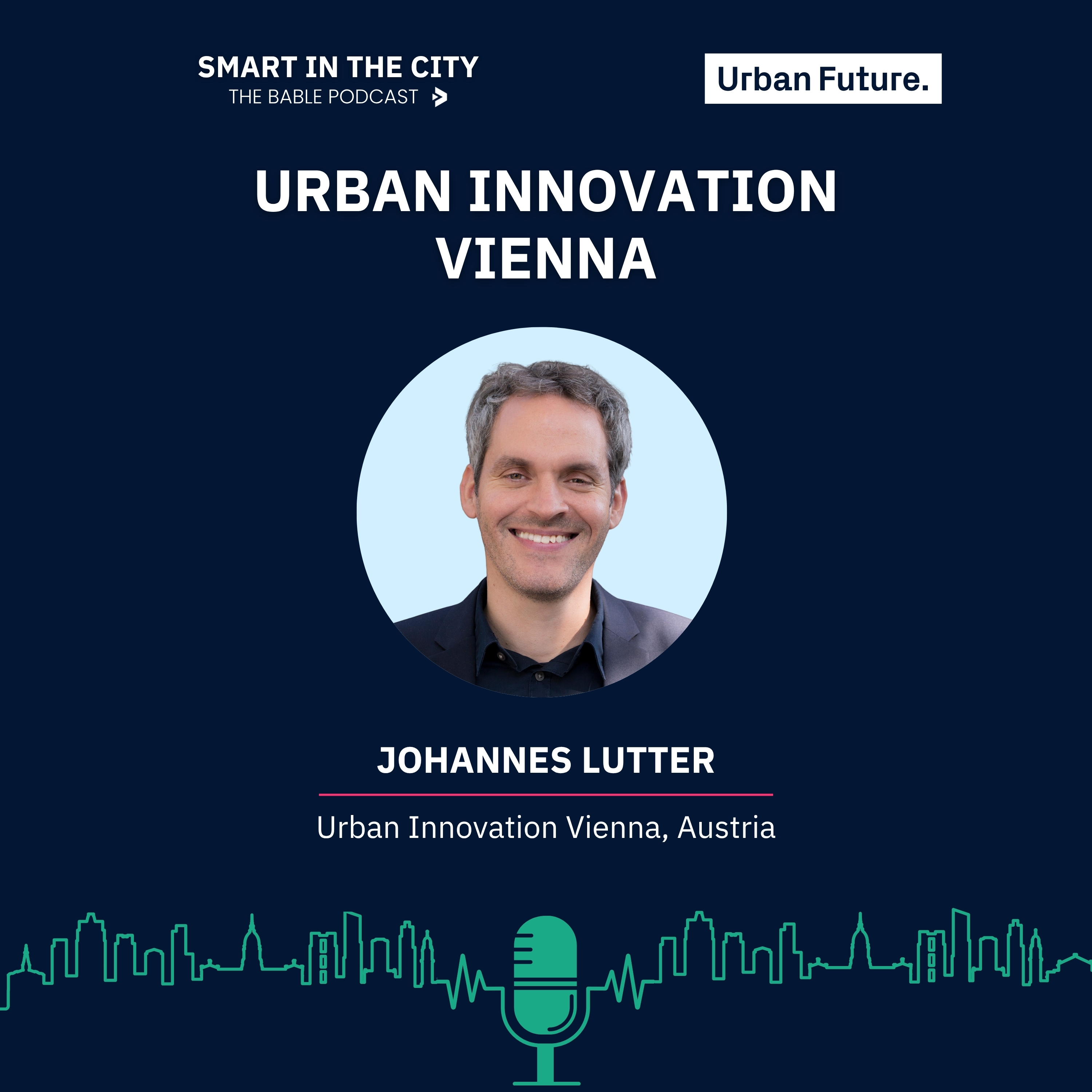
[00:00:46] Speaker A: So welcome back to another episode for our Urban Future Partnership series recorded here at the 2026 edition in Ljubljana. In Slovenia, it's just been an amazing journey with Urban Future over the last years, recording with so many of their amazing speakers every year in different cities, highlighting different stories, expertise, all of that. So big thank you to Urban Future for having us again.
And today we have a special guest of course, and we're traveling to Vienna to explore how the city is turning climate goals into everyday urban reality.
So with me today is none other than Johannes Luto. He's the head of International affairs and Strategic Partnerships and at UIV Urban Innovation Vienna, Austria. Welcome Johannes.
[00:01:33] Speaker C: Hello. Thanks for having me.
[00:01:35] Speaker A: Absolutely, my pleasure. You're my last one of the time and we're coming to a close of Urban Future, which is always a little bit sad. But I'm excited to have one last finale, one last insight into what you're working on and learning more about you as well. So I like to start us off with a little bit of a teaser question just to get the juices flowing, get us moving.
I would like to ask you what kind of public space most feels like Vienna. Maybe it's a square, a street, a park, whatever first comes to mind when you think Vienna.
[00:02:12] Speaker C: Well, perhaps it's the inner courtyard of our museum's quarter as we call it, where you have, where you're surrounded by a mixture of ancient architecture, new cultural museum buildings and a lot has been invested in the infrastructure of these courtyards. So seating infrastructure now, new plants because it's getting getting hotter and people are enjoying that courtyard like, like the living room. They, they just sitting there enjoying themselves. Some of them visiting the museums, many just having a drink. So that is like Vienna feels hopefully
[00:02:51] Speaker A: not in their underwear, like in a living room, but enjoying it fully clothed with some nice, nice coffee, etc. And I have to admit I it been nine years since I was last in Vienna or something. So I, I, I can envision it Still. But I need to go back. For sure.
Yes, Sometime soon. Sometime soon.
So I want to learn a little bit more about you as a person.
Tell us a little bit about yourself, what is your background in what led you to your role today and also lead us into what is uiv. Urban Innovation Vienna also.
[00:03:28] Speaker C: Well, I'm a political scientist, started my work with studies on European policy and then took a shift to local policies, as local as possible in order to be close to where you can actually see the impact of our work.
Urban Innovation Vienna, where I'm working is the climate and innovation agency of the city.
So we are owned by the city and founded in order to support city politics, city administration in the huge transformation processes that we are facing now. So, which is of course energy transition, mobility transition, all questions of climate protection, climate adaptation, circular economy and how we can use innovation, technical innovation, social innovation to achieve the. The goals that we have set.
[00:04:28] Speaker A: Sounds like a simple task, you know, not, not any hard challenges there.
Yeah, exactly.
Lots going on there. Let's unpack a little bit of it in the next 20 minutes or so.
So Viennas has a Smart City, smart climate city strategy which sets a quite a broad direction for the city. Can you outline that a little bit? What feels most important in your work right now?
[00:05:01] Speaker C: Well, yes, the, the strategy, the, that has this strange title of smart climate city strategies, the long term sustainability strategy of the city.
And it's including both climate protection goals. So climate neutrality.
We set the goal for 2040. There are other cities that have set it earlier, but we believe 2040 is still ambitious enough.
But it's also including goals for the single sectors that contribute to that. So the mobility sector, the heating and cooling of buildings. And of course we are at the same time addressing all questions of climate adaptation and the circular economy.
Currently we are into evaluating whether the many goals that we have set are in reach or not.
The monitoring report has not been published yet, but already now we can see that we are achieving things in many areas and we are far from reaching all goals.
There's still a lot to do and that's the core of the work that we are doing.
[00:06:17] Speaker A: What are those low hanging fruits? What are the easily, quote, unquote, easily achievable goals that you've set and which ones look like the biggest challenges?
[00:06:31] Speaker C: I wouldn't say that they are easily achievable, but there are some areas where Vienna has quite some traditions. This is for example, long term investment in infrastructures and services of general interest.
So we have a long tradition in Investing in affordable housing, which is also front runner of ecological qualities, architectural qualities.
We have a long tradition in investing in infrastructures for drinking water supply, wastewater management, waste management, green infrastructure.
So this is, we're here benefiting from, from the tradition of the last decades that, that has always been kept high.
And, and that's where we see also very good performance in the data.
And then there are areas which are new, like adaptation to climate change with a high dynamic, but we will still do a lot more and perhaps a bit quicker, but we see that things are happening. And then there are of course, issues like energy transition that are really huge challenges.
So you have to see that in Vienna we have approximately 101 million households of which two thirds are heated with gas.
So we have now 14 years left to find alternatives for all those 600,000 single gas boilers to find renewable energy solutions for them. And that's really a huge one.
[00:08:20] Speaker A: Yeah, absolutely. I want to touch on the climate adaptation process point that you mentioned.
Can you elaborate a bit more?
What does that mean for everyday life for citizens and how are you implementing that on the city level?
[00:08:38] Speaker C: What we see is Vienna is a city where you can feel climate change mostly in summertime through heat waves.
So heat is the possibly the strongest effect that, that we can feel. And we can see that there is high significant mortality already. So people are actually not only suffering, but dying from the, from heat.
And it's mostly elderly people, people with chronic diseases.
So those who are vulnerable anyway are also suffering mostly from heat.
And so this is not only a climate policy issue, but it's a social issue that we have to address.
What does this mean? It means that, for example, elderly people during heat waves, and we have those heat waves more often and for a longer time these days during heat waves, elderly people are living in an isolated way in their flats and even more isolated because they, they can't go out into public space because it's too hot. So what we have to do is shading, greening public space, investing in furniture so that you can take a rest in the shadow, but also setting up like publicly accessible shelters, we call them cooling zones. So these are just rooms where it's cool, where you can go to recreate and even meet other people that, that feel like you, where you have some, some interactions, some exchange with, with others in, in order to, to come out of this, this personal isolation.
[00:10:35] Speaker A: Yeah, very interesting.
So every city has a lot of targets, has a lot of goals, has a lot of these climate.
What about making them really usable and practical? How do you translate these climate goals, other goals, into quality standards?
Can you talk a little bit about that?
[00:10:58] Speaker C: Yeah, that's of course one of the crucial questions that, that we have to face.
There are some.
For example, when it comes to circular economy, we raised the question on how actually can we make circular economy principles feasible, operational in the building sector.
And the city administration did a cooperation with a university, University of Natural Resources in Vienna, to set up what we call the circularity factor.
So is there something like a circularity factor that we can then use when we do architectural or housing developers competitions that we tell them, well, those with the highest circularity factor will get better marks when it comes to, when the jury judges the quality of projects. And it turned out that it's of course not one factor, but it's a series of indicators that, that contribute to circularity.
And this was now tried out in what we called an urban living lab. So the first urban development process with those housing developers competitions, where we also evaluated whether housing companies have the possibilities to address those circularity issues.
And that way we have kind of set up a methodology in order to assess the circularity qualities of these processes and to create standards that we can use for competitions of the future.
[00:12:49] Speaker A: Okay, very interesting. Are these standards, is this methodology published somewhere or where can people learn more about it?
[00:12:58] Speaker C: Sure. So when it comes, for example, to the housing development in Vienna, we have a system which we call a four pillar system, where we assess every project in terms of architectural quality, affordability, ecological quality, social sustainability. And the criteria are published. So every, every developer, every housing company knows in advance what the criteria are that, that his project will be evaluative of.
[00:13:30] Speaker A: Yeah, yeah, makes sense. I'm. I'm wondering.
Cities can't do this alone, right? So I'm sure your work involves a lot of collaboration with different types of institutions, companies, with the public as well.
I'm just wondering. Oh, and you also mentioned to me before that you just came from a very good session that you were part of around public participation. Yes. So I. That you have a lot to say on this topic.
Yeah. So from your perspective, what makes public participation genuinely useful?
[00:14:09] Speaker C: First thing to say is we know from surveys, Vienna is doing a huge survey every five years with some 8 to 10,000 people participating on quality of life in Vienna. And we know from those surveys that we have an increasing public opinion towards more green, more sustainable development, less traffic.
But actually these are general opinions.
So we are not exactly sure whether people would also agree if you would ask them. Well, if we remove your parking space in front of you, your house, and plant a tree instead, would you still be in favor of that?
So actually we believe that when it comes to climate action, in whatever way, it's important to bring people in in order to get their ideas, but also in order to get a better feeling of their needs and their interests.
And this is all the more important because we won't succeed seed if we only come up with government action and ask for acceptance and ask for approval through elections.
But we will have to see that people are taking ownership of climate issues. We have one project that have presented this afternoon, which is called Vienna Climate Teams, where residents, inhabitants of Vienna, are asked to come up with their ideas for climate action, whatever it might be, redesigning the street in front of the house, setting up a repair cafe, renewable energy communities, whatever comes to their mind.
And out of those ideas, together with experts from public administration, then projects are developed that are actually feasible. And then there is a random citizen jury that decides on which projects to implement with public money that is available for that process.
And what we can see is that that way it's not that we have public action and then there is protests against it or not, but that there is ownership for the ideas of those who have contributed their ideas and have developed it. Over few months of negotiations with, with, with public administration experts and, and then when this project is implemented, they are supporting it and, and arguing it for arguing for it. So this, we were kind of changing the momentum and, and giving ownership to the people.
[00:16:58] Speaker A: Yeah, very good. Really nice example. I think on this point I want to also move in the other institutions, the, you know, the, the academia, the companies.
There's a lot of collaboration that needs to happen to meet our goals.
What do you find are the factors of success for those strategic partnerships for the city?
[00:17:24] Speaker C: Well, for the academia, we had a process quite recently where we asked all city departments, public utilities, services, what actually are the questions, the issues where we need answers from research and science.
And we collected numerous questions and together then with experts from the universities, from research institutions, we developed a research catalog, as we called it, like a common agenda of research for the next years.
So this helps the city to get answers on their actual questions and it helps scientific institutions or research institutions to do work on real life questions where there's really demand for their work. And at the same time they get of course, the test beds, the contacts, the data from the city that they need for their work. So that is one issue with the academia when it comes to cooperation with business.
We're currently Setting out what we call a climate alliance between the city and a number of enterprises, companies in the city.
And we agreed at the very beginning of this process that the focus is not on communication.
So we will not start with a press conference where we introduce everybody who's on board, but we will start with working on issues and then turn to the media as soon as we have some results to present.
And this is a very important process. And the companies themselves agreed to this process and said they have no interest at all in greenwashing issues or something like that, but they want to have direct access to the city in order to have a platform for dialogue, for talks between their interests and interests and goals of the city.
For example, if the city is favoring a shift from fossil fuel trucks or logistic processes to E trucks, so electrified CO2 free vehicles.
[00:19:54] Speaker A: Yeah.
[00:19:54] Speaker C: Then we need of course charging infrastructure that helps also to charge a 14 ton truck within two hours. And then the city has to know what infrastructures they have to provide in in order to make that possible.
[00:20:08] Speaker A: Yeah, really interesting actually because a lot of cities are struggling with this.
How do we incentivize the businesses to get on board? Right. So I think that's a really important insight to, to highlight that they the. The insights into what the city is planning to do in the future as part of their incentives. Right. So yeah, I think that's really interesting to highlight.
I want to ask you, in the work that you're doing, what do you think the biggest misunderstanding is that people have?
[00:20:43] Speaker C: Well, one thing is that perhaps it's not a misunderstanding, but it's one of the, the challenges that we are facing.
I give you an example. We have what we call a climate council. This is a group of scientists and civil sector organizations that give advice to the city government how to reach our sustainability goals.
And they meet several times a year and they have their consultations and negotiations and then talks with each other. And finally they have to come up with three recommendations that they bring directly to the mayor. So they are at the end of the two day meeting, they have a meeting with the mayor where they bring forward their three recommendations. And the tricky thing is the scientists at the beginning said, well, well, we have developed not three, but it's 23 because it's also complex that below that number we want to.
And we said that's a pity because the mayor has only time for three recommendations. So if you don't manage, you won't get the meeting with the mayor.
And on the other hand, of course the scientists are Right. That, that we are at the stage where we cannot decide whether better to invest in action to climate protection actions, so decarbonization actions, or better to invest in measures to protect the citizens from heat and other effects of the climate crisis. But we have to do things all at once.
The only thing is that in order to convince politicians who we have to reduce our recommendations to a number that is feasible for them so that we reach, they are able to reach certain decisions, although we know that the agenda is much longer.
[00:22:47] Speaker A: So it's about prioritization.
[00:22:52] Speaker C: It is. And as I said, the tricky thing is that it's difficult. And if prioritization would mean that we do first things first and other things later on, this might not be the case because we have to make progress in all the issues.
But it's a question of how to bring actually the many goals that we
[00:23:17] Speaker A: have into political action and maybe interlinking them. Right as well. Sure, yeah, that makes a lot of sense. Interesting. So I want to ask you, what do you think is the main challenge that you face when that still slows climate action down for you? And also what would help cities like Vienna move a lot faster?
[00:23:41] Speaker C: Well, the answer is not a comfortable one. That's okay, because I believe we have lots of solutions now ready. We have a catalog, for example, of 100 buildings where we have find solutions, technical, legally working solutions to decarbonize the heating system.
So we know that it works.
The only thing is that we don't have to decarbonize 100 buildings, but 500,000 buildings.
Up to now, we have done a lot with developing pilots, setting incentives, providing free of charge consultation processes, providing funding options.
So there is a lot of activation and mobilization.
And I believe we have reached a lot of people that fall into the category early adopters, first movers, pioneers.
If we really want to achieve climate neutrality by 2040, and we are forced to do that in order to save the climate, we also will have to set the regulations that force us to be quicker.
So it's not only about incentives, it's also about the framework conditions where everybody knows and you have, you have addressed that earlier. Regardless of companies or of private households, everybody has to have the planning security that you know. Exactly.
In the year 2040, I will not be allowed to have a fossil heating system. I will not be allowed to drive a fossil fuel car in Vienna. If I want to drive my car in Vienna, I will have to find an alternative. Till then, still a lot time.
Until then, the tools are there, the alternatives are there.
Consultation is there, but I know exactly the roadmap, the time schedule until things have to be done. And this is what we are still lacking currently.
[00:26:05] Speaker A: Yeah, very, very good point.
So now we roll right into our segment.
The segment I chose for you today is called Top or Flop.
[00:26:19] Speaker B: Top or flop.
[00:26:21] Speaker A: Respond quickly with your positive or negative review on a variety of topics.
So I'll say topic and then you just say top. Meaning it's great. Yes, I approve. Or flop. Like. No, please stop.
Ready?
[00:26:38] Speaker C: Yes.
[00:26:38] Speaker A: All right.
Adaptation before mitigation.
[00:26:46] Speaker C: Starting with a good one.
[00:26:48] Speaker A: They're meant to be tough.
[00:26:51] Speaker C: Top.
[00:26:52] Speaker B: Top.
[00:26:53] Speaker A: Consensus before action.
[00:26:56] Speaker C: Flop.
[00:26:57] Speaker A: Pilot culture.
[00:27:00] Speaker C: Flop.
[00:27:01] Speaker A: Visible change over systemic change.
Flop participation at every stage.
Flop Flexibility over consistency.
[00:27:17] Speaker C: Again, a tricky one. These are all tricky, by the way. Yes, let's say top.
[00:27:22] Speaker A: Okay.
Private sector as a co designer.
[00:27:26] Speaker C: Top.
[00:27:28] Speaker A: Comfort as a climate Metric.
Urban Future 2026 in Ljubljana.
[00:27:34] Speaker C: Oh, top of flop.
[00:27:37] Speaker A: Good. So I threw a couple easier ones. Okay. But do you want to explain any of your answers on why you said top or flop? So I think you said, for example, the pilot culture was a flop, I believe.
[00:27:51] Speaker C: Yes, I believe we have.
Of course we need pilots and we have to develop them. And we are good in developing pilots in many cities, also in Vienna.
But we are always in danger in ending up in dying by pilotis.
So more critical issues. How can we actually scale up things?
And that's why.
[00:28:24] Speaker A: Yeah, the participation at every stage. Also I was wondering about your thoughts there, because I think you said flop, right?
[00:28:31] Speaker C: Yes.
[00:28:32] Speaker A: Like you don't want participation at every stage.
[00:28:34] Speaker C: No, I think we have to be open and fair about the question at.
For what issues and at what stage participation makes sense. And we have to communicate this in an open way. And I believe there are many stages and many issues where participation will really help to contribute new ideas, to find a broader basis for what we are actually doing.
But it would be not true to say that at any stage and for each topic, participation is the right tool to do.
[00:29:15] Speaker A: Yeah, makes a lot of sense.
Now we come to our final question. It's a question that we ask every single guest that comes on. Everyone has a very unique response, as you can imagine.
To you, what is a Smart City?
[00:29:31] Speaker C: Well, let's say a Smart City is a city that is able to learn and act quickly enough to keep up the quality of life for everybody living in the city.
[00:29:48] Speaker A: I like it. I like the definition.
Yeah, very interesting. So with that, that's all I have for you today. Johannes, I could talk to you, I think for a long time about a lot of different topics. But I really, really appreciate you taking the last little while out of the last moments of Urban Future as well to talk with me, to share your insights with all of our listeners. So thanks so much for coming on.
[00:30:10] Speaker C: Thank you.
[00:30:11] Speaker A: Yeah, absolutely. Our pleasure. And also thank you, of course, to Urban Future again, for the partnership, as always, making these conversations possible here in Ljubljana. And of course, thank you to all of our wonderful listeners. This also wouldn't happen without them. So don't forget, you can always create a free account on Baba-SmartCities EU. You can find out a lot more about different use cases, solutions and more. Thank you very much.
[00:30:35] Speaker B: Thank you all for listening. I'll see you at the next stop on the journey to a better urban life.