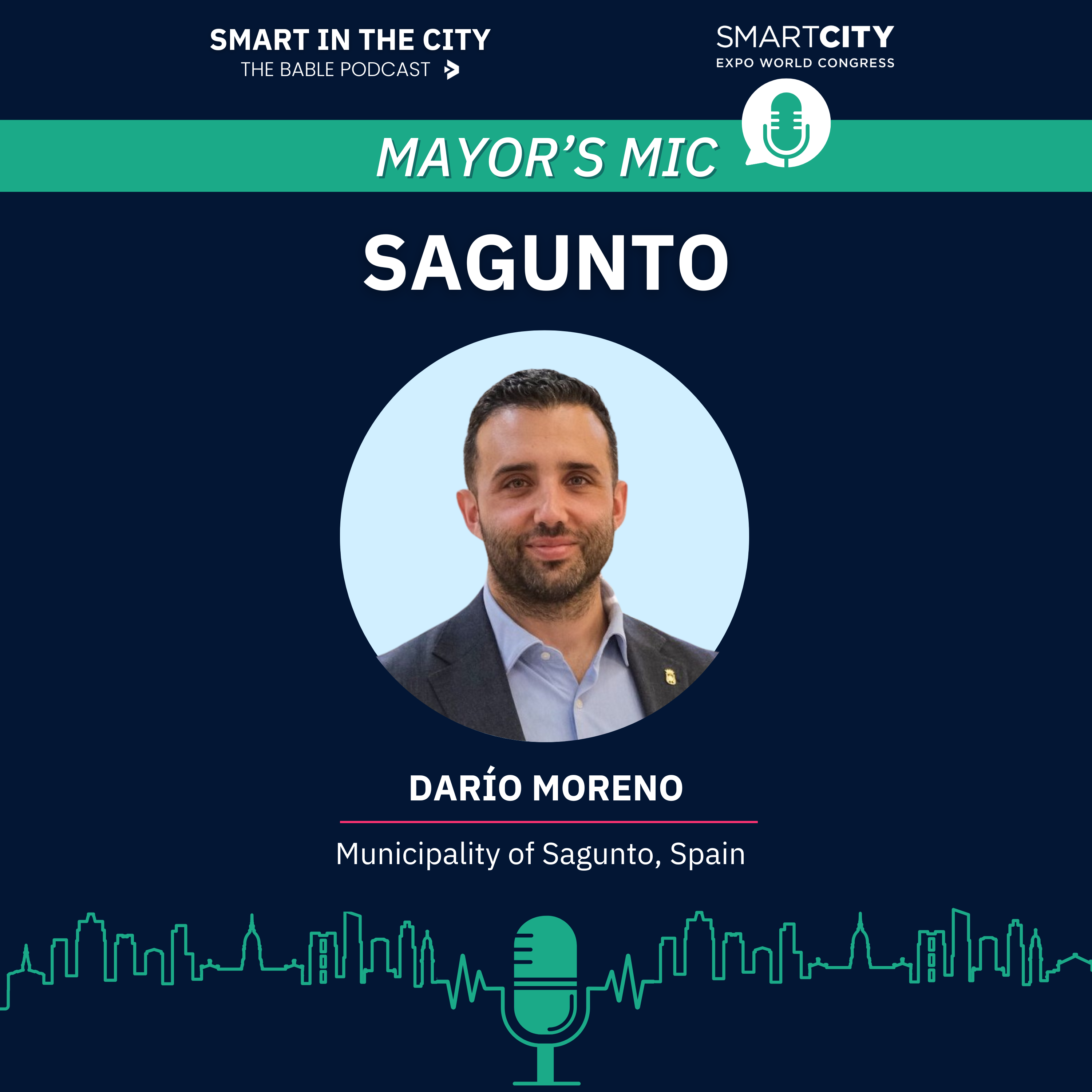
Episode Transcript
[00:00:00] Speaker A: Foreign.
[00:00:07] Speaker B: The City the BABA Podcast where we bring together top actors in the smart city arena, sparking dialogues and interactions around the stakeholders and themes most prevalent for today's citizens and tomorrow's generations.
[00:00:21] Speaker B: I am your host, Tamlin Shimizu and I hope you will enjoy this episode and gain knowledge and connections to accelerate the change for a better urban life.
[00:00:31] Speaker B: Smart in the City is brought to you by Babel Smart Cities. We enable processes from research and strategy development to co creation and implementation. To learn more about us, please visit the Babel platform at babel-smartcities eu.
[00:00:46] Speaker B: Welcome back everyone to another episode of Smart in the City. This episode will be hosted by one of my colleagues on the ground, so I hope you enjoy the change of voice and pace and I'll catch you next time.
[00:00:59] Speaker A: Welcome to this episode recorded live at Smart City Expo World Congress 25 in Barcelona. As part of our media partnership with Fira Barcelona, today we're taking a trip to the city of Sagunto in Spain. And with me today is none other than the mayor of Segunto to talk about how Segunto is changing right now, what's shifted over the last year, how the city is preparing for a mayor milestone, and how strong public private cooperation is turning plans into projects.
So without further ado, it's my pleasure to introduce you all to Dario Moreno, Mayor of the municipality of Sagunto, Spain. Welcome, Daria.
[00:01:35] Speaker C: Thank you so much. Good morning.
[00:01:38] Speaker A: Thank you so much for being with us today.
We always like to start, you know, in a very different way. Not straight into the questions, but if you would have to describe Sagunto as a plant, which plant would it be and why?
[00:01:53] Speaker C: As a plant? Wow.
I don't know. I guess right now I would say an orchid in a way. No, it's very.
Right now it has bright colors for the future. So that's. That's the vice that. That it gives me.
[00:02:04] Speaker A: I would say I love it. I love it. I'm a big fan of orchids. So, yeah, big fan of Segunto now.
[00:02:13] Speaker A: All right, so I would first like to learn more, a bit more about you, your background. What led you to become the mayor of Segunta? What can you tell us about that?
[00:02:22] Speaker C: I don't know. I think I've always been interested in public affairs in a way.
A little bit more into international, to be honest.
But definitely getting into politics and having a positive impact in my surrounding, my environment, my community is something that at some point in life, I knew that I wanted to do.
I studied business and law that is, I would say, pretty.
[00:02:49] Speaker C: Usual thing for people in politics.
Then I specialized in international trade.
I managed to have some international experience they really enjoyed. And it led me grow as a. As a person, as a professional too. I ended up being a lawyer for United nations and anti corruption program.
So that also gave me a whole new perspective about public administration.
[00:03:17] Speaker C: But I knew that at some point I wanted to go back to my hometown.
So when I did it sort of like it came natural to me that politics was a good option, given my background, my experience and my interest.
[00:03:32] Speaker C: I've always been in touch with people from the Social Democrats, in my case. And then it was easy to sort of create a group of people with whom try to create a whole movement in a way to. To expand the horizons of our city.
[00:03:51] Speaker A: What an honor then to come back to your city and then like be able to serve as a. As the mayor.
[00:03:57] Speaker C: Absolutely.
[00:03:58] Speaker A: That's a journey.
[00:03:59] Speaker C: I would say it's the honor of my life, to be honest. And every now and then people ask, no, do you want to go to national politics or do something different or become a congressman?
And I'm not really interested in that, at least right now, because the. I really believe in the product that we have for the city. And so far we're having.
We're being successful in developing it.
Therefore, I don't know, it's pretty exciting for me. And at the same time is there.
[00:04:31] Speaker C: Is such a great responsibility, but at the same time such a great joy when. When people from your own community trust you to lead them. You know what I mean?
So, yeah, you said it right. It's such a honor for me to be here and to be able to lead this project.
[00:04:49] Speaker A: That's amazing.
And so that means you have been in this role for some years now. When you look back at Sagunto today versus maybe a year or two years ago, what feels most different on the ground?
[00:05:02] Speaker C: Well, I think that the city is developing pretty quick. I would say a lot of things are changing. In fact, one of the key things that we need to take into account is demographics.
Sagunto, when I became mayor six years ago, was 69,000 inhabitants. Right now we're in 75,000 inhabitants. And if you count some other extra people, we're around 78k. So for a city this size, increasing around 1000 inhabitants per year is a lot.
[00:05:35] Speaker C: But at the same time, Sagunto.
[00:05:39] Speaker C: Has some particularities.
For instance, it has two different urban areas.
One is 25,000, the other one is 45k inhabitants. So that also Increases in the complexity of being able to manage properly the city. And also regarding the services that citizens have in each one of the areas.
So now one of the things that is changing is that more and more we no longer have two isolated urban areas, but more of a one unique area. And that's developing fast. So we need to adapt the reality of the city.
[00:06:22] Speaker C: To that trend.
[00:06:24] Speaker A: Yeah, I think that's also very interesting from the geographies of some cities that present some other challenges on top of managing the whole city and serving to citizens. But also people are spread out in different centers. Like how you keep them connected and so on.
[00:06:41] Speaker C: Absolutely. And in here, politics, at least in our case, it's also about identities. Right. In our two different urban areas, people are. It's not only about what politicians say, it's a reality that.
[00:07:02] Speaker C: People have different backgrounds. When we talk about the.
What we call the historical area, it's an urban area that has existed for the last 3,000 years, approximately.
[00:07:14] Speaker A: That's some history.
[00:07:15] Speaker C: Yeah, definitely. And we have a lot of heritage from that. That definitely is something that we must protect and we feel proud of. Right.
But it's a little bit more conservative sociologically. People have been there for ages. Definitely. There's people that came along the time too. But.
[00:07:36] Speaker C: It'S also very linked to our Valencian identity.
And people speak Valencian, that is another language besides Spanish.
Instead, when we move to the other urban area, that is what we call the port of Segunto, the area by the sea that's only 120 years old, more or less, and it was fully developed because of a steel factory.
So people came from other regions of Spain, not that linked to the Valencian identity. They do not speak Valencian. They've been way more influenced by unions and progressive thinking. And that definitely it makes it a very interesting city in that way. So for us politicians, we need to recognize that difference and make sure that the policies that we develop resonate with them also regarding their backgrounds. Right. It makes it a little bit more complicated, but I would say also more interesting. And we also, when we talk about the tourism now, when we try to convince people to come to our city, one of the things that we say is that Segunto is the stage for your own story. Right. In a sense, because we have industrial heritage, we have historical heritage, we have 13km of beaches, we have the mountains. So there's really plenty of options in our municipality that will ensure that you will have a great experience, no matter what your interests are. So it's a little Bit like come and discover us. Right.
In a sense, and being aware of those differences, but in a way that empowers us is part of what we're doing.
[00:09:22] Speaker A: That's exciting. And I'm just hearing, I think you're mayor of two cities.
[00:09:28] Speaker A: Yeah, I think it's.
I mean, it definitely adds an additional complexity to like already, like leading in a city and trying to make it a better place to live, to be able to address.
Yeah. Two different spaces with different backgrounds, with a dive, even the diversity that each of these places can have.
[00:09:50] Speaker C: But I would say that that's one of the main things that we politicians should do. We should be able to create projects that unite people. Because I would think, particularly these last few years now, polarizing and trying to antagonize people is what would work best. And the great thing about what we are doing in Segunto is that it's the other way around. We are trying to create something where everybody feels comfortable about, where they realize that our unity is our strength in a way. So that makes me feel particularly proud about the team and about city hall workers, because I really think we're having a very positive impact in our society.
[00:10:34] Speaker A: And I guess there is a role that this new project is playing. So what can you tell us about the Volkswagen Veteri gigafactory, what it means for Sagunto?
[00:10:45] Speaker C: Well, that's basically one of the cornerstones of.
[00:10:50] Speaker C: This moment of change that we're living in the city. Right.
Particularly because I would say that it's one of the biggest industry investments in the history of Spain.
And we're talking about 3 billion euros of investment, if not more, only in direct jobs. We're talking about more than 3,000 direct jobs for a city that is 75,000 inhabitants. Getting a factory like that, the impact of it is insane.
I really think we can foresee the real impact that it's going to have in our municipality.
It's been a long way.
[00:11:32] Speaker C: To get it.
Definitely we had, I don't know, maybe a leap of faith in a way. We really thought that the opportunities were out there and that we decided to, given that, as I explained, a huge part of the city comes from that industrial heritage, and we've been linked to industry for the last 120 years. It's sort of like part of the DNA of the city. So when we started talking, I think there is an ongoing conversation about reindustrialization in the European Union.
When that started happening, Sagunto thought that we really wanted to be one of these new locations. For this new industry. Right. And we put before Volkswagen Group would say, let's do the gigafactory there we were already committed and already advancing in a project for 5 million square meters of an industrial area.
[00:12:30] Speaker C: That facilitated that they would choose us as the final location because we weren't just talking about blueprints or ideas for the future. We were literally already developing this massive industrial area. And at the same time, we were looking for the opportunity.
Definitely there is a risk, because it could have happened that there was no real demand for that and that, you know, everything, we wouldn't be telling the same story. But when you see it in the long term, what we did is we first developed one industrial area that was around 1.5.
[00:13:09] Speaker C: Million square meters. And what we realize is that industries companies were coming interested for plots that were at least 3,000, 5,000 square meters, even 1 million square meters. So we then we realized that that's not that usual to. To have it at least in Spain, maybe in other countries. Yes, but it's something that we really need if we want. We want to compete, to compete in international.
[00:13:38] Speaker C: Market. Right. So.
[00:13:42] Speaker C: Yes, it does have a big impact in our city. But Sagunto wanted to be that place, wanted to be the place where new industry on a definitely new scale would find a place to develop.
That's why we started with this massive project of 5 million square meters. And that's one of the main reasons, I would say, why the Volkswagen Group chose us. Definitely.
And the great connections to Valencia. We're only 15 minutes away by car from Valencia.
[00:14:14] Speaker C: Some of the best universities in Europe, a lot of vocational training, all the infrastructure, we have port, we're very well connected to two airports, highways, the train.
[00:14:32] Speaker C: Rail work, everything. I think it really makes sense, the whole package that we're putting out there.
[00:14:40] Speaker A: Yeah, yeah. So it's also then part of this, what you could offer, but then also in connection with Valencia, with that pool of resources and activity that could also bring them to. To the table.
[00:14:52] Speaker C: Yeah, yeah.
One of the main challenges that we have now, I would say is how to develop the full potential of it. Right.
It's. It's a huge change also because we. We think about.
I'm basically a lawyer. I study business too, but I'm basically a lawyer. So I had no idea about how a battery functions until like five years ago because of this new project. Right. But it's basically chemistry and it makes all the sense.
We usually think about electricity, but it's not that much about electrical systems at all. It's Basically chemistry and we do have some chemical companies, but not that much. So it definitely means that we need to transition to that type of economy.
And that means creating new degrees, adapting the degrees that we already have so that they include this type of topics.
Even created new educational centers that are specifically focused on batteries and chemistry. Because that's what we are trying to do here. It's not only the gigafactory. We are trying to reshape completely what is our business environment so that it is competitive.
[00:16:13] Speaker C: In this world. And that has other implications that we must say. Because again, we're not only talking about economy.
[00:16:22] Speaker C: If we think about the COVID 19 we realize that we don't have that many capacities installed in Europe or at least not enough to guarantee our own safety on a way.
So one of the things that governments have realized throughout all European Union have been we need to re industrialize but also to protect our people. Because if something happens and for whatever reason.
[00:16:50] Speaker C: Our providers from different places in the world, whether it's the us, China, whatever, Latin America, they are no longer able to send us their products, then we really have no reaction options. Right. We need to be able to have a minimum capacity installed in the European Union. Particularly when we talk about batteries. That is something that we all realize that it's basic in our day to day life right now. And it looks like at least it's going to become more and more important.
More than 90% of the batteries in the world are all of them produced in the triangle between China particularly, but also Japan and South Korea.
It really makes no sense that a continent like Europe and a project like the European Union does not have that type of capacities. So we need to be able to develop all these new technology and not only because we transfer it from other countries, but because we're able to innovate and to develop our own path regarding this new technology. So when we talk about the gigafactory, we're also talking about creating all these new innovative ecosystem where this technology becomes something that we can also.
[00:18:08] Speaker C: Develop, that we can also create, that we can also offer something new to the world.
[00:18:13] Speaker A: Right. In a way to make it the European way. Right. To really mark that path and that development.
I think you already hinted so you were already talking about the batteries, what this means for electromobility and you started to also hint on what this means for Sagunto. So how does this project position Sagunto? Maybe in the European, but maybe like the worldwide landscape?
[00:18:37] Speaker C: Yeah.
[00:18:39] Speaker C: Some people call this like the new.
[00:18:44] Speaker C: Mediterranean hub for electromobility. On a way. And it's a little bit funny because we're not really producing electrical cars, we are producing batteries. But it's true that.
[00:18:57] Speaker C: All the new movement that we're creating, it really makes sense. And we're also really well connected to three big auto factories. One of them is in Valencia, but it's from different companies, it's for Ford, but the other one from the Volkswagen group are in Pamplona and Marto DEI here, really close to Barcelona, where we are now.
And.
[00:19:24] Speaker C: When we think about international scale of things, we're sort of the same region. Right. So what we're trying to create here is.
[00:19:35] Speaker C: Domino effect in a way, so that we all move forward towards that. I would say that in the new mobility conversation, what Segunto adds is that we need to reflect about the fact that it's not only about what we design and then buying it to other countries outside of Europe so that they implement those solutions. That's a huge part of the conversation. Definitely we want to have the best solutions, but we need to be able to produce those solutions also in Europe. We need to have that capacity here. So what he's saying is, yes, we need to think about definitely software that is a part of it, but we also need to think about hardware products, industrial products on a different level. And reindustrialization has to be a part of the conversation, whether we talk about electric buses, whether we talk about renewable energies, whether we talk whatever. Right.
We need to have the capacities to produce that also here as a way to protect our own people in an international environment that is changing every second and it's very unpredictable, as we've already seen for the last few years. So I would say that's. That's what it has to add. Besides that, as I said, it's a municipality that is complex, it has different urban areas. So definitely, regarding what solutions to implement, we're also being part of that conversation. But I would say that the main extra point, the thing that really makes us different is that Tigafactory project and the whole reindustrialization conversation that we should keep going.
[00:21:11] Speaker A: Yeah, And I think you were also tying to this idea of how such a large investment can have other potential and positive effects in the rest of the economy. The other suppliers that would need to scale up and develop and will be supplying different elements, parts advising these large investments. So I think there is that other domino effect, as you were calling it.
There is one thing that comes to my mind that I'm thinking if you were to, you know, because Our listeners, there are a lot of people that work in cities.
[00:21:49] Speaker A: And I'm just thinking, if you were to give one piece of advice to them, you've managed like this negotiation with this large company.
They have a lot of power. Of course, you are also like negotiating for them or inviting them to come, but they're also to play by your rules or the rules of the city, and, and the Spanish rules as well. And so what were like, one thing that you would advise other cities if they were to sit, you know, with this large organization, large company on the. On the table, like, what's the one thing that they need to keep in mind to really make sure that their space attractive, but they also, you know, stay true to their values and what they think is right also for. For their local population and their local conditions.
[00:22:37] Speaker C: That's a difficult one.
[00:22:39] Speaker C: I don't know what I would say.
First of all, I guess I would say beware that you're going to have to make some difficult decisions.
[00:22:50] Speaker C: It's very important here that you keep focused on whether what you're trying to achieve has a positive impact in your community or not. But if you really think that it will have, as with the Yafactory, I really think that it goes way beyond Segunto. It's going to have a positive impact in our city, definitely.
But it goes, as I mentioned to me, it's part of a whole European strategy, so really makes sense. And if you really believe in that project, then keep focus on that and what are the key parts of that. And if you're not discussing those key parts, then try to be as flexible as possible to all the other aspects that they might be important, but they're not that central to the whole concept that you're trying to develop. Right.
[00:23:43] Speaker C: One of the things that, for instance, we achieved is for that urban development of 5 million square meters of industrial plots.
[00:23:54] Speaker C: We managed to reduce the red tape so that usually an area of this size it would take, in the Spanish administration, at least, it would take five to six years to develop. If everything went right, we managed to do it in two years.
It wasn't again, constant ongoing conversation inside.
[00:24:19] Speaker C: The different administrations that play a part in this. But we really managed to do it. But because we didn't lose focus on what was the main target that was achieving this huge investment.
The other part that I would say is do not. And sometimes we find these type of behaviors in the administrations, that is some sort of mistrust, not only between parties, that definitely happens, but between different administrations. In the case of Spain, we're talking about the central government, Spanish government, we're talking about the regional government, balancing government and our municipality.
[00:24:59] Speaker C: The whole proposal that we put out there, it was really a reflection of the three administrations working together and.
[00:25:10] Speaker C: Putting forward something that really made sense, that we were making sure that we were all on the same page.
In that sense. That's something that afterwards the Volkswagen group told us that it was key for the decision and knowing that everybody was on board and that everybody would play their different roles, because we have different levels of.
[00:25:34] Speaker C: Roles to play in this investment. But we're all committed to the same goal. So in that sense, I think that's the other advice that I would give.
Try not to be secretive. Either you have trust with the other administrations that are going to play a role in the project that you're trying to move forward with, or.
[00:25:56] Speaker C: You'Re going to have trouble. And definitely your private partners are not going to fully trust the project.
[00:26:04] Speaker A: Yeah, that's a good combination because you were talking about focus. And I think that's also what led you to these discussions and building that trust with different levels. Because in a way you need to really understand who you need to have on board, who needs to accept and also help you promote this project so they can help you accelerate and keep your focus. So that is, I think, a great piece of advice.
Maybe I know this, this topic that could be very long. So maybe just we could focus on. On one concrete thing. But these big investments, they can put pressure on the city, on the developments, maybe on the housing prices, maybe also congestion. So there could be different impacts that it could have in the city. Like maybe given. Could you give an example of one of them? Like how you are addressing that? So it really bends the balances out the results.
[00:26:55] Speaker C: I'm going to stretch it a little bit and give two examples.
[00:26:57] Speaker A: All right. All right.
[00:26:59] Speaker C: Definitely housing is an issue in our municipality, but on a two way, not definitely it's a problem because it's increasing prices a lot and it's sort of like expelling people out of the market. People that have been living in Segunto, now they have to go to cities around or small villages around, because it's more affordable there. Right. And that's something that we are really committed to stop or at least to mitigate the effect as much as possible. But the other thing is that the 2008 crisis really hit us so hard. And as I mentioned, we have two different urban areas, but we had already a lot of plans to develop all the area in between those two main centers. So now it's also an opportunity to be able to develop those projects that failed in the past, but that now they might provide a solution for this. And the second issue that I wanted to mention is also mobility. That is part of what we're talking about today.
It's also an opportunity to reshape the city.
Particularly, for instance, our industrial areas. They were created as sort of bubbles. The we would only be able to reach them by car.
Now, with new industrial developments and also increasing the size of the city, we are starting to get to a new point where we can create new public lines of new transportation. And we're also incorporating some new experiences like car sharing apps that let us detect where there might be some demand that we are. From the public point of view, we're not answering to those two things. The housing and mobility definitely are issues that are part of the ongoing conversation in the city.
[00:28:55] Speaker A: Yeah, a challenge. But it seems also like an opportunity to reshape or revamp things.
[00:28:59] Speaker C: Yeah, yeah, absolutely.
Also regarding public services like education or the health system in a city that is growing fast like ours, we need to pay attention to that so that.
[00:29:13] Speaker C: All these economy potential that we are developing does not hurt the quality of life of people in the municipality, but the other way around. Definitely we're giving job opportunities to people, and that's a huge part of our welfare system. But we need to make sure that all these public services are also still available or even improving because of this moment that we're living in the city.
[00:29:40] Speaker A: Yeah, yeah, no, absolutely.
[00:29:44] Speaker A: We usually have this segment where we change it from one podcast episode to the other. And today we have chosen Shout Out.
[00:29:55] Speaker B: Shout out.
[00:29:58] Speaker B: Mention a person, an organization, or a city you think deserves more recognition in the field.
[00:30:06] Speaker C: Wow.
Okay. Shout out.
That's complicated too.
[00:30:14] Speaker C: Given my. My background, I would definitely say. And given the moment that we're living right now, I would definitely say the United nations for sure, as an organization that should play a key role in this. Right. Not only.
[00:30:27] Speaker C: Reindustrialization of mobility, but being able to have international conversations that enable us to empathize and understand each other. So given my background, I'm sorry, but I have to say United Nations.
I wish we gave more power to it.
And definitely for the last years, they've been financially struggling because less and less countries are committed to these.
[00:30:58] Speaker C: Creating a better world movement that it. That's what it is for me. United nations, definitely. It's not a perfect organization. I'm not saying that, but it's something. I mean, Something that we created after World War II.
And we're sort of like forgetting why we created it and how important it is that we keep these.
I will call it even international movement going. Right? These mutualism idea about dialogue, about being able to solve our differences, not because of power or strength or.
[00:31:35] Speaker C: Threatening others, but because we're able to build something together that is better for all of us.
[00:31:43] Speaker C: Sometimes it's scary. And I say from a European point of view, you see China, you see India, then suddenly you hesitate, like, right, they're getting a lot of power. Are we doing the right thing? Because they are so different.
[00:31:58] Speaker C: From our perspective. Right.
But I think we need to be brave.
We definitely need to keep that conversation going, and United nations is a huge part of that. So I will give a shout out to United Nations.
[00:32:15] Speaker A: Thank you so much for that, Dario, and thank you for challenging us to think about that.
Do really like this shout out. Not just because I have a background in international relations and I've studied, like, these organizations for a while, but I also think it's a very powerful message at a time where there is so much confrontation and these dynamics between different powers across the world. So it is. It's.
I think it's an important reminder for everyone for politics. So thanks for that.
[00:32:46] Speaker C: Oh, absolutely.
That also means. I mean, not being naive, right? It also means going back to the industrialization conversation, that Europe needs to be able to stand by itself so that our voice is respected in the world. And in that sense, maybe in this new mutualism, we sort of, like, faded away.
[00:33:09] Speaker C: Just by.
[00:33:12] Speaker C: Sort of, like.
[00:33:14] Speaker C: I would say, maybe dissolving ourselves into our allies.
But we need to have our own voice to be able to do that. We need to be strong. We need to develop fully our capacities. And say it out loud, what is our concept of the future world? Right. And be part of the conversation, not only support our allies, that's definitely something that we need to do. But also being able to stand by ourselves, as I was saying before, I think that's the best way so we can participate in the United Nations. We move forward with multiralism and a more inclusive way.
[00:33:55] Speaker A: All right, well, we have just come to our last question, and this is a question we ask every single guest to this podcast, and that is to you. What is a smart city?
[00:34:08] Speaker C: I would say, for me, smart cities are mainly about data. I would say being able to get the proper data to make the best decisions. And that's something. I mean, given how complex cities are and how fast changing they are right now, is something complex because maybe the KPIs that you were using six months ago are no longer valid or they do not give you the proper information.
So it's something that we need to be thinking all the time about. Right. But I'm not that much about people usually go for software or technology. Well, definitely it's a huge part of it because you cannot get proper information unless you include all these like, innovations. Right. But I would say to me, it's mainly about having the right data to make the best decisions.
[00:34:58] Speaker A: And definitely there will be a lot of inspiring examples these next days here at the Smart City Expo. So, Dario, thank you so much for making the time. It has been a pleasure to have this time with you and learn more about your work, what you're doing in Sagunto.
[00:35:11] Speaker C: Same, same. Thank you so much for being able to explain our project for Segunto and it's been a real pleasure.
[00:35:18] Speaker A: Thank you so much. And to all our listeners, don't forget, you can always create a free account on Bubble Dash smartcities EU to find more about Smart City projects, solution and implementations. Thank you very much.
[00:35:31] Speaker B: Thank you all for listening. I'll see you at the next stop on the journey to a better urban life.