Episode Transcript
[00:00:00] Speaker A: Foreign.
[00:00:07] Speaker B: The City the BABA Podcast where we bring together top actors in the smart city arena, sparking dialogues and interactions around the stakeholders and themes most prevalent for today's citizens and tomorrow's generations.
I am your host Tamlin Shimizu and I hope you will enjoy this episode and gain knowledge and connections to accelerate the change for a better urban life.
Smart in the City is brought to you by Babel Smart Cities. We enable processes from research and strategy development to co creation and implementation. To learn more about us, please visit the Babel platform at Babel SmartCities EU.
[00:00:46] Speaker C: So welcome back everyone to this episode recorded at the Smart City Expo World Congress in the beautiful city of Barcelona and as part of our media partnership, also with Fiera Barcelona. So I want to give a big shout out and thank you to Fieda Barcelona to start us off for having us, for welcoming us and giving also a great space for us to talk to some of their amazing speakers that have come to talk about their topics, their expertise and share their learnings with us. So today we're exploring the wonderful topic of Digital Twins and how that works for cities. I think it's a little bit of a topic that's a bit ambiguous, I think, and people use it in different ways as well. So I'm really excited to dig into this topic with you today. And for that we are traveling to Germany.
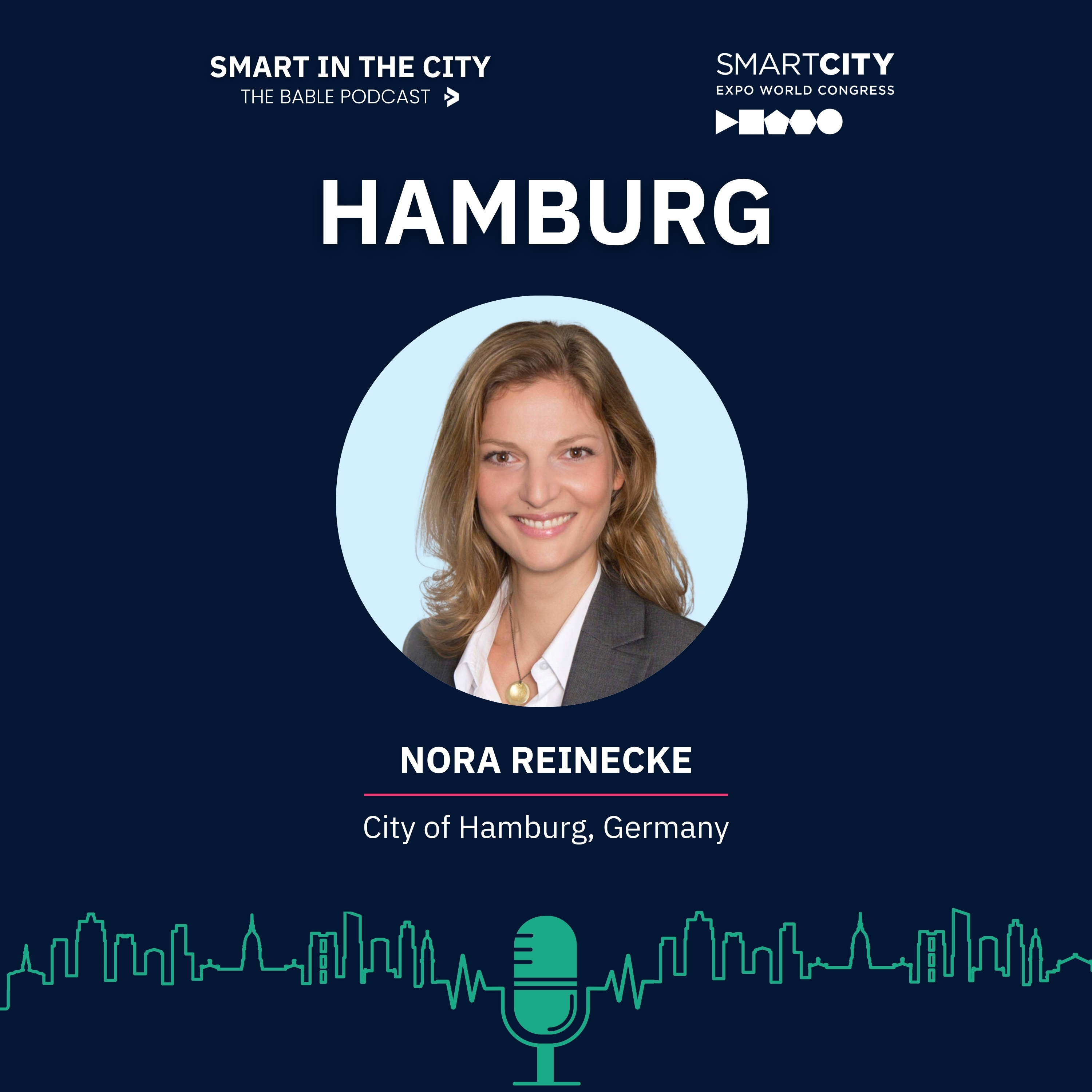
Even though we're in Barcelona, we're going to dive into Germany today with our guest of the day. So without further ado, it's my pleasure to introduce you to Dr. Nora Reineke. She's the project manager for the Connected Urban Twins project at the city of Hambuk. Welcome.
[00:01:50] Speaker A: Thanks so much for inviting me.
[00:01:52] Speaker C: Absolutely, my pleasure. I like to get us started with a little bit of a teaser question just to get warmed up. I also have to mention it's the very end of the very last day that we're recording. So our brains, I think are a little bit low capacity. We're going to get it warmed up here. If you had to describe Hamburg with these three emojis, which would you use and why?
[00:02:14] Speaker A: Well, as you just mentioned, we're in Barcelona right now, so I'm focusing back on Hamburg and I think what, what's very unique for Hamburg or a very strong characteristic is its harbor. So I would take away for the harbor and yes, it's a symbol for our metropolitan identity.
Then I would also pick a tree because Hamburg is a very green city and that makes us, yeah, also resilient to some of our hazards or tasks. That we're facing.
And I would also take a light because there is so much innovation and creativity in our city.
[00:02:51] Speaker C: Good choices. I, I visited a number of years ago and I was really blown away by how I felt there and just the atmosphere and, and everything there. And then I was coming back a few months ago from Sonderburg and I only had to like Pat. I passed through it and I was so disappointed that I couldn't stay. So I really need to make a visit back soon. Explored a bit more, but yeah, those emojis definitely resonate with my experience as well there.
Before we dig in more into your work, I want to learn a little bit about you as a person.
What is your background? How did you come into this role today?
[00:03:29] Speaker A: Sure, yes. I'm a geographer and I have a background in academia and also in business.
And I was very interested in all my, all my life and all my business career in complex analysis and yeah, a global perspective on different aspects, not just one, one aspect.
So that's, that's my background and that's what attracted me to the administration like more than four years ago to, to lead this project because it's all about cooperation and it's about improving our cities and it's about data and data driven decision taking. So I believe it's a very good, a good job to take different aspects of my academical background into consideration.
[00:04:18] Speaker C: What's been challenging? I'm just very curious. A lot of my guests will come from very different backgrounds and then end up in administration. And I'm just wondering, your experience coming from academia to the city, how has that been for you? Because I know Citi can be a little bit bureaucratic and these aspects, what has that experience been like for you?
[00:04:40] Speaker A: It was a lot less bureaucratic than I fear.
I came to the city, yes. And I, after being in academia, I also worked in a company for several years. So I have a background in all three different spheres now. And I learned that once you focus on a goal and you have a great team, you can change things wherever you work. And now working for the city, I can change the city at least a little bit towards a better cities. That, that's a great motivator.
[00:05:13] Speaker C: Yeah, absolutely. You're like the triple helix in a person.
You have the business, the academia and now the, the city. So I love it.
So I think people know a little bit about Hamburg, but can you paint us a picture of its current state? Any unique characteristics?
[00:05:31] Speaker A: Sure. Hamburg is Germany's second largest city and it has a strong tradition in international relations also due to the harbor that I mentioned earlier on, it has a big creative part also in music and different aspects of creativity. And it's quite windy actually, so I would have taken that also as a symbol of a hat. So, yeah, it's a very nice city. I'm born in Hamburg actually, so I love this city and it has very different aspects.
[00:06:04] Speaker C: Yeah, really nice. I think that it's always interesting when you come from the place and then you start working in the city. You must have a very unique perspective, I think, also coming from that.
Okay, now I already alluded to it before, like digital Twin, Connected Urban twin is the, the project. Is it in your title? Right? What does that mean really for you?
[00:06:27] Speaker A: Actually it means a lot to me and different aspects. It's not just the project title, Connected Urban Twins because we've been working together with Leipzig in Munich for the past five years. It's a huge project, the big model project for smart cities in Germany. We were funded by the Federal Ministry of Housing and Building and Urban Development.
So yeah, that was a great experience working together. That's why our digital twins are connected from Hamburg, Leipzig in Munich, because we worked together in a very close and very good project team.
But urban digital twins can also be connected within a city because there are so many different aspects and we build different digital twins for each question we raise for each use case. It's not just one big twin to us because we don't need all the data, all the tools for one question. But the complexity of a city, of course, also needs to be represented in the complexity of a digital twin. And the digital twin of like a machine is a lot less complex than the digital twin of a city. And it's more than just a 3D model. It's.
It also contains different information from visual things, physical aspects, but also information that are not physical and include very different spheres from business, from population, regarding the environment.
So you can connect different twins within the city as well. And that's what I like about our project and our approach to digital twin because it's.
It's always use case and demand driven and it is always about cooperation within the city and between cities.
[00:08:18] Speaker C: Yeah, absolutely. For those that really haven't had much exposure to digital twins, can you explain a little bit more what challenges it really solves?
[00:08:27] Speaker A: Sure. Well, it can solve challenges from small scale to big scale. But all cities are currently facing huge, huge issues, huge challenges.
We are facing climate change, we have mobility, transition.
There are aspects regarding a change of population dynamics or compositions and when cities face the need to adapt to issues that they wouldn't have chosen to have to face, then you have to consider all the information that you can gather in order to take, take better decisions. For example, we, we are city with a river running right through the city. As I mentioned earlier, it's the Elbe.
And whenever there's a flooding, we have to, to be prepared. And the flooding gets more frequently, gets more frequent and, and might even race higher.
And that's, that's a big issue that, that we're facing, for example. But it's also helpful when you consider on how to adapt to heat islands, for example, or when you consider on how you want to change your mobility structure within the city. If you want to reduce private transportation and improve public transportation or bicycle usage, then you should consider to increase the lanes of bikes, for example. And you have to consider all the results because it's not just one, one aspect that causes one result. It's always a complex system.
[00:10:09] Speaker C: Yeah, absolutely.
I'm wondering. So there's a lot of use cases. It's really a holistic tool that can tackle many, many challenges. Can you maybe dig a bit deeper into one specific use case for handbook where you've seen really good results, for example?
[00:10:26] Speaker A: Sure, I'd be happy to do that.
We, as I said, we have an approach that we have a very good data background and architecture when it comes to our digital twin, but it only unfolds when you have a use case that uses that infrastructure. And one use case we developed was really demand driven because colleagues from urban planning faced quite, quite some difficulties when trying to get an idea on how a new building would interact with the surrounding city.
So we developed a tool that easily incorporates a new building into our 3D model. And you can just change it, you can see how it interacts with the surrounding. And we added simulation tools to that in order to be able to get an idea on how wind, for example, and noise react to the new building. So that's a tool that's very, very specifically oriented on the need.
[00:11:33] Speaker C: Yeah, I think that's a great example as well. And I've seen so many amazing examples from cities.
I've also heard that some digital twins sometimes.
Is it a little bit overhyped in your opinion? I'm wondering what you think coming from that because of course we talk a lot about digital twins here at the Space Smart City Expo. Is it overhyped? Like, why do people have this hesitation?
[00:11:59] Speaker A: Maybe I don't believe it's overhyped.
[00:12:01] Speaker C: Okay.
[00:12:02] Speaker A: All in means of what it can do. Believe that the word or the term might be a bit buzzwordy by now and people get annoyed by it because they hear it all the time, potentially. I'm not getting annoyed by it. I love to hear it because I believe that it takes together an idea on how we can improve our cities. Because all decisions should, should be taken while taking into consideration different aspects and not just one.
[00:12:33] Speaker C: Yeah.
[00:12:33] Speaker A: And I believe that a digital twin can, can allow us to do that. Yeah. Enable us.
[00:12:40] Speaker C: Yeah. Another word that was mentioned, right, that you work in is geoai.
Can you explain what that means and how you use that?
[00:12:53] Speaker A: Well, artificial intelligence might be the next buzzword that is used quite frequently currently.
And of course, it's just a new or rather new option to allow us to work with great amounts of data, not having to look at it all by ourselves. So it makes some things a lot easier than they used to be.
And when it comes to georeferencing of AI components, there is a lot of potential.
But as in all other use cases, I believe we should focus on what we want and what we need and not only on what is possible.
So if we need to get an idea on the surface of a city, how many trees do we have, what do they look like, are they in a good shape?
Then it's very convenient to use AI components in order to analyze the structure.
That's one example. But also using large language models can improve our work with digital twins, or generally speaking, with tools that help us improve our cities.
[00:14:04] Speaker C: Yeah, I think it makes a lot of sense and I can see how obviously AI can accelerate a lot of this work that you're doing a lot of manual, past manual work and traditional ways of, of looking at this data.
Of course, a big concern is around bias, around maybe hallucination, all of that with urban data and AI, how do you detect and mitigate it? So, yeah, you make sure it's not impacting any of the decisions negatively.
[00:14:33] Speaker A: I believe, as always, we need to understand the tools we use.
And it's nothing new, it's nothing fancy, but I believe that if we understand what we're using and also the limitations of tools, then we can use it in a way that's good for structuring or taking decisions for cities.
So I believe that transparency and also education for the people who work in the city and also the inhabitants is crucial when we want to use AI in a very, in a good way that helps us.
[00:15:12] Speaker C: Yeah, yeah, I think, yeah, it's so important that we have the right education in place, right for people using AI.
I'm wondering if you have any advice for the cities listening. We have probably many cities listening. We also have some innovation companies, a good mix of our audience. But if cities are looking at implementing something similar, what would be the advice that you'd give them or the first three moves you give them? Something along those lines.
[00:15:41] Speaker A: My main advice is to start demand driven. So talk to the people that need or want to improve a process or develop a new one. Don't just make an invention on a tool that you like and if you have that use case, don't wait until the data set or the tools are perfect, just use it and try it and optimize it on the go.
Then I believe a good databases is crucial. So if you have a good urban data platform, that's a very great fundamental structure that everybody needs and the data sets can be added on the fly, they don't have to be all there.
You have to use the data that you need for your use case for your question.
And then another advice would be to have a good governance structure.
You should be aware of the potentials and limitations working with data. I believe that's very essential and I believe that a good ecosystem within a city is also very important. That's something that really makes us strong. In Hamburg we have a great ecosystem working with different people from different units within the city and also with academia, science, also business.
So I believe that's very good to have a platform to have some sort of connection within the city and then different people can add on to your use cases or to your common goal in very different ways. And it makes it a lot better in the end to add different perspectives and not only connectivity within the city, also exchange with others and learn from their experiences, learn from the perfect best cases and learn from the failed cases. I also like to share stories about what went well and what went wrong because I believe why don't we copy what went well and why don't we not do what went wrong in other situations?
[00:17:46] Speaker C: Yeah, absolutely. We're actually going to get into that a little bit later in our segment, I think too, because I want to learn more about that quick question as well.
Did you procure a digital twin solution or did you build that in house?
[00:18:00] Speaker A: Well, we're quite privileged as a city of Hamburg because we do have developers in our city and what we've been doing in the Connected Urban Twins project is to build open source tools. So that was one of the demands from the Federal Ministry that we Build open source tools because we're a role model project.
Yeah. For other cities in Germany. So what we developed should be available to others as well, should be reused, should be adapted to their needs.
And I'm really standing behind that.
So we're privileged, but that doesn't mean that we're developing all of it ourselves. It only means that we're able to understand what companies might suggest to. To build for us.
[00:18:46] Speaker C: Yeah, yeah, exactly. I've talked to a couple people about this and obviously if you build something in house, it usually takes a bit longer than procuring. Well, procurement can also take a long time. But in general, developing something, not everybody has those resources, but there are a lot of benefits there too. So I'm always interested to hear how, how different cities are tackling this.
Speaking, speaking of tackling, I'm wondering from your perspective in the work that you do, what, what do you think is a remaining bottleneck or challenge that Hamburg is facing still?
What is the thing that you would fix tomorrow, I guess, if you could wave the magic wand?
[00:19:23] Speaker A: Well, I would love to have more use cases using our urban data platform and the analysis tools that we already have and to show us their demands for new tools, for example, in order to improve and grow our toolbox.
Because I believe that the more people use it, the bigger and better it gets and the more it can be reused within the city and also by others.
And our idea is that we have a toolbox, a kit, a cube, and it contains different components, different modules, and those are connected and can be used with each other as long as we ensure that the interoperability is available and can be in place.
So, yeah, I want to increase the toolbox, but especially I want to have people use it and add on their demands for, for that.
[00:20:24] Speaker C: And what's slowing down that for you? Like what is, what are the factors that slow that down for you to, to get that going faster?
[00:20:33] Speaker A: As always, you need money to, to, to build things and to allow people to take their time and learning or using a new tool.
So we were quite privileged to have that big project for the past five years because we've had people who had their full time or sometimes shared time to use the tools we've had to develop them and to develop our idea. But the project is ending in December. It doesn't mean that our idea and our approach is ending. It's just the fundamental work and we want to continue that. So I believe that it's not mainly a technical issue. Of course I want to have a lot More tools. I'd love to. And I like seeing those simulations. It's so inspiring. But even more than that, I want people to understand the potential and their personal benefit when using those tools and improving their own work. So I believe that's still. Yeah, a lot to do, but still also already a lot done.
[00:21:37] Speaker C: Yeah, yeah. Really, really interesting perspective. You bring on that too.
Now I have to ask you if there's something I missed because now we have a open floor and I tried to touch on a lot of the topics, but I know I always miss something. Is there anything that you feel like we didn't touch on yet that you really want the listeners to know?
[00:21:56] Speaker A: Something that's really important to us as well in our approach in Hamburg and also in cooperation with Leipzig Munich, is citizen participation. Because I believe that that's really an important point to take people's ideas into consideration when planning our cities, because it's for the people. What we do should always be for the people.
And using citizen participation tools, for example, DPAs, a digital participation system, is very important to us because it allows us to include people's feedback to planning ideas.
[00:22:36] Speaker C: Yeah, yeah, I think that's really important. How do you.
How do you really capture what people think?
I. What I mean by that is usually a lot of. There's certain people that will always engage and then there's a lot of people that don't engage. So then you miss out on a lot of people's opinions. So on these things, what do you think? How do you get more people involved to actually give their opinions?
[00:23:03] Speaker A: Well, as always, you can't involve everyone, even though if you open it up, but you don't reach everyone. But I believe that it's very good approach to do participation on site and off site.
So if you have workshops, for example, you reach to specific people, and if you also give the option to participate online, then you reach others. So I believe that's a very good approach to at least give the opportunity to more people to participate.
[00:23:33] Speaker C: Yeah, that's a good point.
Okay. With that, we get to move on to our segment. The segment that we have for you today is called trial and error.
[00:23:43] Speaker B: Trial and error.
[00:23:45] Speaker C: What went wrong?
[00:23:47] Speaker B: What mistakes were made along the way? And more importantly, what lessons were learned?
[00:23:55] Speaker C: Would you like to share them with us?
[00:23:56] Speaker A: Looking back at our project, which is almost five years now, at the beginning, we've had the idea to develop use cases together, all three cities.
[00:24:05] Speaker C: And.
[00:24:05] Speaker A: And that was quite exhausting. And at the end we realized we don't have to. Sounds A bit ridiculous looking back on that, but at the very beginning we thought we should have to do that.
But every city has its own infrastructure and has common struggles, for example in climate adaptation, for example, or traffic optimization.
But still each city is individual. So what we then did is to develop our cube, our toolbox that is a modular system. So I believe that's something that is now a lot stronger due to the pain we went through at the very beginning of the project.
[00:24:51] Speaker C: Yeah, really good advice also for others who are maybe trying to tackle this together with other cities as well, that you don't have to do exactly the same, but still can collaborate on that level.
[00:25:02] Speaker A: Right.
[00:25:03] Speaker C: With that, all I have to ask you is our final question, which is the question we ask every single guest that comes onto the podcast. We are here at a smart City expo. So I have to ask you, to you what is a smart city?
[00:25:17] Speaker A: Well, a smart city to me is not just a city that uses tools to be able to capture more data, but that is a city that improves the living conditions of all its inhabitants and uses the tools that are needed to do that.
And that is open and that is interested in new ideas that come around, not sticking to old schemes or old ideas, but as dynamic as people are. And the city is a living system. So I believe it should stay alive and keep moving also.
Yeah, trying, trying, trying out new things that might not all work, but try try out things to, to improve living conditions.
[00:26:04] Speaker C: I love it like your definition, as you can imagine, I get all kinds of different definitions there, so it's fun to kind of put them all together in my mind. It's been a really big pleasure getting to understand more about your work. Thank you so much for taking the time also and these busy, busy days to come and talk to me about your work and what you're doing. It sounds incre. So thank you so much.
[00:26:24] Speaker A: Thanks very much for inviting me. Absolutely.
[00:26:27] Speaker B: Anytime.
[00:26:27] Speaker C: Welcome back.
And also I have to thank our listeners. Of course this also wouldn't happen without them. So thank you so much for listening also all the way to the end. It's impressive in our short intention spans these days and also to our listeners. Don't forget you can always create a free account on Baba-SmartCities EU. You can find out more about different smart city use cases, project solutions and more. Thank you very much.
[00:26:51] Speaker B: Thank you all for listening. I'll see you at the next stop on the journey to a better urban life.