Episode Transcript
[00:00:00] Speaker A: Foreign.
[00:00:07] Speaker B: The City, the BABA Podcast where we bring together top actors in the smart city arena, sparking dialogues and interactions around the stakeholders and themes most prevalent for today's citizens and tomorrow's generations.
I am your host, Tamlin Shimizu and I hope you will enjoy this episode and gain knowledge and connections to accelerate the change for a better urban life.
Smart in the City is brought to you by Babel Smart Cities. We enable processes from research and strategy development to co creation and implementation. To learn more about us, please visit the Babel platform at Babel SmartCities EU.
[00:00:47] Speaker A: So welcome to this episode everyone. Recorded live at the Smart City Expo World Congress in Barcelona as part of our media partnership with Fiera Barcelona. So first off, I have to give a big thank you to Fira. There are partners on this, connecting us with amazing speakers and some of their VIP guests coming from all over the world to record with me today.
And really it's such a. This is the last day of the, of the event. We're all tired. But yeah, so many great conversations, so much going on. So big, big thank you for them for hosting us here.
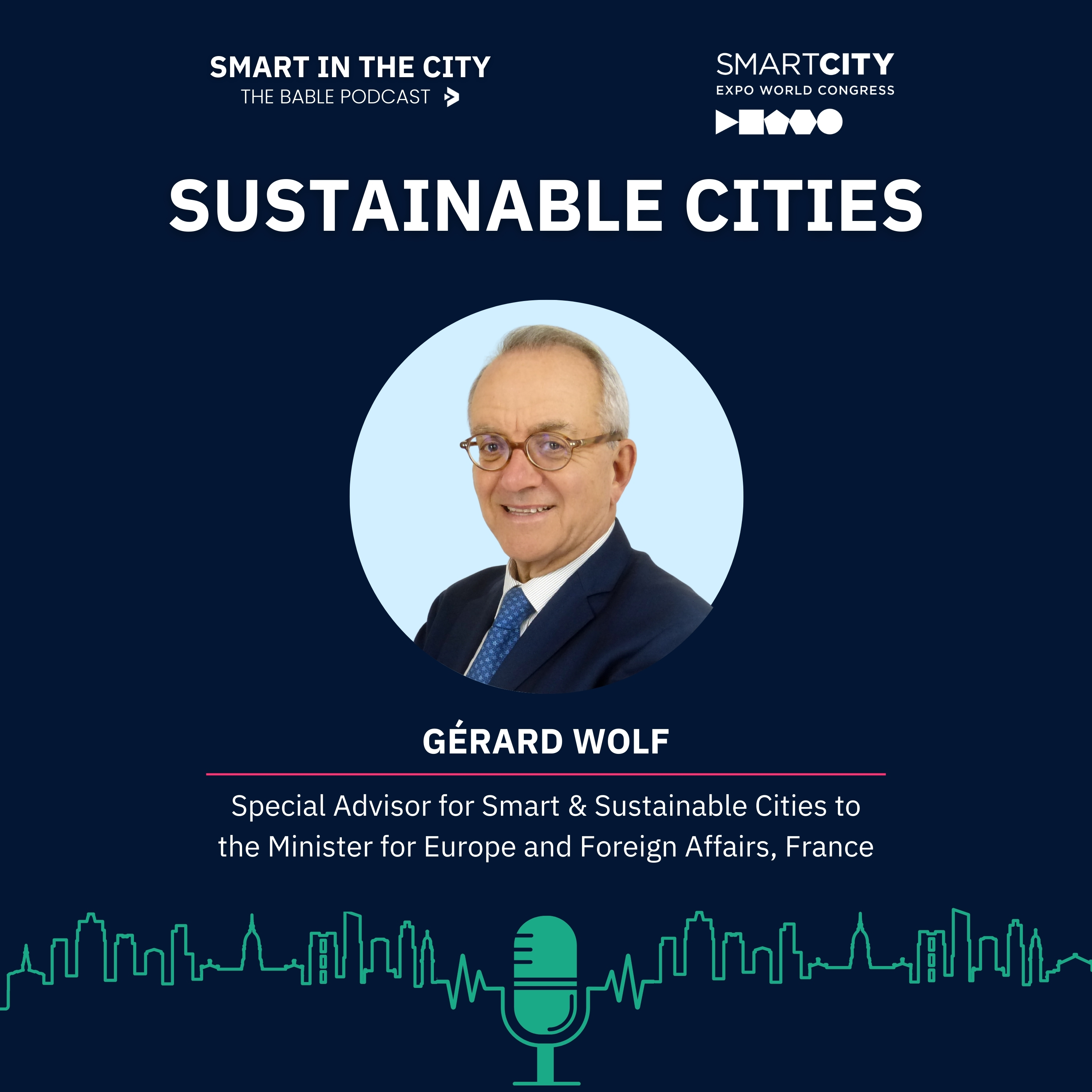
Now we are in Barcelona, but I want to travel for this episode a little bit to France and really understand France's vision for sustainable cities. And for that we have the perfect guest for you. His name is Gerard Wolff. He's the special advisor to the Minister for Smart and Sustainable Cities in France. Welcome, Gerard.
[00:01:46] Speaker C: Well, thank you. Bonjour.
[00:01:47] Speaker A: Bonjour.
[00:01:48] Speaker C: It's a pleasure to be with you.
I think if we talk about sustainable cities, we talk about a lot of different things. It's not the same answer. You know, one size does not fit all in all the countries, as you said. The French view on that is finally very simple. Number one, what the hell are we talking about?
We are talking about a city wherever in the world where at least you have the four essential services.
Four, not 200.
Number one is energy. If you don't have energy, you can't do anything in your city. Number two is water. And of course the problem of potable water.
Number three is waste management.
If you have waste everywhere, you're not going to do something, right? And number four and last one is transportation. On top of that, of course, everywhere you have the question of health care. But all these four services, we decided a few years ago that we are not bad. You know, very French people very often say we are the best. No, sorry, I'll make it a yeah, we are the best.
So the reality is not we. No, we are not the best. We are trying to be the best. We are trying to give the best solutions.
And again, one size is not fit all. We don't give them the same solution where we talk about Bangkok or Santiago de Chile or Los Angeles or wherever in Africa.
By definition it's different.
The answers are completely different.
What is the same two or three things. Number one, trying to decarbonate as much as we can. Everything related with construction.
We did it with the Olympics.
Olympics was a good test for French companies, by the way, not only French, European companies, because all the tenders are international, to try to get to a new city which could be, as much as possible, decarbonated.
We did it. We promised to the International Olympic Committee that we will go with a carbon footprint divided by two on an equivalent of the same size city.
City, meaning the Olympic village, et cetera.
All the facilities, 70 of them. Seven, zero. We did it. We did. Minus 47%.
And an independent agency is not us giving this figure.
So decarbonation number two, accessibility in all the countries, not only in Europe, and sometimes Europe is late compared to other continents.
Taking care of old people, taking care of blind people, taking care of people with disease, etc. Is key for us.
Number three, capacitation en espanol. Capacitation, capacity formation en francais. For the local people, you could say, okay, what's new there? Well, the thing which is new is that if you want to have a sustainable city, you must be thinking about building it, but also about the life of the existing facilities.
So this is. This is the basics.
[00:05:31] Speaker A: This is the basics. But yeah, we're going to get a lot more into that. So in depth a little bit later on to. I want to. I usually start us off with a little bit of a teaser to get us in the flow. And then I also want to learn a little bit more about you and then we'll get all into what you were talking about. Yeah, so. So let's do it.
So just as a little warm up, I want to ask you from your kind of holistic perspective, if you had to choose just two of the following things that I say to maximize in these projects that are being implemented in France, which two would you pick?
Impact.
Simplicity.
Cost or time?
[00:06:14] Speaker C: Simplicity, certainly.
Number one, whatever. Yeah, an impact because of decarbonization, etc.
[00:06:22] Speaker A: Yeah, yeah, sounds good. I thought it would be a bit of a tricky question, but I think you had a clear answer. So good.
[00:06:30] Speaker C: Was it a trap?
[00:06:32] Speaker A: It's a trap. It's always a trap.
I want to learn a little bit more about you and your background. You and your background. Where did you come from? How did you start getting into all of this?
Tell us about yourself.
[00:06:46] Speaker C: Well, I'm a bizarre guy because I'm French, but I'm also Irish by my mother.
I'm a rugby player. But this is no interest for people, except it gives the feeling of making things together in a team.
I don't know how to play alone, if I can say so I'm not playing.
And I'm an engineer, biochemistry at the beginning. And then I make some stupid political studies in France. And this. Oh no, I should. I shouldn't say stupid publicly, but anyway, and. And then I joined for 20 years the public administration called corporate.
And then I went to the biggest energy company in the world called Electricity de France, where I was chief of staff of the president at the beginning. And then I was the member of executive committee in charge of all international.
And parallel to this I joined the MEDEF, which is the French private sector organization gathering 80% of the companies in France.
And on top of that they asked me to be envoyer, special envoy for Sustainable Cities International.
And also some job about the Olympics. And now I'm chairing also the Heritage committee of the Olympics 2024.
And I'm the most important things. Sorry, but you asked me about me. Yes, I'm a grandfather. Oh yes.
Young. Well, no, I'm not young, but a young grandfather of Capuchin and Oho. That's it. So you know everything.
[00:08:36] Speaker A: Very good, very good journey, Very interesting journey. And also love the. Love the new grandpa.
[00:08:43] Speaker C: Thank you so much.
[00:08:44] Speaker A: So, congratulations.
So you, you. You articulated these four essential services, right? Water, waste, energy and transport. Yeah.
Can you explain and give us a little bit more detail and how you knit these elements together within a city strategy rather than keeping them as silos? What's your perspective there?
[00:09:07] Speaker C: This is seriously, it's a very good question because this is all, all the problem you have when you built or extend your city, when you retrofit your city, when you. Whatever. When you think about city, if you say that less services are to be checked or to be designed after your main projects, which is then you're wrong today because what is the reality? The reality is the scarcity of resources everywhere in the world. This is not political, this is not, you know, kind of be. Be green just for fashion. It's a reality and we, we are under pressure, so we have to put it other way around. Say, okay, the thing we have to do is whatever happens, build new towns or retrofit but retrofit is not enough.
Build new towns have to be thought from scratch as somewhere where you can have these services and then you build the rest of it.
It's other way around.
I'll just give you for, for the people who are listening to this, I'll just give you one example.
Prime Minister Modi in India two years ago, I was leading the delegation over there and about cities in India, which is an amazing issue.
And he said, look, not only that we have babies, but each minute, 24 hours a day, 365 days per year, we have 10 people migrating from rural to urban each minute.
So when you think about the fact that today 1.7 billion people, urban people have no decent cities, it's a must to think the whole thing the right way and to think about this essential services and then build it.
[00:11:30] Speaker A: Yeah, I really love your way of thinking about this.
So you see how a lot of cities are transforming and how cities are really going on this, let's say, sustainable city journey right now. Right.
What do you see as the fastest wins for cities?
And what do you think tends to need deeper transformation?
[00:11:55] Speaker C: I think the deeper transformation is, I'll begin with this, is to, to inverse the, the way to think about it as, as we said before, meaning that yeah, we know that there's an emergency, but the question is not to say we'll just build this and then we'll just build this, etc. It's to say think about before and then build it. You have to have a planning of how many people you can accept or try to find solutions for them and then build it.
But if not, if you're under pressure, which we all are, you can do a lot of those things. The other, other way around is to think that, well, sometimes I, I may, I meet, I won't give names, don't worry, But I meet mayors or deputies or whatever, sometimes ministers, very often ministers, saying okay, I understand what you say, but this takes time.
The emergency AI will help.
AI will help if we give AI the right inputs.
AI is our, our object. It's not AI who will decide it.
[00:13:21] Speaker A: Yeah.
[00:13:22] Speaker C: So because we are not counting cars or counting bottles, we are counting people.
So the reality is that when I meet here, for example, in this splendid smart city forum each year, it's very interesting and reboosting, you see, because you see people from all the continents and say, help us. We have to go faster, but we want to go the right way. And it comes to the same conclusion.
We have to know country by country sometime Inside the same country, city by city. There are big differences in big countries and large countries.
What do you want first?
Doesn't mean take five years to decide, but think about upstream.
What exactly is the lead? And then you can build it quicker.
[00:14:20] Speaker A: Absolutely. I think that's a good way of looking at it. You, you mentioned also the Olympics, of course in Paris in 2024 and we had the 2024 Olympic and Paralympic Games there.
And I've heard that you did achieve around a 47 reduction in carbon footprint compared to previous Olympic standards.
And I, I believe you were quite involved in that process. No.
Can you walk us through that? How did you achieve that? What were the barriers? All of that?
[00:14:51] Speaker C: Oh, the barriers were multiple. Amazing.
Well, the first thing is of course you have to think about it before. I mean try to build the whole thing like that. But take into account every single point of the building process.
Just take an example, demolition materials, deconstruction materials.
Instead of having lorries coming with cement, blah, blah, blah, blah.
If on a place where there. There was something, there was an old city or if you retrofit that you reuse these materials, it's minus, minus carbon of the low.
The same thing. This is things that people understand easily.
Another thing is that in a lot of cities, big cities, you have a thing called rivers.
Well, river is something which is useful to bring material instead of taking lorries and then in the way to build because this is just part of it. And the way you build.
Think about wood. Wood is much less carbon footprint than anything else.
And before you know, we had people saying oh la la, impossible. You can't bring wood in big towers because firemen cannot go if it's in, if it's.
Which sounds right, except that today you know how to have wood material which is not easy to.
For a fire is not easy to go to this as with concrete. So things have changed. And to use wood, to use a new system of preparing all the material for the new buildings. I won't go into details because then it will be a little bit technics. But. But this is the way. But it's step by step. If you don't take it step by step, you'll never go over there.
And then for the existing buildings all the thing is to get it to the right level of isolation or techniques today which can help going to more circular economy.
And that's the key word of the whole story, circular economy.
When the one of the best thing. When I give lessons, if I can say so or speeches in universities, I Said one of the best example of circular economy is waste to energy.
We have plants everywhere in the world who are producing energy from waste.
And this is the best example. I mean it's, it's, it's less waste.
You mean what, what's still there at the end of the process? It's a very small part of the previous waste in terms of cubic meter and you produced clean energy.
So all this and another example on circular economy is today the heating of the computer as you know can be recuperated to make some energy.
[00:18:14] Speaker A: Yeah.
[00:18:15] Speaker C: Think about another example just for, for the people who are listening to this to, to understand for the Olympics we built a Olympic swimming area arena, an enormous one.
Just think for those of auditors who didn't went to Paris.
It's, it's, it's, it's an enormous arena in which you have, you can have five swimming pools. You can imagine the, the length, the lodging, everything this and as you know these arenas, they are horrible in terms of, of carbon equation if I can say so because you have to air conditioning, you have to clean the water, you have to recycle, blah blah blah.
Today the energy of this, this arena is 10%, 90% is either solar energy or recuper recovery as we say, recovery energy from the computer.
[00:19:22] Speaker A: Yeah, really amazing.
I, I like your emphasis also on the circular economy.
I just have a follow up question there because what I see of course there's a lot of really cool circular solutions out there. Innovations. You might have seen some today also or, or over the last couple days here.
There's a lot of great innovation but of course with most innovation the problem is scaling this up for cities.
[00:19:45] Speaker C: Absolutely.
[00:19:47] Speaker A: Do you have any examples that you've seen that have really worked at scale of these?
[00:19:52] Speaker C: Yes, we have a lot of them.
The things we are trying to elevate and then we think does it work or not? And if it works, I'll give you an example.
We, it's a bit technical but let's go there's for the Olympics again we decided to, we, we checked with a scientific commission.
One of the, the startups said look, as you know during the summer you have some in the air, you have some bad particles for, you know, for the breeding etc.
And pollution.
We know how to make it. It's like it looks like an enormous mushroom if you want and which aspires the pollution particles. Yeah, it's, it's just take them.
And we thought this is, or this is serious. We tried with. Finally we decided that it could Be serious.
And we put one in the Olympic Village. In fact, particles are very dense when it's very hot.
It was not a very hot summer, so it was not completely compliant to what we said though on the same term. And I think that for our auditors this will mean something.
We put a little one into a little of these mushrooms into a, a primary school which is next to the Olympic Village and which is under two road auto speedways.
[00:21:46] Speaker A: Yeah.
[00:21:48] Speaker C: Where the, the, the carbon emissions are great.
In this school before 40% of the boys and girls had things to help them breathing.
Since they have that zero. That's not us who said it, it's the director of the school. They said a semester after zero breathe help.
[00:22:14] Speaker A: So how can we get more of those learnings out there then? Because you know, this is amazing. If you have such good results from, from this project, then why not every school? Right.
[00:22:25] Speaker C: When it's a very good question and before to be. I mean I'm a scientific. Basically then I make stupid other studies. But we are not going to say that we made everything right. Yeah, some. But this is science.
Sometimes you, you try something and it doesn't work. So yes, we also had failures. I won't go into it because that's not the question. But just to say we are not saying we did everything. Well, we had some problem. Now to go to your question, we talked about that and we have more and more. But you know, if you make a tweet on that or a, I don't know, podcasts on that, it's not because of that that everybody will do it. So it takes time. But if you never try, you never have it. So. But we know that some of the delegation received in Paris thought about that and are thinking and are proposing to the company which did it to, you know, let's think about how can we do it. The problem is that for this example, which is not the case for everything, but for all this, it's a tiny startup so they can't deliver in China next week. Right. Yeah, but, but it's. We, we're doing, we. We're trying to help them and SWAT City Barcelona is a good example for these examples to, you know, reach more.
[00:23:55] Speaker A: Yeah. Reach more people. And I think it's also our goal. Right. As you mentioned. Exactly.
[00:23:58] Speaker C: This is why I'm talking here.
[00:24:00] Speaker A: Very good.
I, I also want to talk a little bit more about the retrofitting of the buildings that you mentioned.
I understand that France's approach might be a bit different than other countries.
Can you talk about your approach to retrofitting.
[00:24:16] Speaker C: Well, the thing is that considering that if you want to have a new neighborhood completely different, sometimes you say, okay, first we bring everything down, we wash it, if I can say so, to be sure everything is clean. And. And then we rebuilt and we say, no guys, that was the former system.
Today let's see what we can save.
Which probably is going to be not all, but for th. Those parts that can be saved, which probably be less expensive to rig to a fifth than just bring it down and build something new. Number one.
Number two, I was talking at the beginning about demolition materials, the construction materials till now and even in France, to be honest, and everywhere in the world you have, if you have somewhere where you. You put down a tower, a building, you see thousands, no, thousands of dozens of lorries taking the concrete, cement and bringing to somewhere else. No, leave it here, if I can say so. And retrofit can be the material for a new concrete, etc. And I won't go into detail, but you can see that piece by piece. In a sense it's, it's in the mindset of the architects, of the public authorities, of the private sector, of everybody, of all the stakeholders of the city to think about retrofitting is very often now, couldn't be before, but now because of the techniques is easier and quicker and sometimes much less expensive.
Just a last point on that. This afternoon we have a conference on this and I will give an other example which is Hong Kong.
Hong Kong, as you know, has 8 million inhabitants. Whatever happens in 10, 12, 15 years, there will be 9 million people. The problem is that Hong Kong, all the, the islands, because there are few islands, are busy. If I can say you, you know, you can't build a new island, so how do you put the next million people?
So this is a very good example of how do we do that. And we had delegation of Hong Kong coming to France during the Olympics because part of the retrofitting for the Olympic Village was there to think how do we do with existing buildings to put them down, but use all the materials and making either higher or bigger to welcome more people. I mean, it's a very easy question.
And I think Hong Kong is a good example for us, for, for all countries.
And because we, not only with local companies, but also with a lot of French companies installed over there.
We took the, we elaborated a green book together with the authorities saying what can we do to put at best the. The.
The idea or the equation of circular economy.
Today we were talking about waste to Energy. One of the biggest plant of waste to energy is operated by Veolia in Hong Kong and is producing more and more energy, clean energy with the waste existing. Because you cannot put. When you're next to an ocean, the, the old habit. I'm not saying Hong Kong or any anywhere, including in France with Lucy on Atlantique, you know, we put things in the ocean, said okay, that, but that's old time, you can't do it that anymore.
[00:28:46] Speaker A: Really an interesting example with Hong Kong as well. So what do you think is the biggest bottleneck that cities are facing on this journey? What is the biggest remaining challenge that they need to confront to be able to really complete this goal? Let's say, I guess it's not a completion, right? It's always ongoing. But to get to where they need to go.
[00:29:13] Speaker C: I'm afraid I'm going to answer a little bit aside of the question not to. We'll come to your question.
But the major issue, when I see mayors everywhere in the world with the biggest city in India or Latin America or where else or in Asia, the biggest challenge is not the retrofitting. The biggest challenge is the slums. You can call it favelas, whatever. Bidonville in French, the word you want.
The reality is that this is just not possible.
We were talking in June with the mayor of Cape Town, South Africa and here we met with South African people.
We cannot accept all. When I say we all people.
We cannot accept townships or equivalent to go the same way. This is not possible. It's our responsibility.
Not only the French people, not only the so called people in charge, but everybody. And, and when I meet a mayor again, wherever in the world he says, look, okay, we'll see. We can have a superb metro, metro or cable car or whatever, and new potable water. And by the way, we still have problems with some sort of, again, take the word you want, but no, this is not possible. We're not allowed to do that. It's not possible that As I said, 1.7 billion people are in cities called cities, but have no access to electricity or water.
This is not to make it shiny for the French companies, because it's not only the French company who can solve that, it's all the people.
It's not. I'm not answering your question. It's that on top of each country, the decent way to live is the first priority. And to give these people access to energy, access to. You know what I was talking about, Prime Minister Mali, he said my problem after saying 10 minutes, 10 people by minutes per minute. Sorry. He said, my principal problem today is toilets. You can say, okay, why the hell the Prime Minister of an enormous country like that is talking to somebody with a delegation, chairing French delegation of 40 companies talking about toilets and somebody, maybe you, you have people who will kind of laugh about that. But no, the problem is our problem.
And, and I'm very happy that in smart cities today, here in Barcelona we also have this question coming out of the existing.
Less, less well, behavior of I don't know what's the right word even in French. But we're not allowed to have that kind of second class existing cities. And again we have it in Europe also.
We have to take care of that.
[00:32:53] Speaker A: Yeah, it's good thoughts to leave us on. I think for the main interview I want to now go into one of our segments.
I know that there's still a lot of work to be done as you were just mentioning a lot of things that we need to focus on more. But I also want to go into our segment now that's called shout out, Shout out.
[00:33:18] Speaker B: Mention a person, an organization or a city you think deserves more recognition in the field.
[00:33:27] Speaker C: Ooh la la. If I take the name of a city I will have 2084.
[00:33:32] Speaker A: So forget the cities.
Maybe a person or an organization, anything is doing incredible work.
[00:33:40] Speaker C: You know, I was talking with the, the head of, of. Of this conference that the team who make a splendid work, really splendid work year after year and they said I'm not, I will answer your question but one of the reasons this year we have, we're just talking each year, you know, how are you? How are you? Have a coffee. And they said for the first time you, the French brought to your pavilion a Club de la Ville Durable sustainable city, Club of Cote d'. Ivoire.
This is interesting because it's not a company, it's not a city. What is it?
So I think this, and I'm just coming out of a meeting with people from Santiago de Chile and they said exactly the same. What is that? Club de la Ville Durable in Cote d'. Ivoire.
And the answer, and this is something that I think Sweik Barcelona will, will take. And they asked us to invite more of our clubs existing in the world because it's the way of considering that the thing is not to bring good points or, or you know, bad, bad, bad notes to a city.
The thing is to prepare everybody together to find solution and to bring solution. Not to think about it, but to deliver.
And our Club de la Ville Durable are based on this idea, a city is the sum of all the components. It's a puzzle.
If you come with all the guise of the different pieces of the puzzle, then you have a better chance to give the right answer to the question.
So now if I go to your question more directly, I wouldn't. I talked about Hong Kong, I could talk about a lot of different cities.
But I think that what is exciting me and all my teams is that we have more and more cities around the world, in Africa, in Latin America, in Asia.
Thinking about the fact that they have to prepare the 20, 50 cities and not the 20 for the five years coming years.
They have to prepare it and think globally and, you know, try to put all together.
So what's the best city?
I should say Paris, but I won't say Paris because this is too easy.
[00:36:48] Speaker A: It's not about who's that, but maybe it's a specific area that they're best in, right?
[00:36:53] Speaker C: No, no, no, no. Because you could talk about a lot of.
[00:36:57] Speaker A: Every city has its strengths and weaknesses, right?
[00:37:00] Speaker C: Exactly. If you talk about Tokyo, you have a lot of things very interesting if you talk about, but you, you, you can talk about Cape Town, as I said, you can talk about wherever in the world. And, and you have the best and sometimes the worst.
[00:37:16] Speaker A: Absolutely. But you want to shout out basically the, the club, the, the clubs of, of cities for the work that they're doing. Yeah, I, I, I also agree. I think these organizations also are becoming more, and these types of organizations are becoming more and more important, even in. I was talking on the podcast with some other stakeholders yesterday and I mentioned, you know, you would think in the digital age, where it's so easy to stay connected, why do you need these organizations that connect? But you need it more and more now than ever before, I think, in the digital age. So, yeah, last question I have for you. It's a question I ask every single guest that comes onto this podcast and we are at a Smart City Expo. And it's to you, what is a smart city?
[00:38:05] Speaker C: A smart city is a city which is helping the people to live the best way, whatever their revenue is.
Where we meet again, the question of the slums.
The best city is the city in which you can give our children, and for me, my grandchildren, as I said before, the best chances.
That's it.
When we built a cable car in one of the cities of Colombia.
[00:38:52] Speaker A: The.
[00:38:52] Speaker C: People, some, let's, let's be blunt, if I can say so.
[00:38:57] Speaker A: Absolutely.
[00:38:58] Speaker C: Some of the people told us, ah, you will never do it. You know, you have peaks everywhere. I won't, I won't name the city. But because we have the problem in. Don't go over there, you know, it's.
It's okay. We said, but they wanted.
And the problem was that this part of this city was crossroads for all sorts of problems of heroin or all the different horrible things you can have drugs you can have, right?
And so when it was decided by the city to launch the process, we were not sure. And the company which did it, French one, was not sure they would wanted to do because the drug cartel said, we don't want that because people will come.
And it's not our protected area.
The mamas, the ladies over there said that cable car, we need it for our children to go to school, simple as that.
For our grandfather, grandmother to go to the hospital.
They can't walk up or go down and they can't take a taxi, they have no money.
And the team was there. French team said, okay, but we don't want to have problem with the drug system.
They said, we take care of that. If there is one problem, we will. With the mamas, we will take care of that.
This is operating since 10 years. We had not one problem in 10 years.
This is the answer to your question. It's to prepare this generation to have access to university, to the city.
And you can say, okay, that's for developing country. But it's the same in our countries.
Look at Spain, look at France, look at we have problem.
So this is the way we all together.
And the private sector has a responsibility, the public sector has a responsibility. The sustain. A smart city is a city where tomorrow is smart and sunny for all the people.
[00:41:43] Speaker A: Absolutely. Very well said. And with that I just have to give you a big thank you for spending this time with me. I know it's a busy time, we're a bit tired, it's the last day. So it was a lot of talking still for you. So I really appreciate your time, time and energy that you put into this.
[00:41:57] Speaker C: Thank you. Merci beaucoup.
See you next year.
[00:42:01] Speaker A: See you next year.
[00:42:02] Speaker C: Okay, bye, bye bye.
[00:42:03] Speaker A: And thank you of course, to all of our listeners. This also wouldn't happen without you. And don't forget, you can always create a free account on Bible-SmartCities EU. You can find out more about different use cases, solutions and more. Thank you very much.
[00:42:18] Speaker B: Thank you all for listening. I'll see you at the next stop on the journey to a better urban life.