Episode Transcript
[00:00:00] Speaker A: Foreign.
[00:00:07] Speaker B: The City, the BABEL Podcast where we bring together top actors in the smart city arena, sparking dialogues and interactions around the stakeholders and themes most prevalent for today's citizens and tomorrow's generations.
I am your host Tamlin Shimizu and I hope you will enjoy this episode and gain knowledge and connections to accelerate the change for a better urban life.
Smart in the City is brought to you by Babel Smart Cities. We enable processes from research and strategy development to co creation and implementation. To learn more about us, please visit the Babel platform at babel-smartcities eu.
[00:00:47] Speaker A: Welcome to this episode recorded live at the Smart City Expo World Congress in Barcelona. It's part of our media partnership with the Viera Barcelona and so a big shout out and thank you to them for a wonderful partnership.
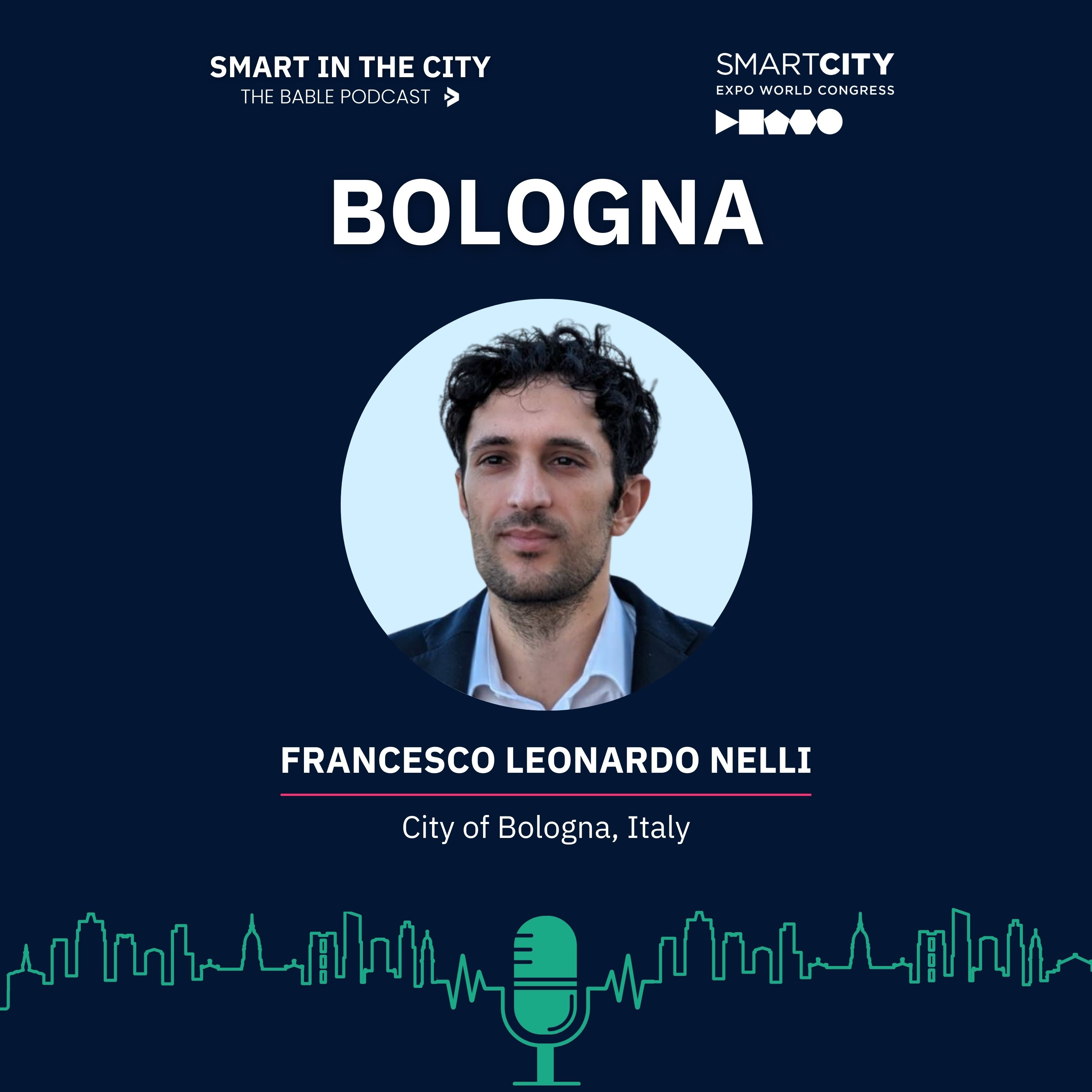
While we're in Barcelona, we are traveling today to the lovely city of Bologna in Italy to explore citizen powered innovation, how diplomacy between cities meets local co design and climate action, all of the above. So lots of topics I think that we'll cover today. Learning more about Bologna. So if you're interested to learn more, I have the port pleasure to introduce you to our guest today. His name is Francesco Leonardo Nelly, the coordinator of the international Relations unit at the city of Bologna. Welcome Francesco.
[00:01:33] Speaker C: Thank you. Thank you. I'm glad to be here.
[00:01:35] Speaker A: Glad to have you. I know it's a very intense day, so both of our brains are probably quite fried, so you're getting us at our worst. But also very curious mindset I think in these days to learn more about what you're doing, what you're working on, all of that. But to get us a little bit warmed up because we probably have this brain fog and brain fatigue. I have a question for you.
If Bologna were an animal, which animal would it be and why?
[00:02:02] Speaker C: You know, it's, it's a funny question because we have a TV show in Italy and they make this question to famous people.
So I kind of feel famous right now.
[00:02:12] Speaker A: You are, you are, you're famous on Smart in the City? Yes.
[00:02:16] Speaker C: No. Well, I would say an ant because they are hard worker industrials and they have the spirit of working a community.
[00:02:26] Speaker A: Good. I don't know if I've ever gotten an ant before. I like that.
[00:02:30] Speaker C: Yeah. You know, also the, the way they, they work because Bologna is not a city where you have big companies. There are, it's a small and medium enterprises.
There are, it's a city famous for the cooperatives and like the ants, they, they work in, in a group and also from the architectural Point of view, I think, you know, we have the canals hidden behind our city, under the city, and we have the porticos, and it's somehow, you know, like living in a ant city.
[00:03:12] Speaker A: I like that visual that we have now of Bologna, this little ant city underground.
Tell me a bit more about yourself now as well. Are you from Bologna? What's your background? What led you into your role today?
[00:03:27] Speaker C: I grew up in Bologna. I'm not from Bologna, but live there since I was 2 years old, so.
[00:03:33] Speaker A: I think that counts.
[00:03:36] Speaker C: I studied there and then I decided to move a little bit to explore the world. Actually, I move quite a lot for studying, studying, working abroad.
I'm not one of those people that think that living outside, it's something that change your life and you get essential inspiration, you know. But still, of course, it open your minds and give you some input.
At one point I just had like this nostalgic feeling about my city, and I want to come back and try somehow to put everything I learned, try to.
To give something back to the city that give me an education.
So that's why I try to work in international relation and where I'm working right now.
[00:04:22] Speaker A: Yeah, interesting. I'm. And I'm. It's funny always talking to people who grew up in a city. They left for a while and then they always come back. And I think you always appreciate the place that you lived in so much more there when you left and come back. Right.
[00:04:37] Speaker C: Definitely. It was strange because I left when I was a student and then I came back as a worker. So it's a completely different city.
[00:04:44] Speaker A: Yeah, I can imagine. I left. I left Colorado myself, where I grew up when I was 18 and went and lived, studied and lived all over the world, and I haven't come back yet. And that's maybe sometime in the future, so we see. But I definitely, every time I go back to visit, I have a deep appreciation for where I grew up. So I. I think it's a good. It's a good experience.
[00:05:07] Speaker C: Have you ever been to Bologna, may I ask?
[00:05:09] Speaker A: I haven't, actually. I've been a lot of places in Italy, but I haven't been. So next time. Ye.
[00:05:14] Speaker C: Yeah, I'll try to promote it, so.
[00:05:16] Speaker A: Yeah, exactly. I would love to go. Definitely. It's. It's on the list, so.
Yeah. So anyways, I guess the next question is in. In alignment with this. For those who haven't visited and don't know much about Bologna, like me, I guess, what would. What does that look like? What should they know?
[00:05:36] Speaker C: Well, Bologna is not like Rome, Milan, Venice, you know, the city that you already know. And you go there maybe because you want to see the Coliseum, something like this.
There is a sentence that people used to say that when you go to Bologna, you are not in Bologna. You become part of it, and it represents a little bit the soul of the spirit of the city. Of course, you can come to Bologna to eat tortellini and mortadella, but you stay because you feel part of the city.
You will get in love with the colors of the city, the spirits of the community that you have there.
[00:06:16] Speaker A: Yeah, really good. And what does it look like? So you're at the Smart City Expo. Right. What does Bolognia look like as far as what you're doing as a city, as far as civic participation, as far as, you know, implementing smart city technologies, let's say just kind of paint us a picture in that regard as well.
[00:06:39] Speaker C: It's a really active city. I was, as I was saying, so it's really easy to see the civic participation around the city.
There is a place that I love. It's called Piazza Luchadala. Luchadala Square. He was a really famous singer. And this is a cover square. So you can stay there in winter, summer, whenever you want.
There are so many different spaces and young and elderly people there. You can find them both. So when you don't know what to do actually is you can just go out, go there and for sure where you will find some events.
[00:07:20] Speaker A: Yeah, it sounds really, really nice.
What do you think about how Bologna is shaping kind of the city diplomacy?
How does city diplomacy shape the way you act locally in Bologna? If that makes sense.
[00:07:38] Speaker C: Yeah. No, actually, thank you. It's. I love this question because it's. Well, it's one of the focus of my job and I'm working with it with my.
My director and the deputy mayor for international relations.
[00:07:53] Speaker A: Yeah.
[00:07:53] Speaker C: Maybe I could say hello to them.
[00:07:56] Speaker A: Shout out.
[00:07:59] Speaker C: It's. The idea is to show that the city diplomacy, it's not an extra, like a charity that you put on top of a pie.
It's more something that it's part of the.
That you have to work on it. Because cities are not like an island.
They face all the global challenges and they are the place where you should find most of the changes and global challenges.
The way it would be nice to put the city on a top level on international relation. That's what we are working for.
[00:08:39] Speaker A: Yeah.
[00:08:40] Speaker B: What's.
[00:08:40] Speaker A: What's your goal? I guess when. With your job. And so what does, what does Your work, how does that tie back into citizens and what they need? Like how do you connect this, like your goal, your work and how that creates impact for citizens?
[00:08:59] Speaker C: Yeah, it's, it's. It's not easy. It's not easy at all. Yeah, I would say that you should listen first.
Try to really understand what you are listening and then trying to elaborate and work on it in a responsible way.
Trying to be a little bit more concrete.
I think the city has a strong tradition on listen the community needs and we create a foundation which is called foundation for European Innovation.
And the main focus is to engage citizens participation. So try to connect the municipality with the needs of the citizens and share it and try to find solution. Sometimes solutions what decision requests cannot be implemented, but you also need to explain it why.
[00:09:58] Speaker A: Yeah, absolutely. I think that communication piece is quite challenging, right? With explaining, okay, you wanted something, but we can't deliver it. So that communication piece is very, very important I guess to make this a bit more concrete as well. If you had to choose one flagship initiative to really unpack today, which one would you like to go deep on?
[00:10:23] Speaker C: There are so many and they are so huge flagship initiative that it's hard to explain. For example, we have one which is called Green Bologna. Then we have City of Knowledge.
There is the climate mission, the idea to make the city neutral, carbon neutral by 2030.
So it's hard to choose one and to explain one, but maybe I can choose a project that somehow can work on all these initiatives. And the project is a digital twin. So the idea to make a virtual reality city, the idea is to use it to help the decision making process.
So to. To help citizens, politicians, enterprises to work in a better way in the city.
It's interesting because Bologna, many cities are working on the digital twin, but Bologna is trying to make its own digital twin. So we just did not bought something from a company, but we are creating from scratching from zero.
That's interesting because you have a digital twin that should at least exactly answer to the needs of your city. It's sweet for the needs of the city. It's not something that you both and then adapt it to the needs.
It's a different way to consider it.
[00:11:53] Speaker A: Yeah, absolutely. And I understand that this project is ongoing still, but have you, have you finished completing it? Do you have use cases of the digital twin in action already?
[00:12:05] Speaker C: I will focus on one case study which is on mobility.
So the idea to use the digital twin to optimize the way people can move around the city, I think can be really Interesting to let them understand and see how Bologna is an old city, small streets, so you have to make the best of what you have. You cannot change the city.
There are people talking a lot about this.
I mean, cities also about the 50 minute city, you know, provide all the services around.
Digital twin can be useful for this and it's interesting because it can be useful for technicians, but also for citizens.
[00:12:49] Speaker A: Yeah, maybe to dig into that a little bit more. Have you gotten feedback from citizens yet? Have citizens like been part of the process or used any application? Kind of talk about that civic piece?
[00:13:02] Speaker C: Yeah, the civic level will be implemented. We will start to implement it this year. So it's still on, on a test phase.
Right now it's used by technician. The next level will be work on citizens. But before, as was saying before, there is the need to communicate well to the citizens. And so there will be this phase through the foundation of European innovation, to engage different stakeholders and go on different levels.
[00:13:31] Speaker A: Yeah, I'm curious. We have to revisit that then in a little bit of time and see how it's playing out also with how it's really impacting citizen lives and all of that.
What would you say is kind of remaining in Bologna if you were to pick one key challenge that Bologna really needs to face?
What do you need to accelerate change? Are you missing any tools from your perspective? What do you think that is?
[00:14:01] Speaker C: So many challenges. I know so many challenges.
[00:14:03] Speaker A: Hard to pick one.
I gave you two if you like.
[00:14:08] Speaker C: No, because I think the. The world is moving so fast and for cities it's hard to keep up.
Yes, especially for European cities that, you know, are.
City with a huge. I don't want to say ancient city, but they have a huge history.
[00:14:26] Speaker A: Yeah, yeah.
[00:14:27] Speaker C: So it's, it's not too easy.
So you feel this pressure somehow that the world is going so fast. You have all these topics on the table, you know, migration and tourism and this make the urbanization of the world somehow. So cities are for the first time in the world. I think this is the first time that the city are where the most part of the population lives.
And so you need buildings and you don't have it and the costs rise up and so you have a number of people that cannot afford. So the affordable housing is also topic. It's like a Domino's everything.
So it's, it's hard to find a solution to this. But probably the solution is innovation using a wise way.
[00:15:21] Speaker A: Yeah, absolutely. And I think governance also plays a huge part in this and in the ability For Citi to be able to react quickly and kind of keep up with the fast changes that you need a good governance structure to be able to handle this and adapt. And this is of the biggest challenges. Right. Because cities have old governance structures, cities have old legacy systems in place. So I, I see that challenge obviously with a lot of our work and a lot of cities that I talk to as well.
And really getting forward, forward thinking leaders is also very challenging sometimes where they're willing to take risks. Right. Because that's what innovation is, is taking those risks.
[00:16:05] Speaker C: Definitely.
[00:16:05] Speaker A: Yeah.
[00:16:07] Speaker C: And you will know that something will not work, something will work good. But that's why it's so important, city diplomacy. Because you can talk with other cities and compare their solution, see if you can scale up and. Or they can switch for you.
[00:16:21] Speaker A: Also, are you doing a lot of a big topic that I've heard these last couple days has also been around experimentation and so really and being able to take a lot more risk because you experiment in low risk situations with new technologies and then once you've tested it, of course being able to scale it, either high tech or low tech solutions, but being able to really experiment with a lot of the most innovative, let's say AI has been a big topic, of course to really try it out and really understand the risk of it before implementing. Is Bologna doing any kind of experimentation on that level?
Wonder your thoughts there?
[00:17:05] Speaker C: Yeah, actually I don't want to mention it again because about the foundation of urban innovation that started their main topic, actually they're working exactly on this.
The way they work usually is to select a topic. It can be, for example, an interesting project is the school squares. So we found out that around the school, especially after Covid, there was nothing outside enough space for children when they go out to have a safe space, safe place when they can play waiting for their, their parents.
So we start this project working with the schools, the children, the residents of the area, trying to imagine they would like change the the area.
Then we collect data and we do. We did pilot project Small Small Squares and see how that works. Collecting data again. And for example, we just noticed that the number of people that were living in the area, they increase incredibly, not only during the weekdays, but also during the weekends. So it means that people really enjoyed the area. It was not only because there is the school there.
[00:18:14] Speaker A: Yeah, absolutely. You talk a lot about city diplomacy. Obviously that's a big part of your job. What about also with the innovation companies?
We have a lot of cities that listen to the podcast, but Also some innovation companies and other stakeholders.
So for, I guess also I'm interested to hear, have you talked to any interesting companies here on the floor?
And also maybe if a company has a really good solution, what advice would you get them to starting a meaningful conversation with Bologna?
[00:18:49] Speaker C: I think there are three ways a company can work with the city. The first one, if they try to sell their products, their solution, which is completely legitimate, it can be useful sometimes.
The second is make an investment in the city, so you can work with the city on find a soft landing mechanism.
And Bologna is providing different ones. So we will have an event on the 17th of November. We will open a new space which is called Exactly.
Landing Boat. So there will be the inauguration of this place.
And the third one, which for me is the more interesting one, is just the company that want to develop something together with the city.
So you start to talk with the administration, with the community, try to understand what are the needs, and then develop together with the municipality, because this is something nice about our municipality. We are open to discuss.
So working together to create the solution that we both need.
[00:19:59] Speaker A: Yeah, absolutely.
Yeah. Good ways of approaching it, I think too many times, of course, companies come and they just want to sell. Right.
And this is a challenge, and I understand that.
[00:20:11] Speaker C: Yeah. But it's not something bad because I know the company, they. That's their core business.
[00:20:16] Speaker A: Yeah, of course, of course.
I think it's more though.
I always recommend understanding the city need first and then seeing if the solution might fit, if that makes sense.
You know what I mean? Like coming at it from that angle, rather than like, this is what you need.
Exactly.
[00:20:36] Speaker C: Sometimes you feel like this, especially now, because there are so many things.
[00:20:40] Speaker A: Yeah. It's very overwhelming, I think, for cities to actually understand what innovation is correct.
Right. For them. So. Yeah, we talked about a lot already, but I'm wondering if we missed anything. I'd like to give you the open floor in case you have anything that we didn't yet get the chance to talk about that you think would be really relevant for listeners.
[00:21:02] Speaker C: Can I honestly say. No, not really.
I have nothing in my mind right now.
[00:21:08] Speaker A: It's been a lot of stuff, so. No worries at all. No, you can. You can always reject the open floor. I always allow it. Yeah.
[00:21:15] Speaker C: Yeah. You know, I always didn't like, like the open question. Also exams too open.
[00:21:21] Speaker A: I know. As soon as people ask me an open question as well, sometimes my mind just blanks and you're like, oh, I did have something until you asked me.
[00:21:29] Speaker C: So I'm sure that when we finish.
[00:21:33] Speaker A: This, and I will, you will remember something.
You didn't say something. That's why I like to give it, because I know I can't cover all the bases. But no worries, you can, you can reject it gladly.
Now we come to our fun segment. Our segment today that I've selected for you is called Inspire us.
[00:21:51] Speaker B: Inspire us just a little bit with a story, a quote or anything that has inspired you recently.
[00:22:00] Speaker C: I'm sorry, you will be disappointed for sure.
[00:22:04] Speaker A: You're not going to inspire me.
[00:22:07] Speaker C: I would love to, but I'm not sure I can. But I, I'm. I read this sentence a couple of days ago.
I just wrote it down because I want to say it properly. It's Demagogues rise the power to making promises. Mayors stay in power by keeping them. I think it's really interesting because like right now there is this populism that is spreading quite a lot.
But for in the city, it doesn't work like this. You have to, to work hard to, to stay and to, to promote your projects. Citizens react immediately.
So if the municipality are the closest entity to the, to the people. So yeah, it's really important to, to work and make real things. So also when you promote innovation, you cannot just promote innovation by itself. It has to be something useful. Otherwise the citizens will think that it's.
[00:23:05] Speaker A: A waste of their money and something more concrete. Right to you because otherwise it's just too theoretical for, for people to grasp. Yeah, I like it.
That was a, that was a good one. I like it when people. I like it when people bring quotes because I'm horrible at remembering quotes. I like a lot of quotes and then I forget them. So this helps me remember really good quotes as well in the, in the future.
[00:23:27] Speaker C: So me too, I started to write it down for this reason because every time I say oh, what was that? I can't remember.
[00:23:33] Speaker A: Yeah, I knew I need to start doing this.
It's a good idea.
Now we come to our final question. It's a question that we ask every single guest that comes on. We are at a smart city expo right now and there's lots of different definitions of actually what that means. I'm wondering what is your definition to you, what is a smart city?
[00:23:54] Speaker C: I think a smart city is a city where it's nice to live in a simple way now, where there are human relations, where are easy to make human relationship.
It should be a city where there is the right balance between the history of the city and the innovation.
So a smart city is a city that is able to.
To listen the. The needs of the city.
[00:24:24] Speaker A: Yeah, absolutely.
I love that we're moving more and more into that definition because, you know, 10 years ago, smart City was just about the tech. And I'm really glad that at least here in Europe, that definition has totally changed in the last few years. So I like your definition. I'm really glad that you took the time to talk to me today in this very busy, crazy mess.
[00:24:48] Speaker C: I need this. I need just a chat.
[00:24:50] Speaker A: Yeah, exactly. It's a nice chat. So thank you so much and I hope to welcome you back sometime for sure.
[00:24:58] Speaker C: Thank you. Thank you for having me again.
[00:25:00] Speaker A: Yeah, absolutely. And of course, I have to give a big thank you to all of our listeners. It also wouldn't happen without you.
So don't forget, you can always create a free, free account on Baba Smart Cities Eu. You can find out more about Smart City use cases, solutions and more. Thank you very much.
[00:25:16] Speaker B: Thank you all for listening. I'll see you at the next stop on the journey to a better urban life.
[00:25:34] Speaker A: Sam.