Episode Transcript
[00:00:00] Speaker A: Foreign.
[00:00:07] Speaker B: The City, the Baba Podcast where we bring together top actors in the smart city arena, sparking dialogues and interactions around the stakeholders and themes most prevalent for today's citizens and tomorrow's generations.
I am your host, Tamlin Shimizu and I hope you will enjoy this episode and gain knowledge and connections to accelerate the change for a better urban life.
Smart in the City is brought to you by Babel Smart Cities. We enable processes from research and strategy development to co creation and implementation. To learn more about us, please visit the Babel platform at Babel SmartCities EU.
[00:00:46] Speaker C: So welcome back to another episode of Smart in the City. We are now recording this in the new year and it's a new opportunity to accelerate all the ambitions and actions and things we have going on to create better urban lives.
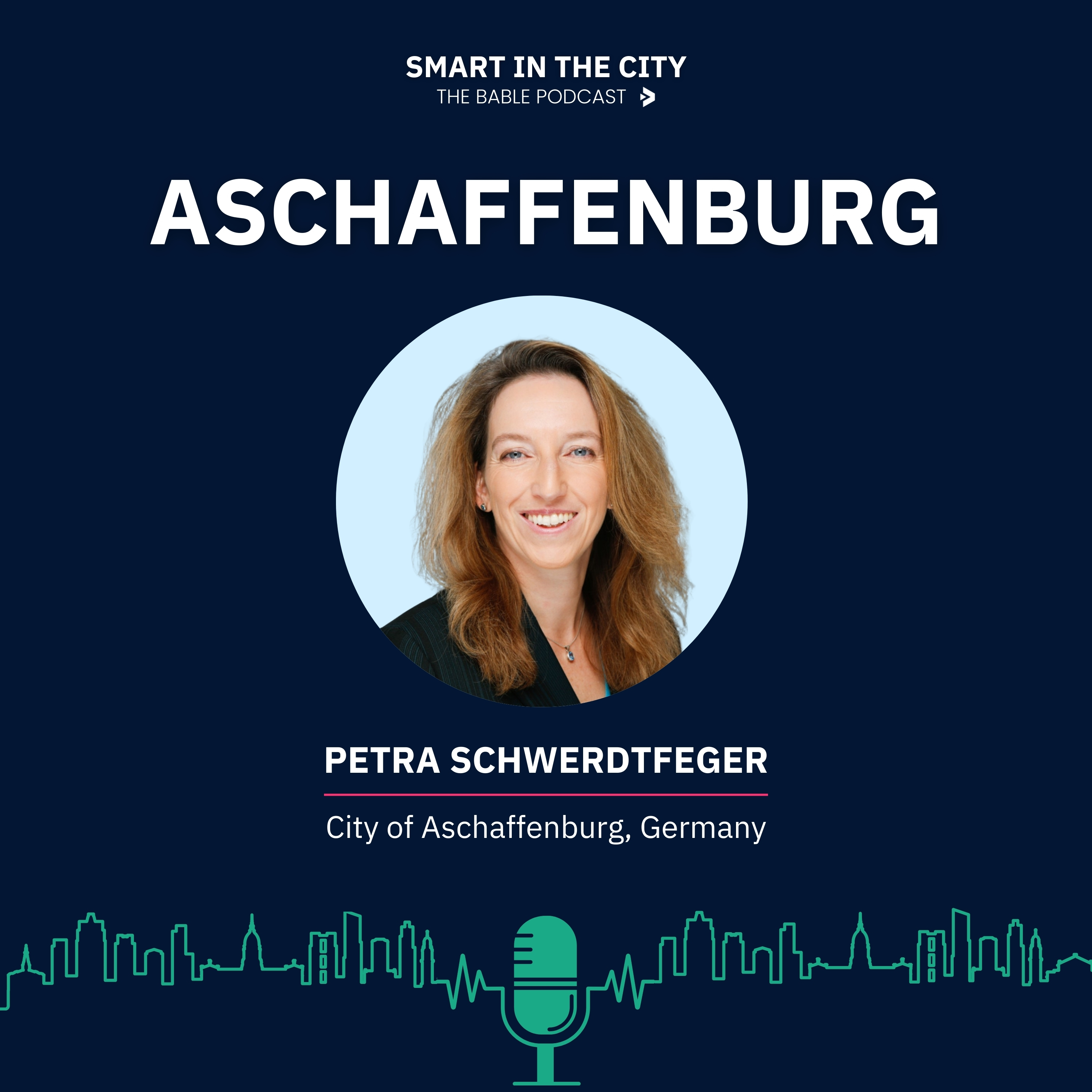
So today we're traveling to Germany, to the city of Aschaffenburg, a city in Bavaria.
We are talking data, digital and more. With me today is none other than Petra Schwerdfeger. She's a Smart City officer for the city of Aschaffenburg. Welcome, Petra.
[00:01:20] Speaker A: Thanks so much. Pleasure to be with you.
[00:01:23] Speaker C: Yeah, really nice to have you. I'm really curious. We actually haven't spoken before this, so it's. It's really an exploratory call also for me to learn all about it. So I love this angle as well too.
I like to start us off with a little bit of a teaser question, just to get us warmed up into the flow of things before we get into the main interview.
And this is a teaser question we often ask at the beginning of our episodes, but with a bit of a twist.
So if Aschaffenburg were a type of plant, which plant would it be and why?
[00:01:57] Speaker A: Well, that's almost a poetic question, I would say. So, yeah. In my opinion, if Aschaffenburg were a flower, it would be a wild rose. It grows at the edges, along paths right where the city meets nature. Just like Aschaffenburg, sitting on the main river with a spessart forest in the east and urban life all around.
It is beautiful without trying too hard.
Honest, open and approachable. And it's resilient, able to thrive even through conditions. Much the city itself always evolving.
The wild rose gives more than it looks. It feeds insects and birds, standing for sustainability and the common good. Delicate, yes, but with thorns. Friendly, yet full of character. That's Aschaffenburg in a nutshell.
I love it.
[00:02:47] Speaker C: It was very poetic. That's one of the most poetic answers I've ever gotten.
So, any poets there I'm sure just loved that.
So, yeah. So moving on, I want to learn a little bit more about you before we dig into all of the work.
Tell me about your background. What led you into your role today?
[00:03:08] Speaker A: Yeah, so I studied media management in Wiesbahn and worked then for two decades as a project program and service manager at stock registered US based IT companies.
Then I took about two years off and worked as a volunteer in shark and ocean conservation.
When I needed to get back into a paid position. Well, as two years off payment is quite a lot, I wanted to get into a job where I can serve the community and not only shareholder value.
And then I saw the job opportunity as Smart City officer at the city of Aschaffenburg. Went into the job interview and well, I guess it was love from both sides at the first few.
And there I am now.
[00:03:55] Speaker C: Very interesting background. It's one of my favorite questions actually, always is learning a little bit about people's backgrounds because it's rarely a linear path to the roles. So really interesting.
You've already painted us a wonderful kind of vision of a wild rose. But paint us a bit more of a picture about Aschaffenburg really. What makes it unique, what does it look like? Tell us more about it.
[00:04:21] Speaker A: Yeah, so Aschaffenburg is a mid city. We got about 72,000 inhabitants and yes, said it has some rural parts outside. It has a very old in town as well, which is beautiful.
And yeah, if we now look more into as well the topic of our, of our podcast, if we look at the topic of digitalization, this is a big and important task for us now Schaffenberg and our digitalization strategy has the name Dialogue City and yeah, that's a word play. It means dialogue as a dialogue.
And on the other hand it's a combination of the words digital and analog because city cannot just be digital. And today as well, not only analog, we need to combine it. And we say that technology should always serve people and the people should be at the center of technology decisions as well. Together with the citizens of Aschaffenburg, we want to continue developing our vision of a livable city for Bribant Aschaffenburg that makes possibilities of digitalization accessible to everyone and involves them in the process as well.
We value and live citizen involvement and we have as well a lot of lighthouse projects in this whole area.
[00:05:49] Speaker C: Very cool.
I like the play on words too. I love those little.
I don't know how to call them actually, but yeah, those little play on words are really, really nice.
So I understand that you have a smart city dashboard. Yes, and it's also been replicated among other German cities, etc. Can you tell us a little bit more about the function of the smart city dashboard as well as what really makes this replication work?
[00:06:16] Speaker A: Yeah, of course. So initially we wanted to just have a climate dashboard with some live data, some static data and with a potential to be expanded with more data types.
We were looking for a dashboard which was easy to handle from the author side, but as well from the user or reader perspective.
And it should not only show charts, but provide as well explanations to make the charts less freely interpretable by the reader.
Ideally it should be of course open source of code.
Well, I was looking around for an existing solution which we could adopt. Why I am convinced that this is not a good way to spend taxpayers money for reinventing the wheel.
So whilst looking around I found in the city of Munster exactly what I was having in mind. Fortunately their climate dashboard had all the points covered and was developed through a German federal funding program for smart city model projects. A perfect match as the idea behind this funding program is to make things replicable as well.
So we extended this Munster dashboard with our own ideas and developed it further, mainly with a focus on displaying our sustainability report in a user friendly way as nobody is really wanting to read a 1101 page PDF document if we are realistic for doing so. We got a 50k euro grant and we worked with a web agency as we don't have internal resources for such kind of work.
After the go live of each development stage we followed the saying do good and talk about it.
So we used any possibility and this gave us visibility at the right peers of other cities and they got interested. That was mainly due to the dashboard design as we offered a very easy way of adapting the dashboard which would reduce down the cost for the other cities of about 80k which we had paid at the time to the below 20k if they would work with a web agency, depending on how much they change on the icons or on the design.
Since then the cities of Marburg and now freshly the city of Frankfurt Main got online with their versions to others are working on it. More are interested. We are now having regular calls between all those cities who are using this dashboard to exchange experiences and new developments to continue to not reinvent the wheel and keep the costs low as possible.
[00:08:57] Speaker C: Yeah, I'm a big proponent of replication of course, and I think that there's a lot more to be done there. I'm just wondering what do you Think what other solutions can we be looking at for replication?
I'm just curious to understand your thoughts on which solutions should be replicated but are not replicated enough.
[00:09:21] Speaker A: Well, it's really most of those projects, if we look into the projects, the smart city projects, which are funded by public programs in Germany, they all have in mind that these should be replicable use cases to other cities.
We had this as well in our funding project, which was called Twinby Digital Twins for Bavaria. And I think this was a really good project where we got some funding for learning about Digital Twins and as well by helping to set up the solutions.
But now a lot of cities want to replicate that, but there's no money for it and. But there would be even less money to reinvent the wheel and do it on their own. So this could start with things for energy saving things, or in another program where we had been participating and it was called Communal Digital, we had developed in Aschaffenburg AI bot which is able to interact with the user. And we were using this to ask citizens in a two weeks user project what they would do to enhance the inner part of Aschaffenburg, if they would put somewhere a selfie spot, sun sales, some more water stations or whatsoever.
And this AI bot was leading the people through a design thinking process, was asking for some questions, put the whole thing then at the end into a PDF report which was then shared with the departments in the city and it was a jury who was selecting then the three best ideas.
And as we had just a limited budget, actually there were a lot of good ideas, but we do not have a big budget.
And that's a bot, for example, which could be used for a lot of things. So this was a trial, but could be used later if there is enough stuff behind to really respond then to the ideas which are getting in and work with this in a lot of different cities, a lot of different departments. And these are ideas which should be replicated out.
Yeah, absolutely. Yeah. I have a lot of things in mind which I would like to replicate if we would have the resources and the budget for it.
And a lot of it is open source.
Yeah.
[00:11:47] Speaker C: Which actually I wanted to ask you about as well, because you chose open Source, right. For the dashboard and your gis as Schaffenberger gis.
[00:11:59] Speaker A: What.
[00:11:59] Speaker C: What were kind of the pros and cons that you weighed with that when you were moving to implementation?
[00:12:05] Speaker A: Yeah, working with open source is very often a prerequisite for applying or being accepted for funding programs or funding schemes.
And there were really A lot of great open source projects which are available for adoption.
And so the decision was literally a no brainer. And having said that, we of course nonetheless thoroughly reviewed and discussed those internally with several parties before we decided to go for implementation.
So actually for the dashboard I don't see any cons on our public geo information system which is called aschaffenburgergis.
This is based upon a technology called Master Portal here. The city of Hamburg is the inventor of this open source project and many other cities adopted that already before we did and became members of the Master Portal implementation community behind most of the open source projects as a community.
Again, the software is easy to use and it is just great to be able to offer the citizens a map which includes the information in addition to what for example Google Maps does not have, like where the next disabled parking slot is, which is close to a certain building or school, or where do I find plastics bags for dog poo?
You won't find that in Google actually.
Or where does my bus leave at the closest station, how is the weather, the live weather and the weather station at my quarter, etc. Etc.
Here we had some difficulties to get started to speak openly at the beginning. Some departments didn't want to put in addition their data into the internal GIS which is a feeding our apgis.
We convinced them by offering to do the first data transfer and show them how easy it is to maintain the data.
Our big advantage was that we did a website relaunch in parallel for Aschaffenburg De and we told everybody that we will not include outdated maps or address data a part of this. It just makes sense to store data which got a georeference into a geoinformation system.
Finally this little internal pressure worked and since then more and more departments are happy to provide their data as they see that this is really of a good use.
But back to your question. With the Master Portal there's only one con and actually it's not a converse. Just the backside of the coin is if changes to the Master Portal code should be done, the process takes longer and needs the agreement of all members of the implementation community.
Yeah, or okay, there is a site development possible which is funded as well by a single member only, but a part of this. It's a really, really great piece of software.
And yeah, for both projects, Smart Data Dashboard and Master Portal of course we need to do some marketing to make people aware and using those.
So this is something where you will need to put some money and resources into. But the feedback is good.
[00:15:19] Speaker C: I'M glad to hear that. And it's always a process of collecting feedback and making improvements.
[00:15:25] Speaker A: Right?
[00:15:27] Speaker C: So I guess whenever you implement anything digital, there are critics saying, okay, why are you investing money in this?
Maybe it's just kind of for marketing or storytelling. Other than is this really operational? Let's say, do you have any ounce of you that kind of agrees with this or do you think that no, you've seen the full utility of it?
[00:15:53] Speaker A: Well, is it storytelling?
Yeah, definitely. As we provide the people a tool where they can find all information to certain topics at a single point without the need to read through 100 pages plus of a report PDF file or to click through several websites. Now they can compare data more easily on their own and on their own pace with additional information by the city government, which helps interpreting their data. That we could say it's storytelling. I say it's just putting things into the right perspective from a city government perspective.
So what's the operational point of view? Providing an easy access to data at any time is something we should not only optionally do in a city, as the data we show is not always nice or beautiful, like increasing numbers of job searches and increasing costs.
It's again, it's not storytelling. We are showing the truth even if it's not very favorable sometimes.
And this is the point where I say that those who state it's just innovation storytelling are wrong.
I or well, we rather see it that way. Public money, public data.
That's why we plan to expand as well our open data portal with more data over the next years too. We aren't preparing that, but yeah, due to lack of personal resources, we won't get this quickly done.
[00:17:22] Speaker C: Yeah, makes sense. I do like how you framed that. That of course it is storytelling. But there's nothing wrong with storytelling. You have to do some storytelling around this. But it also has the util, right? So it can be both at the same time. So.
So a lot of our listeners are cities and they're very keen to learn from other cities, of course. But also some of our listeners are more on the technology company side, research, institutions, etc. So I also want to ask you from your perspective, working at the city, you have a lot of technology providers that maybe approach you wanting to sell you things.
What do you think is like if a technology company wants to build solutions that cities will actually adopt, use, replicate all of these things, what should they understand about how municipalities make technology decisions?
[00:18:18] Speaker A: More and more cities are going the open source first way due to the above explained backgrounds and Cities do not want to have a vendor log in.
We more and more understand as well that we need to own our data and we should not depend upon one company that could support the software. And ideally solutions should be interoperable with other solutions in place. So we won't have a data log in if that's not required by law. What could be as well in several cases.
So this is one part which should be understood.
On the other hand, yeah, innovation, development and specialization is expensive for innovators. This is something we understand as well.
But the problem is that most municipalities just don't have the money to spend if they aren't part of a funding program.
And that often, once again open source.
But of course many of us would be interested to have some fancy new things. So actually that's a catch 22 and I don't have a good idea how to resolve it.
[00:19:24] Speaker C: Yeah, it's always a problem, right? It's not necessarily that you don't want it, but you have to make tough decisions and prioritize based on the needs and impact that you, that you want to have. So that makes sense.
So you've, you've mentioned, right, you've developed these tools, delivered them moderate effort, maybe a lot of effort sometimes, but moderate effort, limited budgets.
From your perspective, what's the thing that cities constantly over complicate when starting digital projects?
[00:19:56] Speaker A: Well, we shouldn't reinvent the wheel and this is what often happens as people are doing things like they are used to do it. And we should go and ask peers in our network and their ask as well if anybody saw already a solution for a use case. We have and it makes sense to put more time into asking around than to start thinking about how we could do new or how we could maybe get the funding for it.
Because it's easier to adopt a solution because even if you find a funding call, you are not sure that you would get it and that would cost a lot of time again. So this is something use your network and check if there are maybe as well others who would be willing to invest with you in something.
And another thing is you need to find a coalition of the willing in your own city department and there start small with those allies and plan then for expanding in the next steps as we did as well with both the Smart Data dashboard, but even more with the Aschaffen Burger case. And as other departments see the first good results, they will more easily participate too, or at least provide the data.
[00:21:18] Speaker C: Coalition of the willing. I love that phrase and it's really good Advice.
So what do you think? I've heard some challenges pop up of course while we've been speaking. But what do you think is still the remaining big challenge that you're facing when you're doing your work? What kind of tools, funding mechanisms, other things would you need to accelerate that change?
[00:21:43] Speaker A: I would say funding of internal resources is the biggest issue. We simply do not have enough stuff and well, as well of course the payment which you get when working for a city.
But still let me do some advertising for working at the city government. I worked for two decades at a stock registered company or yeah, actually it was three.
And of course I had there a much better salary as I have today, but I had as well 50 plus hour weeks there as a normal working week with the expectation often to be available ideally 24, 7.
That's different when working for a city. And there are much more things on the positive side which finally makes it like working there.
We have great teams, we are serving the public. We see that things are developing even if it's slow. Well, this is actually another challenge coming from the industry.
I have never believed that things really take such a long time. Whereas well, to speaking to one of the majors could take 3, 4 weeks to get an appointment.
But if you see on how many different topics the people are working and this there I'm coming back to. We do not have enough stuff.
It's just natural that they don't. Well, they can just not replicate themselves.
So things take much more time than it would do in industry where simply more money is.
Yeah, but coming back to that, it's of course the personal decision of each person if we want to work in the industry and will gain more money, but maybe have as well a lot of more stress or working than in a municipality which maybe needs a bit more nerves because it takes much longer to get things done.
[00:23:40] Speaker C: Patience is a key quality as well.
[00:23:43] Speaker A: Yeah, yeah. Actually it would be great if there would be federal funds to adopt project of other cities as mentioned before.
That would. Yeah, well, reduce the reinvention of wheels.
[00:23:56] Speaker C: Yeah, absolutely.
Now I like to give you a little bit of an open floor. This is the time when we talked about a lot of things, but you're doing a lot of more things probably too.
Is there anything that we missed in our discussion today that you think would be really important for listeners to know?
[00:24:15] Speaker A: Well, I don't know if it's. If you have as well in other countries, but there's something, what I would really like to mention what a good thing is what we have here in Germany and that is that we have a side of this federal Smart City program, a program which is for the non funded cities and they call it Smart Start spart.
This include really great courses and excellent peer learning opportunities with those funded municipalities so we can learn from each other. And this is something what really should be used and we should use our networking and share what we have developed so far. So this is so important and well, then you will find as well a lot of other cities which have got projects which you would like to replicate so.
Well, I think we have been talking about it, but it was still important for me to mention.
[00:25:20] Speaker C: Yeah, it's a good tip for sure.
Now we come to our segment. The segment that I have for you today is called Shout Out.
[00:25:30] Speaker A: Shout Out.
[00:25:33] Speaker B: Mention a person, an organization or a city you think deserves more recognition in the field.
[00:25:42] Speaker A: Well, to whatever it would now get into my. My mind, I fear that others would get upset because they have other great projects as well. So yeah, I think I shouted out on Munster already because they made this base dashboard, which is great. Or Hamburg for. For the master portal. And I can just really say, look at the geosystem Hamburg, go there into the main city part in Alston, put in this, the 3D mode that is. Well, we would like to have this as well. And sometimes we get some money to fly over Aschaffenburg and do those area pictures as well, however.
So yeah, the city of Bamberg maybe they have as well. Or they are funded in this federal program as well and they made a solution. It's called Bakim. And this is to be used that you can fly with a drone over your forest and the AI behind will recognize from the trees in which kind of health state they are.
And this makes it more easy than for the people who are responsible for the forest to go out and care for single trees. Or if there was a big storm, they know where they needed to cut something down.
And this helps as well against the staff problem which cities or as well even counties have.
So this is a project which is really great and which I hope that we can bring to Aschaffenburg as well. Sometimes.
Well, there are many more. So. Well, we could continue probably for now the same time as we were just using podcasts, but I think we are.
[00:27:27] Speaker C: Running out of time. I fear a full podcast with just Shout Out.
[00:27:31] Speaker A: Yeah.
[00:27:32] Speaker C: Yes. And we are getting to our final question and it's the question we ask every single guest that comes on and it is to you, what is a smart city?
[00:27:43] Speaker A: Yeah. So for me, a smart city means using digital technologies and data to make a city more livable, sustainable, inclusive and future ready, while keeping people at the center of all decisions.
And I think a city should not just use technology because it's fancy. It should have a meaningful economic and or ecologic impact and as well support democratic processes.
[00:28:08] Speaker C: Great definition. I love it. As you can imagine, I get all different types of perspectives on that. So yeah, it's. It's really nice to hear. I with that, I just have to give you a big thank you for coming on. It's really been a pleasure speaking to you. So thanks for spending this.
I was going to say, what day of the week is it this Tuesday with me having me, you know, learning so much about the work that you do. So thanks so much for your time.
[00:28:34] Speaker A: Thanks a lot for this opportunity.
[00:28:37] Speaker C: Absolutely. And thank you to all of our listeners, of course as well.
Wouldn't happen without you. So don't forget, you can always create a free account on Baba Dash, SmartCities EU. You can find out about more use cases like some of the ones that we spoke about, other solutions, implementations. Thank you very much.
[00:28:56] Speaker B: Thank you all for listening. I'll see you at the next stop on the journey to a better urban life.