Episode Transcript
[00:00:00] Speaker A: Foreign.
[00:00:07] Speaker B: The City the Baba Podcast where we bring together top actors in the smart city arena, sparking dialogues and interactions around the stakeholders and themes most prevalent for today's citizens and tomorrow's generations.
I am your host Tamlin Shimizu and I hope you will enjoy this episode and gain knowledge and connections to accelerate the change for a better urban life.
Smart in the City is brought to you by Babel Smart Cities. We enable processes from research and strategy development to co creation and implementation. To learn more about us, please visit the Babel platform at Babel SmartCities EU.
[00:00:47] Speaker C: So welcome to our special Major Cities of Europe 2025 partnership series which shines a light on practical replicable actions cities are taking to steer urban innovation in the age of AI and climate transition and else happening in the world today.
So today we'll talk about the realities of connectivity, digital foundations, what cities should prioritize and we are traveling to the UK for this episode.
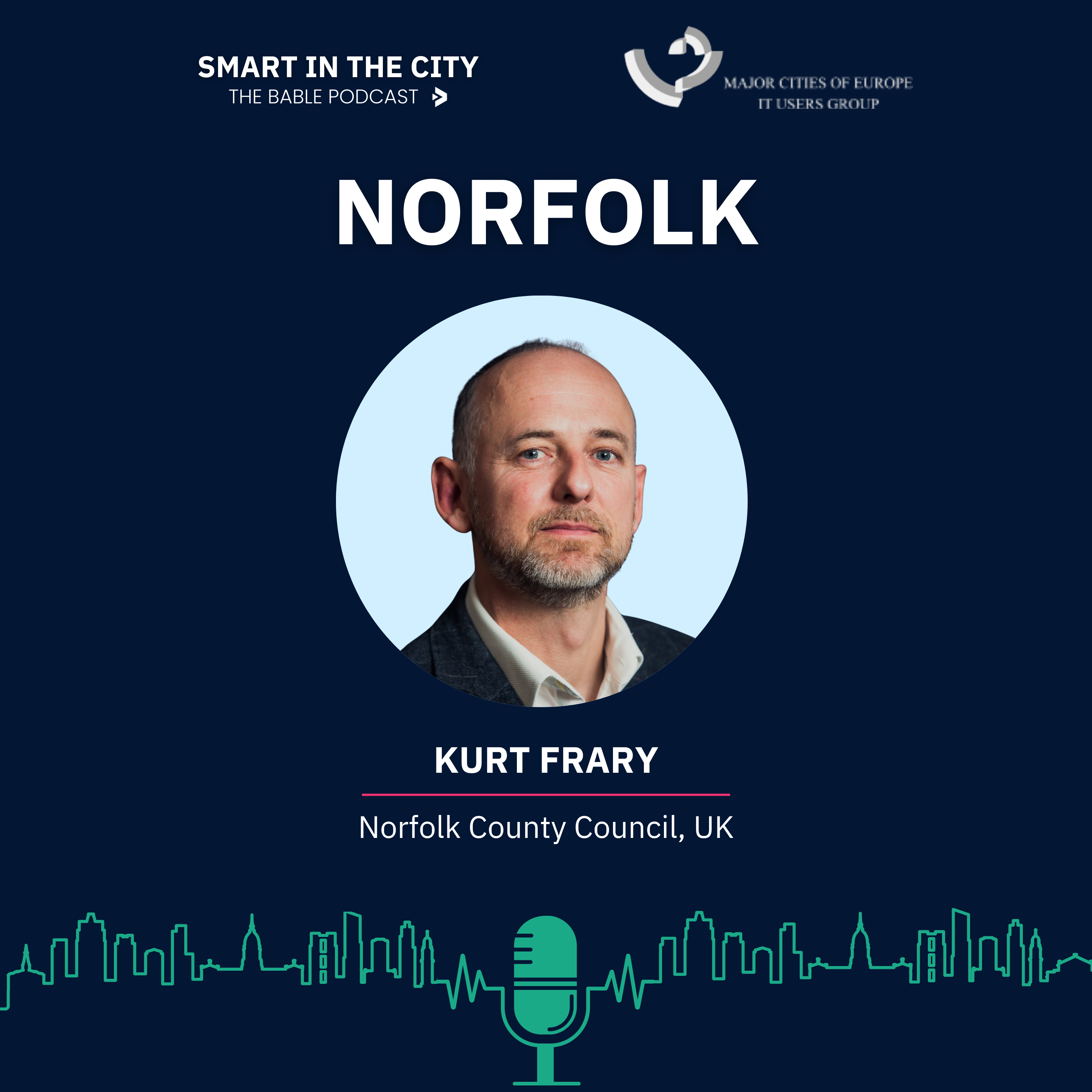
So with me today is none other than Kurt Freire. He's the head of IT Chief Technical Officer at Norfolk County Council in the uk. Welcome, Kurt.
[00:01:26] Speaker A: Hi. Thank you for having me.
[00:01:28] Speaker C: Thanks so much for coming on. I'm very curious to learn more about your work. This is actually our first time talking, so this is also like a very exploratory talk between us and I get the opportunity to learn all about your work, so I'm excited about that.
I like to get us started with a bit of a teaser question, usually to get us warmed up into the flow of things.
So the teaser question I have for you today is if you had to describe Norfolk county state of innovation with just three emojis, which would they be and why?
[00:02:04] Speaker A: It depends on how you look at emojis, don't it? So there's the light bulb, because I think that represents that we're open to new ideas. So I love the idea of a light bulb, a sun, because there's light at the end of the tunnel and smiling. Because we're not held back from innovation, we're encouraged to innovate.
[00:02:26] Speaker C: So.
[00:02:26] Speaker A: So it's a light bulb of the sun and smiling.
[00:02:29] Speaker C: Okay, very good. I.
It seems like a very bright future then. And you, you look at it very positively, the current state of innovation. So we'll unpack that more shortly. But to start us off, I want to learn a little bit more about you as a person. Who are you? Where did you come from? How did you land in this role today?
[00:02:50] Speaker A: Yeah, I've had quite an unusual journey, I think. I didn't go to university. I, I, I left school, I went college and then I ended up getting a job for Norfolk County Council in many years ago, in 1989 as a computer operator. And my first job was to split printed paper from carbon, where they printed multiple copies with carbon in between. That was my very first job, my very first role. So standing in a room, letting the, you know, splitting the paper from the financial reports.
From there I looked after mainframes and older style computers and then after many years I ended up working for a large company called Capita, which they basically signed some contracts, gave you a job, sent you off to deliver those contracts, which was quite interesting.
Then I had family and came back and got a job back at Norfolk County Council in a senior role.
And then eventually I joined the Society for Innovation, Transformation and Modernization called Socoton, which is part of Major Cities. And I got onto their top talent program and my world changed at that point.
Learning about my peers and working with them suddenly escalated me in my organization and in national context. So that's my journey. But day to day now I lead the digital services for Norfolk County Council, for Great Yarmouth Borough Council, for Norfolk Fire and Rescue and schools. So those four things are in my portfolio. That's my day job. But I also do innovation as well.
[00:04:28] Speaker C: Really interesting journey and quite a glow up, I have to say as well, from, from splitting papers. Also I feel like our younger, younger listeners are like, what are you talking about? What is, what is the splitting papers thing?
[00:04:41] Speaker A: Yeah. So perhaps we should unpack that a tiny bit. So they used to print finance reports through printers, these large printers, and then they'd have three sheets of paper because they wanted three copies and they'd put carbon in between the paper and that print on one and that would go through all three. So then you have to split it up to give three reports out.
[00:04:59] Speaker C: I really love hearing people's stories, like their journeys into their current role. So thanks so much for sharing. For people that are like, where is Norfolk?
Can you, can you paint us a picture of what, where it is geographically, what it looks like, what does the region feel like?
[00:05:22] Speaker A: Yeah. So Norfolk's quite a hidden treasure in the uk. It's in the east of England. So if you look at the map of the uk, there's a bump towards the south, quite a big bump on the east side. And Norfolk is that bump effectively, or most of that bump. And it's quite a rural county. So we have a large city called Norwich which is fabulous. We've got an old Norman castle, probably the, I think it is the, the most retained castle, Norman Castle, probably in the world actually, but definitely in the uk.
And we've, we've got a large rural county with loads of beaches. They're all about 20, 25 miles away from the main city, Norwich, So we get a mixture of urban and rural. So we have urban and rural challenges, but we get the pleasures of having urban and rural as well. So you have lovely countryside, lovely beaches and lovely cities to go shopping and enjoy. And there's museums, as you'd expect, and there's lots of outdoor activity. So if you like a bit of both, that's a great place to be. A lot of people do retire and come to and end up living in Norfolk.
[00:06:30] Speaker C: Really interesting. Actually my interesting fact, my mom is considering, she's planning to do the coast to coast trail in England this summer and I believe Norfolk is part of that. Right, okay, perfect. So I might, I might be in your, I might meet her for, for a few days of hiking.
So maybe, maybe I'll come visit soon. It sounds lovely.
[00:06:53] Speaker A: So it is beautiful.
[00:06:56] Speaker C: Amazing. So to talk a little bit more about innovation. So Norfolk is, is not London and Paris and New York City. Right. It's a, it's not a megacity, it's mixed, it's large, largely rural as well. So how does that shape, how is accelerated in the region?
[00:07:19] Speaker A: Yeah, so the other thing you need to know probably about Norfolk, which affects the answer to that question is it's very flat.
So we don't have many hills. And people come to Norfolk and comment there's not many hills. So that helps us with things like connectivity. But if we talk about innovation generally, I think the challenge always is how do you do things differently and how do you reach people?
So, Ben, urban and rural, we've got a lot of rural communities that need extra support and help.
And to innovate we need to consider both urban and rural. So if you're in a city, you just have to consider urban, don't you? But you don't have connectivity challenges like we do in the rural community. So they affect how we think. But the heart of all innovation is people, isn't it? Because actually the only reason you're innovating is trying to get to people, trying to help them better provide services or, or whatever and, and make a difference to their lives.
So that that mix is always at the forefront of our mind. So it's about people, it's about urban and rural and the mix of that.
[00:08:28] Speaker C: Okay, I, I want to unpack that a little bit more around the people aspect and maybe with some concrete examples. So can you maybe share with us a little bit on a project decision initiative something along those lines that you think has on how people live, work, play, et cetera?
[00:08:52] Speaker A: Yeah, and I've got three examples that are linked, so that will probably help people understand the journey in Norfolk. So the first one is a few years ago I rolled out the largest Internet of things IoT network in the UK across Norfolk. So I bid for some money to allow us to put the connectivity in across Norfolk and Suffolk, but primarily in Norfolk, where we rolled out 110 gateways across Norfolk. So these are where you could buy a sensor and then it talks to a gateway and then that makes that data available on the Internet. So if you take the example you want to monitor air, air quality or temperature or things like that, or if a switch is turned on or something like that, you can use an IoT network for that. Now, the reason I wanted to roll out across Norfolk is that gave the opportunity for public sector to use it to improve services.
It gave people the opportunities in individuals to try out the technology and learn about it and it also made it available to businesses. Now, that was such a success in terms of helping people understand new technology and connectivity that we started things like hackathons for schools so young people could come and learn about the technology to bring up their digital skills. But also that's allowed us to have a very recent addition this year because we've got a particular road in Wellney, Wash. So in North Norfolk, there's a road that floods regularly. So we have a lot of rain this time of year with definitely floods. We get a lot of transport go along that road and then people, when it's flooded, we normally have to go around and close all the roads leading to it. That costs money, takes time, takes effort. And people will then chance their luck, ignore the signs, drive through with juggernauts and large cars and then get stuck and then they have to wait till they're towed out. Now that's a. The issue with that is it's a risk to life.
It costs us money to close the road every time.
The local residents get very unhappy that the road's closed. When they live locally, it affects our daily lives.
What we've done this year is we've got a local company to create some new road signs that flash up and light up when a car comes along. If the road is closed, we can close the road remotely.
We can get the Environment Agency data and it will tell us if the road water level is so high that it's flood. So we can automatically close it. We can automatically open it. But also that means it's open and closed quicker for the residents and it doesn't cost us as much money. So that has a real impact on local village life and people traveling across that road. And that's using the IoT network to do that.
And then finally, the other thing that we're doing around innovation is, like many organizations, we're considering what we do with AI and new tools that come into the market and automation.
We've talked to a number of carers, unpaid carers. So these are people who've got family or parents or whatever they're looking after daily that has become their job. It's a real stressful thing, isn't it, looking after people.
And we've asked them how they would like us to contact them, how they would like to access services, just generally. And, you know, 24, 7, there's no particular time that there's perfect for them. And they've said on WhatsApp. So we've put AI on WhatsApp, on an app called Quora to pilot that for the. For the unpaid carers to be able to contact us and access services. And that seems to be going really well.
[00:12:34] Speaker C: Okay. Yeah, really interesting applications with these projects. Can you talk a little bit about the challenges that you faced as well when implementing this?
What did you encounter and how did you overcome those?
[00:12:48] Speaker A: Yeah, with any innovation, there's always lots of challenges. The first one, which I'll show out, is a lot of people go, well, we're going to go and innovate.
And they think just saying it or giving someone a job title of it makes it happen. That doesn't, you know, there's a reality to it.
So the thing for me is you don't plan an innovation project that's 12 months, 24 months long. You know, that doesn't work because that's more of a program and that's for something else. Innovation is about short, sharp, trying something. If it works, then build on it and build up.
And that makes it really interesting because I think we've had a lot of success through doing a pilot on something and if it works, then go right, can we expand it a bit more? So the IoT network, for instance, we thought, you know what, we'll just buy one gateway to start with. We'll put it on county hall, we'll see if it works, we'll try something with it. We'll show people if they think they can use it, then we expand. That worked for us. The thing with the carers is working because we've asked them what would work for them, we've talked to real people and we said, we'll just try it. You know, it's a trial, it may or may not work. People are on board with that. That's when you say, we'll do it for 12 months, it's definitely going to work.
That's not the case ever.
[00:14:00] Speaker C: Yeah, but you say that so simply, right? Like, oh, we just try something and then we, if it works, we scale it up. But this is something that everybody is really struggling with, right? How do you scale up innovation?
So what have you seen work well for scaling up and what has not worked well?
[00:14:19] Speaker A: Well, I think, I think it starts with right in the beginning where you've, you've got, you've got to be prepared to take a few risks or not be so risk averse. So some organizations and some people will go, we can't do that because what if it goes wrong?
So if you have that attitude, you're never going to innovate because you'll just stick with, it ain't broken, so let's not fix it.
Whereas actually, if you look at it from a point of view, well, if we do it differently, let's try it, will it make it give us any benefits? Will we find out something unknown? Now to then scale that up, you've got to consider, well, if we do that, is there another opportunity that's opened that we can look at and consider and who do we need to talk to? Because a lot of it's about communication and working with people who, you know, I work in digital, but I've got to work with people who are living, whatever that problem is. Yeah. And you can't just buy technology and go, I'll just buy a bit of technology, we'll try it that way. It doesn't always work like that. You have to have people as well as the technology.
[00:15:22] Speaker C: Yeah, really good advice.
Are there particular, particular communities or user groups that you think about most when planning these innovations? So for your last example, you were targeting caretakers, right? How did you decide on that group, that user group? How, how do you fit this in?
[00:15:41] Speaker A: Yeah, so that's an interesting question because really we don't necessarily target individual groups unless they're the subject of the problem.
But what we have to think about is looking at services for the masses. So if it will, if it will help a mass of people, you then have to look at who it may not help or have an adverse effect.
So for instance, if we're doing something for the older generation, it might not work for the younger generation, or if we're doing something for my age and then, and then the older generation who, who we sometimes think aren't technology advanced. But surprisingly, there's a lot of older people who do like technology and they play with it, use it daily. So I suppose you have to challenge some of your own assumptions when you're looking at the different groups you're trying to help. Yeah, but, but, but also, mustn't ignore, there are some specific groups that do need help. So if you're trying to tackle a specific problem like loneliness or homelessness, then clearly you've got to go and speak to those people in those groups and involve them in what you're doing.
[00:16:58] Speaker C: Yeah, absolutely. That makes sense.
Also, in that last project you mentioned AI. Right.
And with AI, of course, it's a bit of a buzzword or a bit.
It's very much hyped and for good reason, I think as well. There's a lot of interesting applications that can be implemented by public sector, but there are challenges as well.
So I want to ask you, what do you have in terms of your plans for AI? What do you see as some of the core benefits moving forward in your work, as well as some of those core risks?
[00:17:37] Speaker A: Yeah, so I lead our AI program at Norfolk and I also chair our AI Governance board. So I set that up two years ago because I could see the technology and I thought we needed senior leadership and direction and guides around that. So our program basically is threefold. We've got a personal productivity AI, so they're the things you can buy off the shelf and give to someone and they can just use. So you know, you can be writing a document and the AI will help you there, and tools that will help you schedule your calendar. So that we call that personal productivity.
Another area is business productivity AI tools. So this is where you've got a specific business problem. Maybe you want to automate something and add some AI in, but you have to put some effort in to think about the processes, tidy those up, then implement something like machine learning AI, where actually it learns from masses of data and then makes decisions or helps helps with that. So this business productivity, but that's not off the shelf. You have to go and do something to do that. And then there's another bit which is where AI creeps in to some of the systems and services and applications you're using.
So the everyday tools that we may be buying from suppliers and partners where they've added AI in, they may then charge us for it. But there's that. That part of AI as well. So our program covers all three elements of that.
But notwithstanding, there is an element about working with the public as well. And I'll come on to that in a second. So we've got these three, three pieces. The personal productivity one is going really well.
So if I give an example of that, we have a service called Adult Social Care, where we look after the older generation where they need it and they need support and help. And sometimes we have to have interviews with our social workers with those people we're trying to help. And sometimes you have a long interview and they have to document that and put it in the system so we know and don't have to keep going over the same conversation and we work out what care they need.
We've gone from five hours plus documenting those meetings and putting on the system to minutes, literally minutes. So that's a good example of where the AI absolutely will add benefit. It may not save real money, but it's got saved real time, allowing social workers to do the core job that they came into, which is social care and helping people.
In terms of the business, functional AI and the automation.
So hyper automation, as some people will call it.
We've taken a pilot around falls, so we've taken a load of data and applied AI to help us predict when people will fall. And the reason we've done that is because if someone falls three times and they're older, they usually end up in hospital or a home.
So if we can intervene early, we can help them stay out of care longer, saving public money, but it's better for the person.
Now, our falls pilot has been so successful in terms of interventions that we're now going to see if we can do the same thing with loneliness data and people who need some support there. So that's where we're going next. So those two things work. There are things that we've tried that don't work. You know, you can't just give someone some AI and go just get on with it. That doesn't work. You have to train people. And some people are a little bit afraid of it. Of course they would be. They may be worried about their job or they may be worried about what they do with the data.
And then finally we are starting to see systems where they're bringing in AI and they want us to use it. And then we're getting some conflicting things. So it Might be that we want to write up case notes and the case note system, or the system where we store them has AI built in. But we've also got a tool that we prefer or our social workers prefer, which then gives us a bit of conflict there. So we've got all of those on our AI program.
I think the only other thing I would say about it is, look, we've, we've gone to our county council members who are our leaders, and when we've had the conversation about making decisions about real people's lives using AI, they have said absolutely categorically they want us to have a human in the loop when we're making decisions about people's lives. Yeah, so that's our mantra, human in the loop.
But we can use it for other stuff as well.
[00:22:09] Speaker C: Yeah, absolutely. I've been hearing that a lot recently for a lot of different applications as human in a loop. And I, I think it's, it's a good philosophy.
What about people that might say that are a bit of tech skeptics, let's put it that way, who say, okay, can't, can't we like fix the basics first without just implementing more tech across, across the board?
What do you say to that?
That skepticism?
[00:22:44] Speaker A: Yeah, so that's an interesting question because before AI was around, people go, no, don't just buy a technology to solve, to then find a problem. You know, they say to find the problem first. There's a couple of things, really. The first is I think, Personally, I think AIs absolutely got a place in everyone's future in terms of helping solve some of the issues.
So if you think about it, one issue is demand. There's always a challenge with demand, especially in the public sector. So we're getting an older and older generation, a larger and larger older generation that we need to support and help.
We're getting more demand on services, just generally on all services.
And the only way, we've only got a finite budget. So the only way we can do and deal with that and deal with it effectively, not just deal with it effectively, is to use tools like AI to automate and, and pick up the lower value stuff. The stuff that just needs something to happen quickly with tools like AI and automation, and then that allows the staff to concentrate on the higher value stuff or the more difficult stuff to give a better service. So that's the first thing. The other thing is if we don't use AI, we're just going to end up breaking, you know, the budgets don't cover everything we want to do. People are going to have problems with the system. They won't get the care or support they need. There's all of those, those things.
And then finally the other point about AI is look, it can do stuff on mass, can't it? So if you look in, into the health world, it can do its thing so quickly as finding things and cures that we never knew we would get to because we didn't have the capacity to either think it through or analyze all the data. Whereas AI can do that, that laborious thing where we might miss something that can help with that. So absolutely, it's got a place. But I do agree you don't just give AI or put AI in a place with no plan for it. You've got to have some sort of plan to deliver that.
[00:24:55] Speaker C: Yeah, you mentioned also just, just one more thing on the AI. I want to touch on the data and privacy concerns that people have.
How do you manage that data? How do you kind of quash these concerns? And are some of these concerns also very valid?
[00:25:13] Speaker A: Yeah, I would first start with concerns are valid, you know, but it's like anything, we've already got most of the controls and stuff in place anyway before AI came along. So let me just give you an example of if right now someone wrote a letter and then gave it to someone else and said just send that out and put your name on it, sign it. You wouldn't do it without reading it, would you?
So why would people even consider doing that with AI? And there's been some high profile cases in the press about large companies using AI to do stuff on reports and then saying it's their work.
[00:25:50] Speaker C: I saw that yesterday.
[00:25:52] Speaker A: Yeah, we won't name them to blast.
[00:25:55] Speaker C: Them, but I saw it.
[00:25:57] Speaker A: Yeah, yeah. So for me, the way I look at it is, look, we've issued some really sensible guidelines. So not hard policy guidelines which are don't put personal identifiable information into AI. You wouldn't post something on the Internet about someone else, would you in your role? So don't do that. And the current rules around how we handle information are very clear that you don't do that. So why would you do it just in a new tool?
So you don't need new rules. But we've issued guidance guidelines anyway own what comes back from AI. So if you use the tool, we know that sometimes they hallucinate or if your prompt isn't very good, you know, you might not get back what you want. Just check whether it brings back with is a tool. It's like Anything, you wouldn't just take the first answer.
So I think that's right to be concerned.
We haven't seen in, in the industry a large data breach based on AI yet. That's probably going to come at some point because somebody will put something in AI they shouldn't. But the other thing to say is some of these local tools are in their own segregated sandbox. So for instance, I will name one because everyone's familiar with Microsoft Copilot. Now if you use that in your organization, it's trained in terms of the English language or the generative model on English language. But then your data, when you, when it looks at your data, is local to you and your Microsoft tenant, your Microsoft organization.
So it's safe to use that in our environment. So we tell our staff, use Microsoft Copilot, you can use AI, but we approach, we ask you to use this one because that's the approved, safe way of doing it. Nevertheless, other people will use AI. I've got it on my phone here. It's not a work phone, you know, I don't put, put any work stuff in that and I would not put any personal information in any other AI because you shouldn't be doing that, full stop.
[00:27:58] Speaker C: Yeah, absolutely. Good reminder for everyone as well, I think.
So if you could wave a magic wand and you could unlock one thing, you have to choose one that would accelerate change across the region, budget, skills, policy, partnership. You can also come up with another one. If you choose, which one would it be? What would help you accelerate the most?
[00:28:24] Speaker A: It's the true collaboration of data.
So data is at the core of everything.
But what we do at the moment in every industry really is we put our arms around the data and go, we've got to look after this properly. Of course we have, but we don't share it properly.
So if you've got one service over here and they've got information about a person and that might be key to another, there's all, it's too complex, the system is too complex. We don't share to the benefit of the person we're trying to help as well as I think we could. And actually that needs to change. So we need to change the way we manage data in the public sector and across industry in a safe and secure way. But we need to change that because it's not got the person at the heart of what we're doing.
[00:29:12] Speaker C: I've heard that a lot actually recently, this discussion around sharing data also just from an organization foundational standpoint that even departments don't know what data lives in other departments within the council. Yeah, right.
And so if, if that is occurring, then we're really not maximizing what we have, right?
[00:29:34] Speaker A: Yeah, that's right. And a really good example, and I'm not criticizing my colleagues because they get frustrated with it as well, is if we've got, say there's a health organization with some health data around someone and we've got public, local government organization with data, those two, you know, you should be able to see the whole person in terms of data. So you can go, well, they had that issue over there and this is happening. This is how we can predict whether we need to intervene and help them. And that's really frustrating. And as a user of services in my community, like whether they're health or whatever, actually that's really annoying having to repeat the same conversation with each of these professionals.
[00:30:14] Speaker C: Yeah, absolutely. Is there no way, maybe I haven't thought about this properly before. Explore this fully. Is there no like database of like centralized place where it's like it has all the data sets everything in, in the organization? There's, there's no such thing yet, right?
[00:30:31] Speaker A: Or no? Yeah, no there isn't. And, and also the rules don't allow us to do that because the rules are very clear. If you're collecting data, you should only collect it for the purpose that you're collecting it. So you can't. I can collect data on behalf of another organization because if I get it off the person because I'm there in front of me, I can then share it with them. That doesn't work. However, I did have a thought about this which would be transformative, but I don't know how practically we could implement it if you owned your own data and had to have it. So if you had a stick with on or you had somewhere where you own it, so when you go to a NX professional, you just show them your data so the organizations don't own it, you keep your own data.
Now that would be a completely flip on the head of the way we manage data now.
But I suppose the issue that some people might say is, well then you're carrying some ID card around or something. But it'll be up to you whether you share that data or not then. So I'm in control then and I have all the data that all the different agencies might need in a safe, secure way. I don't know, that's just a way of doing it differently.
[00:31:38] Speaker C: Yeah, this would be a very interesting like working group topic or something to Explore with some of the, with some different mods, minds and stuff on, on how different organizations can do this better. Because I've been hearing this a lot in the, just in the last few weeks also as a, as a bigger and bigger challenge. So. Yeah, yeah, really interesting. So I also want to say that of course a lot of our listeners are coming from public sector and I think they relate to a lot of the things that you're saying and have learned also a lot within this episode. But we also have listeners that are coming from private sector. They're innovation companies and they also have their challenges. Right. How do they get their innovations implemented, scaled up in, in different public sector domains, let's say. So from your perspective as cto, what would be something that you wish that they would understand better about how you work or how they can do this more effectively?
[00:32:38] Speaker A: Yeah, I'm quite vocal of this stuff about working with partners because I manage a lot of the commercial contracts we have at Norfolk with some of these tech companies.
And it's all about relationships, really. At the end of the day.
There's a few things I say about this. At the end of the day, if people just try and sell to us, they do a cold call to us that doesn't work.
We have rules around procurement in public sector and the rules are there to protect, protect them and protect us and make it a competitive market and fair now. So Cole calling, if someone calls, phones me up and said, would you like to buy this product? No, because I can't. Legally I can't. And also you should know what your customers can and can't do. Which leads me to the main point, really. They need to understand the sector and the people who work in it.
The things they don't always pick up on is we've got finite budgets, we've got increasing demands.
And public sector in the last few years, last five, six, seven years since COVID is probably more transformative than a lot of the partners that we work with. We're doing things differently, we're trying different things. Now if they understand that that will help them work with us to get to a better place.
The problem is if they don't understand that and they're just trying to make a lot of money and trying to give us something we're not interested in or doesn't work for us, then the relationship is not going to bloom and we're not going to be able to help each other. And we do understand that these partners are in the industry of making money, but also solving some of our problems. So in an ideal world, they'll come to us and say, you know, you've got this problem over here, we can really help with that and we can work on it together. That would be the way to go.
[00:34:29] Speaker C: Yeah, yeah, absolutely.
I see this a lot as well. Just this disconnect between public sector and private sector and what they're trying. The, the end goal might be similar actually or, or hopefully let's say.
But the, the means to get there are so mismatched and the, the timeline also is, is oftentimes mismatched as well. So I think that's really good advice.
I want to ask you if, if there's something that we missed in the conversation, I like to give you the open floor as well. If there's something that we didn't get the chance to talk about that you think is really interesting for our listeners to know, is there, is there something that comes to mind?
[00:35:10] Speaker A: Well, to be honest, yeah, there is. So when I think about all of this stuff, you know, you put it all together, there are some other things that are really important and they came out at the major cities event in terms of the socket and digital trends report.
So the things we need to be looking at for 2026 and beyond around all of this conversation is data we've touched on that is cyber as well. Because if we're making changes, we're innovating, we're doing things differently, we need to be really mindful that there are some bad actors out there who will want to actually get involved, maybe put ransomware on or do DDoS attacks or whatever. They want to do bad things when we're trying to help people.
But the one thing I will emphasize is, look, we may talk about technology, we may talk about data, but we need to make sure people are at the heart of everything we do because it's about those people we're trying to help and provide services to and make a difference. The people living in our cities, living rurally, we need to make sure people at the heart of everything that we do and that includes urban and rural. You know, if people haven't got connectivity, they can't use digital services. Are we have we then increasing the digital divide? So we need to think about those things. So people, people, people.
[00:36:34] Speaker B: Yeah.
[00:36:34] Speaker C: Very, very good.
Well, last words of the main interview, I should say I still have a couple more questions for you because we move into our segment.
The segment that we have for you is called Hot take of the Day.
[00:36:50] Speaker B: Hot Take, Take of the Day.
We want to hear an Opinion of yours that may be slightly controversial or debated.
[00:37:03] Speaker C: Do you have a hot take for us?
[00:37:05] Speaker A: I, I do. And, and I've thought about how something that aligns with some of the stuff we've been talking about.
Now, now let me just give you a little story. Very short story. So. So I've got two children. They're both adults now.
One's 23, one's 25, one's in it. He's doing programming and websites and things like that. So he's a developer. And the other. They both went to uni. And my daughter, who did digital art at university.
Now my son absolutely loves AI. He thinks is amazing. It's going to improve his job. Even he's not worried about it replacing his job. I think he feels that it will support it and help him do more.
My daughter's. The complete other end of the spectrum is killing the AI is killing the digital art industry and the artist industry and is actually going to destroy the world. You know, so we've got very opposing opinions of it. And, and I'm somebody in this space.
[00:38:09] Speaker C: Yeah.
[00:38:09] Speaker A: And, and, and my opinion actually is there is an opportunity for artists or other, other areas to use AI as a new medium.
So people will think, well, that's crazy. But, you know, we've got pen, paper, we've got paint, all of that. AI could be a new artistic medium and could change that industry forever and probably has already. And that's the same with music.
It could be a new medium for music and things like that that now many people, I suspect, will have a complete opposite view of that. And it will be destroying the world, taking people's jobs. I get that as well. But that's my opinion.
[00:38:49] Speaker C: No, it's really interesting. Hot take, actually. But you haven't convinced your daughter yet of that hot take.
[00:38:55] Speaker A: Absolutely not. I don't think I ever will because, you know, she loves art.
[00:39:00] Speaker C: Yeah.
[00:39:00] Speaker A: And she's very, very good at it. Very proud of her. But I can see her take on it as well. And sometimes you got to see both people's points of view on these things.
[00:39:08] Speaker C: You know, I'm, I'm one that. I really want AI to do all the things that don't enjoy doing. I don't want it to do the things that I do enjoy doing.
So I want, I want the robot that does my laundry, you know, But I don't, I don't care for it to, to write creative pieces necessarily for me.
[00:39:26] Speaker A: Yeah.
[00:39:26] Speaker C: Maybe some more of the, let's say tough work, research side of things. Etc and piecing that together. But I still want to have a little bit of the human touch, human in the loop. Right on some of the creative stuff as well. So taking it, taking its ideas, brainstorming with it to do that with, coming up with new ideas.
But I don't, I, I, I, I love that it can do things that I don't want to do. I, I'm really waiting for the robot to do all my housework, to be honest.
[00:39:59] Speaker A: So, But I, I tell you what, I also like the idea of if you want to do something new. So if you want to learn a language or you want to learn art or whatever, actually it's really good coming up with a plan for you week by week. So you, you don't have to think about that bit. Now. Some people like making plans, don't they? Yeah, but they can, they tend to then not do it, do the thing they're aiming the plan for.
[00:40:22] Speaker C: But yeah, but if you enjoy doing the plan, then you don't need to use AI for it. But if you don't enjoy doing the plan, then use AI for it, do the things more that you love to do and do the things less that you don't like to do. And that can be a benefit. I think that's my take.
[00:40:39] Speaker A: And the brilliant bit about that is if you, if you have the goal, which is to do something by a certain date, using AI to work back from that date to give you the plan to get you there actually is really interesting.
[00:40:52] Speaker C: Very, very good application of it. I agree.
Yeah. Exciting times that we're in, right?
[00:40:58] Speaker A: Yeah.
[00:40:58] Speaker C: And for that I have one final question. It's a question that we ask every single guest that comes onto the podcast and it is to you, what is a smart city?
[00:41:09] Speaker A: So I'm going to take your smart city and change it.
So I believe it shouldn't be smart city, it should be smart county.
Because all over we've got more than just cities and we need to consider that.
And a smart city for me is not just an automated city. You could go down the technology route. What it is about for me is having the right information, the right data about things, people's movements, travel, what happens with the weather and all of that put together so we can put that back in the public's hands so they can make better decisions about their lives.
So some people say, you know, it's about predicting things. Well, I don't think it is. I think it's making things available.
I'm very pro, making sure data is as open as possible, except for where you need to secure it rather than you just secure it. So if we collect data as a public sector organization about the weather, about the temperature, about, you know, where busy roads are, all of that, that should just be publicly available. Why wouldn't you? We're doing it. We're public servants. So a smart city is a city that thinks smartly about that data.
[00:42:24] Speaker C: Yeah, really good points. I. I had a lot of fun talking to you today, Kurt, and for that I just have to give you a big, big thank you for spending the last, you know, 45 minutes with me, sharing all your knowledge, your INS fights. Really, really interesting, I think, for our listeners. So thank you so much for, for coming on.
[00:42:45] Speaker A: You're most welcome. I've enjoyed it, too. Thank you.
[00:42:47] Speaker C: Yeah. And I also have to give a big thank you to major cities of Europe for making this happen with us. Thank you for partnering on this episode. And the last thank you I have to give is, of course, to our listeners for listening all the way through. That's always an accomplishment.
And thank you for supporting the podcast and supporting the work and helping to share it.
Don't forget, you can always create a free account on Babel Dash Smart Cities.
You can find out more about different use cases, solutions and more. Thank you very much.
[00:43:17] Speaker B: Thank you all for listening. I'll see you at the next stop on the journey to a better urban life.