Episode Transcript
[00:00:00] Speaker A: Foreign.
The City the BABA Podcast where we bring together top actors in the smart city arena, sparking dialogues and interactions around the stakeholders and themes most prevalent for today's citizens and tomorrow's generations.
I am your host Tamlin Shimizu and I hope you will enjoy this episode and gain knowledge and connections to accelerate the change for a better urban life.
Smart in the City is brought to you by Babel Smart Cities. We enable processes from research and strategy development to co creation and implementation. To learn more about us, please visit the Babel platform @Babel SmartCities EU.
Welcome back everyone to another episode of Smart in the City. This episode will be hosted by one of my colleagues on the ground, so I hope you enjoy the change of voice and pace and I'll catch you next time.
[00:00:58] Speaker B: Hello and welcome everyone to another episode of our special Major Cities of Europe series. In partnership with the NCE Community.
This series objective is to shine a light on practical, replicable actions cities are taking today to steer urban innovation in the age of AI and climate transition. I'm Jeanne Talon, Senior Communications Advisor Global at Babbel and it's my pleasure to host today's episode.
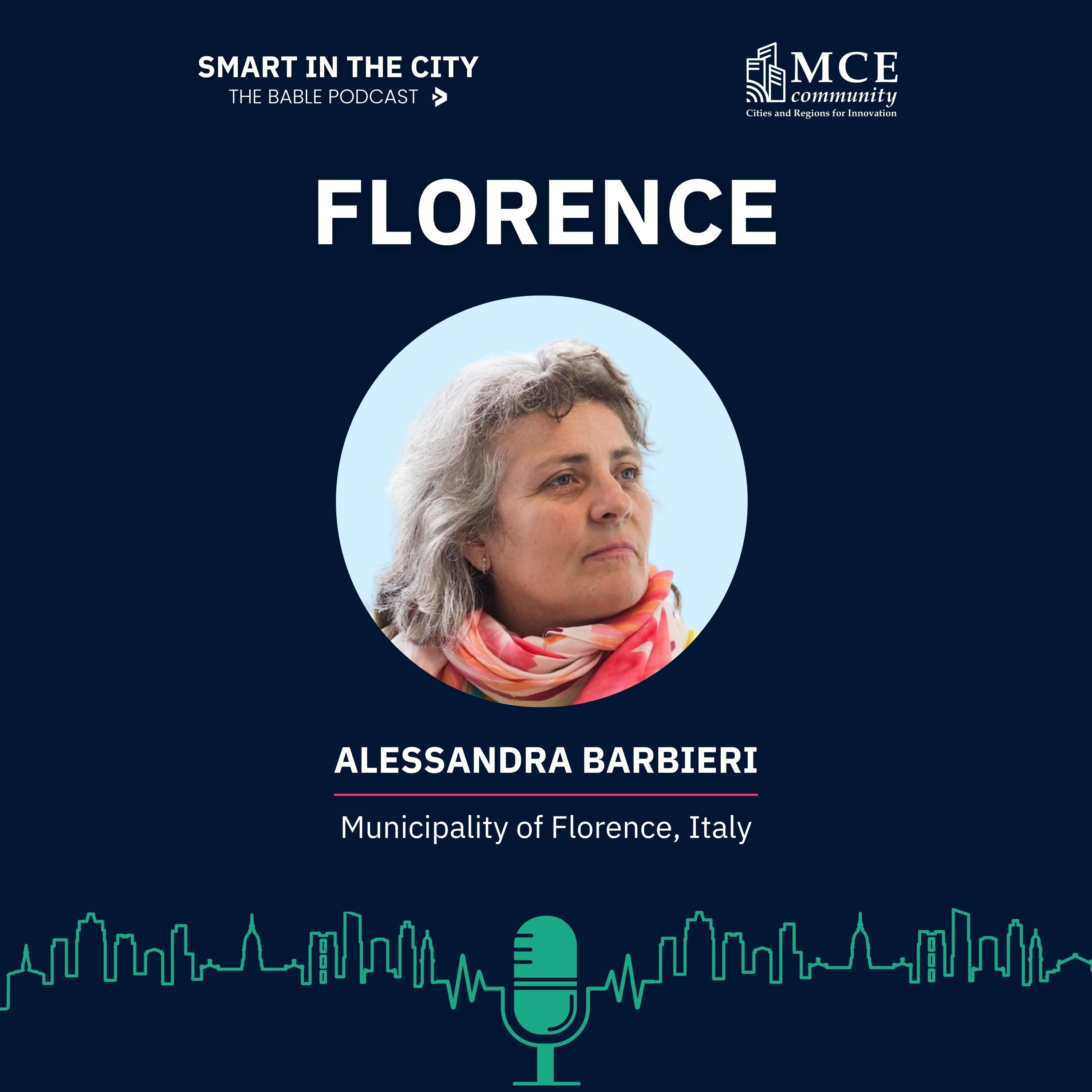
And for this episode we're traveling to the city of Florence in Italy, which has recently developed a formal AI adoption plan to guide how artificial intelligence is introduced into public services.
I'm very happy to introduce you to our guest of the day, Alessandra Barbieri. She is a manager in EU projects and fundraising within the City Manager department at the municipality of Florence.
Welcome to the podcast, Alessandra.
[00:01:55] Speaker C: Thank you very much. Very proud to be here, Very happy. Thanks for your invitation.
[00:02:00] Speaker B: Thank you. Very happy to have you here. And so to get us started, before we dive into the core topic of today, which is Florence AI adoption plan, I would like to ask you a question to kind of warm us up. If you have to pick only three words to describe Florence, which words would you choose and why?
[00:02:23] Speaker C: Nice question. I think that Florence is worldwide well known cities because of cultural heritage. But I would like to break down these images and if I have to pick up three words, my preferred would be lively city, smart city and the city for all.
[00:02:44] Speaker B: Nice, nice. So three concepts. So it's a little bit more three words, but I will allow it because we do want cities to be inclusive for everyone.
But yeah, I really like that pixel. So thank you. Okay, so now we know a little bit more about Florence through your lens and now we would like to know a little bit more about you as well. So could you maybe briefly tell us A bit more about your background and what led you to where you are today.
[00:03:13] Speaker C: Yeah, I'm happy to share my experiences that are quite long in the municipality of Florence. I've been working within the municipality for more than 25 years and in the last 15 years I've been in charge of despite my study that are on political science, I've been in charge of Europe and in terms of funds and projects and. And according to these activities to be enlarged to some concept that was the one of the smart city first for which I'm the contact people, let me say and then for our path towards climate neutral and I'm also the contact people for the mission cities to be zero neutral by 2030 and that's also give the idea of the approach that is a holistic one that the municipality is having within the visionary cities of tomorrow to be aligned to the need of well being and an interest of people.
[00:04:22] Speaker B: Very, very inspiring. Thank you. Thank you for giving us that overview of your background and your and your motivations as well.
So let's maybe dive in now into the. The main topic of today, shall we?
So maybe start with the big question. Why did Florence feel the need for an AI adoption plan?
[00:04:43] Speaker C: Yeah, I think that at least for Florence, the adoption plan on artificial intelligence is not merely a legal or administrative requirement. It's something that is close to a transformation process aimed at integrating this AI system into public services in manner that reflect some issues that are at the core of the management of this AI that is thoughtful, secure and strategic.
The objective of the plan that we've been just approved is to guide this evolution while ensuring both innovation and stability.
Every decision is designed, needs to be designed to uphold service quality, protect citizens and employees and ensure that AI is used in a manner that is transparent, legitimate, ethical, secure and compliant with European national standards and focus on continuous improvement is a lively system as all their technology has been doing it through this last decades, let me say.
[00:06:02] Speaker B: So that's a big ambition. So could you maybe then describe a little bit to us how it looks exactly and what is the overall structure of this adoption plan, how it aims to cover all of this?
[00:06:17] Speaker C: Yeah, the idea is to start from the previous experience that we have as a piloting some system in which we were using the AI and transform this pilot system in the more structural one according also to the requirement, the legal requirement that were expected under the European information, but also to the national one.
So the plan actually is based on four key pillars I.e. planning, compliance, implementation and monitoring in accordance with European national Regulation specifically, the plan draws on European AI act and on the aged guidelines. Aged is the national platform for the digital transition manager. So in compliance also with the national law which define the requirement, the safeguards and accountability criteria that are necessary to have a safe and reliable use of these emerging technologies.
So we are trying to fit the rules into the needs. And this is something that the municipality at the level institution closest to the citizen is expected to be done.
So we have been trying to define a system that could give answers to the citizen needs in terms of services at the same time, to be in compliance with the national and European law protecting the system that AES generated.
[00:07:53] Speaker B: Very nice. So being close to both EU regulation and to the citizens need, I'm also wondering if you are addressing what often is an issue also with municipalities, which is internal capacity.
Is there any room for any capacity building in this AI adoption plan?
And yeah, did you feel the need to maybe plan ahead on how to bring people along also within the municipalities?
[00:08:23] Speaker C: Yeah, absolutely. Because AI is not just technical issues, let me say, in charge, just of the IT department, of course, let me say they are the leader of this process, of this transforming cities. But on the other hand, we are talking about public services. We are talking about delivering a system that is helpful and answering to the need of the citizen. And that means that all of the departments of the cities are involved in the system.
So one of the issues, the challenge, let me say, that were faced when the plan start to be described before the approval is to think how we can have on board all the employees, because in a different way, all the staff that are working for the municipality have an impact in the using of the AI.
So according to this, and taking into account that the municipality is about 4,000 civil servants, it has been deployed a progressive training program that is expected to have on board all the people that are working delivering are the back and the front office of these services.
For that, the city has decided to invest heavily in internal expertise, recognizing that no technology can deliver real benefits without a full understanding on the part of those who manage it, because the citizens are using it. But on the other side, the back of the office is managed by people that are using the technology at the same time are using also the service that we are delivering. So the training has been realized in several stages.
And we've been starting one year ago in summer of the last year with the sort of introductory meetings with external experts that have been in charge of this training from university experts and other specialists agencies, together with IT department colleagues that are a sort of facilitator and helps in putting in practice all the training that we are doing. So it's a sort of professional setting for people that is attending and it's different according to the people that are taking part of the class.
But on the other side the IT colleagues helps in translates words in action. So that is very useful. It's a very huge work for our colleagues of deity. But at the same time it's the best way to have this training according to the use of it.
So we start last year in summer with this introductory meeting that was meaning to explain why the training is needed. And then we had some technical in depth session starting with some key suppliers dedicated in particular to the engineering aspects of the AI models and to more informed and advanced use of the platform employee. And that was of course reserved to more skilled technicians the technical side of the municipality. Then from December until January of this year, we have some additional program conducted with the law firm specializing in AI related issues, focusing particularly on the AI act regulatory compliance and liability that was needed to have the background in which our plan has been established.
And then it's ongoing because IT expected to be hanging within February and March training dissemination activity that has been organized leaded by our IT department and therefore targeting the directories and the managers and then the officer responsible, the staff, let me say with focus on use cases potentially of the management and the risks connected to the use.
And then from February March until February until June. Sorry, it was. It is petty to have some specialized training for the organization management itself. So for more or less all the staffs that are focused on operational management and understanding the technology requirements of the a project that can be delivered in services.
[00:13:30] Speaker B: Wow, that is a very extensive training plan. Then I think that's.
That's really impressive how you also made sure that everything from really the technical side of things, but also governance and ethical use and also the legal part of IT is really embedded through IT for the relevant people as well.
I'm wondering also when you were talking about as IT technician kind of translating the technical part of it, will it also also be maybe something that can be used to be more transparent throughout the citizens on how AI is used by the municipalities from now on, is there also maybe a communication plan attached to the AI adoption plan of Florence?
[00:14:20] Speaker C: Let me say that more than communication plan, it has been based of some pilot services. We have been delivery since last year.
We had the opportunity to test, let me say, some concrete initiatives within some sectors that we thought could better benefit from this Piloting test and for instance, we launched a chatbot for the register office, one of the most common, dedicated to the changing one's residence.
So it's been designed to simplify access to information and reduce processing times and workloads. And that was an example that gave us the opportunity to start a communication system in delivering in a different way the services. The services still are the same, especially the one that we can say are the primary one at the one close to the registry office. But on the other hand, we are aware that people exchange exchange also the time. So they give the opportunity to take information at the basis of the service whenever we want is something that is needed. And moreover, Florence is a city that has been used, let me say from the different type of people is not just residents. There's a lot of temporary users, as for students, for instance, or people that is working for a limited time, but is needed to have some services.
So this chatbot has been delivering a lot of languages, about 24 in order to be also responsive to different platea that is staying in Florence.
Some of them are coming from international states members. So it is needed also to give this opportunity and AHAB help a lot in thermal languages. So it was quite useful. Then we had a sort of step forward within always the registry office. And we launched a chatbot, but dedicated to a broader score of the services offered.
In order to give also to opportunity to know which services are delivered by the municipality. Because it's different in different member European states. The competencies are not the ones that are in Italy at the national level. So that was also an opportunity to give some advices about which services are delivered from whom and how you can get from the municipality.
And these are the our, let me say fourth use cases with generative AI.
But we also had prior 2023 and 2024 some application of artificial intelligence non generative one. But give us the opportunity to see how we can manage data, the information in delivery services and the tools. For instance, one deliverer for the recognition of the roof slopes based photos in which we could install the photovoltaic panels. Here is our climate change challenge that came soon, but also to have the opportunity to map the private green spaces. Because we were delivering our green plan. So it was used to have also information about the surfaces occupied not only from the public, but also from the private green. So that was a way also in reuse the the activities for planning. But it was not just some test in planning activities, but also in operational one. For instance, we take the opportunity to Recognize the so called K boxes uses from the short term rental and was a way also to act in and proceeds in safeguarding the territories. And also the the need to be aligned to the national but also local rules in terms of short term parental. So he had several experiences that help us in delivering that match the need of answering to the needs of the people, but to match also the people within the municipality that are leading the process so they can match through our IT department colleagues the way in which we can better realize the services according to the external deals, but also to the backs of our colleagues and help them in creating the best services.
[00:19:22] Speaker B: So yeah, I can really see how you really built this AI adoption plan based on your previous use cases. So it didn't come from nothing. You had all of this experience previously that you're building upon. So I think that always strengthen any kind of roadmap that we can make if we take the learnings from the past with us along the way. So I guess you mentioned environmental challenges that Florence is trying to address with AI, for example, in that particular case.
But maybe I think the plan also flags environmental impact of AI as a consideration. Right. So I will be interested interested in knowing how you are thinking practically about responsible consumption of AI within the municipality in terms of maybe energy cost or anything else.
[00:20:20] Speaker C: A lot of analysis has been realized before. Our plan comes about the impact of the the use of AI that we know it's quite strong.
A lot of analysis and studies suggest the need to keep the eyes open on the environmental uses and impact in order to have a balance effect of the use of AI, but at the same time to be in compliance with the climate needs.
So we know that AI has a significant energy cost and therefore requires responsible adoption policies. And according to this need, the plan includes a focus on environmental impacts related to intelligence artificial to raise user awareness. That's the main issues about the appropriate use of this technology.
That doesn't mean that it's black or white, let me say means that you should take the decision aware of the consequences of your decisions. This is the main, let me say, motto we are using when we are approaching and designing the use of the AI to be aware about the consequences also in terms of environmental.
[00:21:42] Speaker B: Okay, very nice.
And so what would you say is right now the main challenge that Florence still has to face? And what do you think is needed still to accelerate a little bit this change the adoption of AI or maybe anything else in Florence at the moment?
[00:22:05] Speaker C: Let me say that one of the most challenging is the time because the Time of technology is the different time of the releasing the public services in practice. So we need to find a way in which AI help us in filling the gap. Let me say somehow, because that's something that is not so easy to manage during the time. And also through our Smart City plan, we realized that technology is really an amazing tool to achieve faster, maybe better the results, but you know, better, fast, cheaper. You should choose two of them, you cannot have the three of them. So it is needed to make this analysis also when you are choosing the delivering the system using the AI. And that's why I think that the governance model that we have been provided thanks to this plan that is putting together all the role in a cooperation way, from the political side to the administrative one, in which also the data manager is in the digital transition manager, together with this office works together steering committee that help in finding also an answer to this need. Because there's a lot of expectation from the use of AI, A lot of people are visionary about it. But then when you go deep in action, then you have to be sure to use this tool to achieve the best result. But we need to be aware the consequences to release the best services that you had. The one that we tested had very good results. And that's why we've been going through the adoption of this plan that in Italy is one of the first. So we were also sort of innovative somehow, but of course, just in terms of thinking and planning. And now we need to find a way, after we finish our training moment, how we can deploy the best the digital service and which are the services that are that better fits to the use of the AI. But this is something that our colleagues are working on together with the process that are coming together with the data from the people that is working within the departments interested in releasing the service about mobility, about register of office, social services. There's a lot of services that could be having AI as a tool that help in achieving the results that are expected.
[00:25:05] Speaker B: And with Florence being kind of pioneering this AI adoption plan model, as you mentioned, what advice would you give to any city that would like to replicate this AI adoption plan? Where and maybe they don't know exactly where to start. What would be maybe your first advice for them to get started?
[00:25:28] Speaker C: To have a strong analysis of what exists, which are your situation in terms of technology, in terms of services and digital services, and which are the things that are more frequently asked by the people that is living in your city, then you need to have also a clear idea about the rules that combine this path that are European, but also national rules and the gdpr that is our umbrella right now, under which all the tissue, all the decisions need to be taken.
[00:26:09] Speaker B: Of course, very important and I guess so we have a lot of cities listening to our podcast, but we also have some companies that are listening. And for those companies that maybe have a solution, an AI solution that would be relevant to public administration, what would you say is the best way for those companies to start a meaningful conversation with Florence if they would like to offer that solution?
[00:26:40] Speaker C: Yeah, the municipality is based on public tender offers. So just check in our network what we are doing. This could be suggestion to see where we are and where we are going. On the other hand, keep in mind that interoperability is something that it is needed for cities that is working on public interest, because this helps in reusing or the systems that we have and give a simpler way to translate into AI what is already existing.
[00:27:20] Speaker B: So always coming back from that important message, don't start from scratch, always build on what is already there.
[00:27:27] Speaker C: Yeah, for sure.
[00:27:28] Speaker B: Yeah, really important. Thanks.
So we're coming to the end of the main section of our interview, but before moving on, I would like to ask you maybe to give you the open floor and ask you if there's anything that we have not touched upon that maybe you think our listeners should really hear about.
[00:27:50] Speaker C: Oh, I think that the main, let me say information about the process that has been leading to our AI plan has been analyzed and presented, maybe available together with the people coming from our IT department for more consistent, let me say, information, more technical details, if it's needed.
And I think that it is relevant to think about a system that is more realistic is something more technology and that's something that the municipality is aware about it. But maybe when you go in practice it becomes a bit difficult to keep it together. I think that it is needed to have really an approach that are keeping together all different interests also within the municipality.
Breaking the so called silos, because silos because heavy hands municipality is just one and we have to work as just one, not just different people in different department. The municipality has been a long experience.
The municipality of Florence have been a long experience under this collaboration system we started in 2014 with our digital Florence.
That was an agreement with Flores, the city of Florence, some of the relevant stakeholders to work all together on ET issues.
And this agreement leads to have this internal task force that is working to have a common view and approach, because ET is something that is needed in all the departments. So we had the possibility to start to work together more than 10 years ago and now in practice we see that is very helpful. So that's maybe one message that you can leave. Working together, not think about just one department, not think just about technology, but having technology as a tool that is a real horizontal transversal and having it means to have a lot of talk with all the colleagues of the department. But at the end it helps.
[00:30:22] Speaker B: I can imagine. So yeah, definitely. Always important not to take technology for technology itself, but always embedded in what is truly needed and what already exists and bringing people along the way, I think. Yeah, always is important. So thanks a lot.
Now we're moving into our fun segment of the. Of this episode and today the segment I have chosen for you, Alessandra, is
[00:30:49] Speaker C: shout out, shout out,
[00:30:54] Speaker A: mention a person, an organization or a city you think describes more recognition in the field.
[00:31:04] Speaker C: I think that we could have several suggestions. I'm thinking about cities, I have to be honest, because maybe it's the sector in which I'm more used to getting contact with.
And for instance the city office we had in France, we had peer training, working together within a European project based on data management.
And we had opportunity to have also a visit in Molino where we saw a lot of work that is been doing and the approach based on data centric use.
But it was something that is not part of a process, was not the final goal, but was a tools to manage at the best, all the services, all the knowledge and the planning. And I think that is quite similar to what Florence has been doing this last decade. And I think that it's not so big, it's not so well known maybe, but I think it's really relevant the job is doing and the cities well being, you can breathe it when you are at sea. So I think that we can make really a good reference to the cities. On the other hand, because we are medium size, it is similar, maybe bit smaller. So let's make references to a big one.
And I think that Barcelona could be a good example. So we just stay in the Mediterranean area. I know, I'm sorry, but it's a good example in terms of investment in people and they have this big smart seed control room in which a lot of data are managed. But it was not just management of data itself, but source management data for the social impact and social issues. And I think that's something very interesting for us. We are already working on it, but seeing that somebody else is doing is really helpful.
[00:33:23] Speaker B: Hmm, I'm really glad you picked those two examples, especially Isli Molino. We actually recorded also a podcast episode in collaboration with major cities of Europe. So it's an episode in French, but for any French speakers or people understanding French in our listeners, I would invite you to go back to that episode with Eric Le Gard because it was also a very interesting one. So happy that that was one of the first cities to come to your mind. And yeah, we also have been in conversation with people from Barcelona and we couldn't agree more with the great work that they are doing as well. So thanks a lot, Alessandra. I think now I only have one more question to ask you. And this is a question that we have every single guest that comes onto our podcast and it is to you. What is a smart city?
[00:34:18] Speaker C: What is smart cities? Florence.
Florence is an example. We need to be visionary.
As I've been saying, I'm European Project manager. If I would not be visionary, I would never get a succeed project.
So that's why I'm investing myself. But what the municipality is investing in is your city, the city where you are living. So for me, it's Flores. Florence is what is expected to be in the next future, the real smart city.
Loridico. I need to say it again because I always use it.
I think that Florence is expected to be my smart city of tomorrow. The city in which I'm living, the city in which I'm working, the city in which my family is growing. And I really hope I need to be visionary to be the smart city example for the smart small size, medium cities.
[00:35:20] Speaker B: Very nice. I think it's the first time that we have. We had an answer like this on the show. I mean, we, we often have people being. Yeah.
Telling about how they think smart city should be citizen centered, about the people inhabiting the city. But I really like that you, you're taking this approach of making it as a goal for the city of Florence. So very nice. Thanks a lot.
Yeah, I mean, thank you very much for your time, Alessandra. Unfortunately I don't have anything else for you at the moment. But I truly enjoy talking with you and learning more about Florence's work around AI adoption for the municipality.
And yeah, I want to thank you for joining us.
[00:36:06] Speaker C: Oh, it was really my pleasure. And let me thank all my colleagues of the IT department, specifically Leonardo Ricci that gives me so many information and make me so happy to be aware about this next step of our city. So thanks a lot to give me the opportunity to show what we are doing.
[00:36:26] Speaker B: So we are thanking also Leonardo at the end of this episode as well.
And of course we are thanking also our listeners.
Don't forget that you can always create a free account on Babel Dash Smart City EU if you want to find out about more Smart City projects, solutions and implementations throughout Europe, but also globally. And I want to thank you all very much.
[00:36:49] Speaker C: Thank you. Many thanks. Enjoy.
[00:36:53] Speaker A: Thank you all for listening. I'll see you at the next stop on the journey to a better urban life.
[00:36:59] Speaker B: It.