Episode Transcript
[00:00:00] Speaker A: Foreign.
The City, the Baba Podcast where we bring together top actors in the smart city arena, sparking dialogues and interactions around the stakeholders and themes most prevalent for today's citizens and tomorrow's generations.
I am your host, Tamlin Shimizu and I hope you will enjoy this episode and gain knowledge and connections to accelerate the change for a better urban life.
Smart in the City is brought to you by Babel Smart Cities. We enable processes from research and strategy development to co creation and implementation. To learn more about us, please visit the Babel platform@babel smartcities.eu.
so welcome back everyone. This episode here is one for the urban mobility and transport lovers. I know you're out there. We have a lot of listeners within the mobility field.
If this is you, then you definitely want to stick around for this episode.
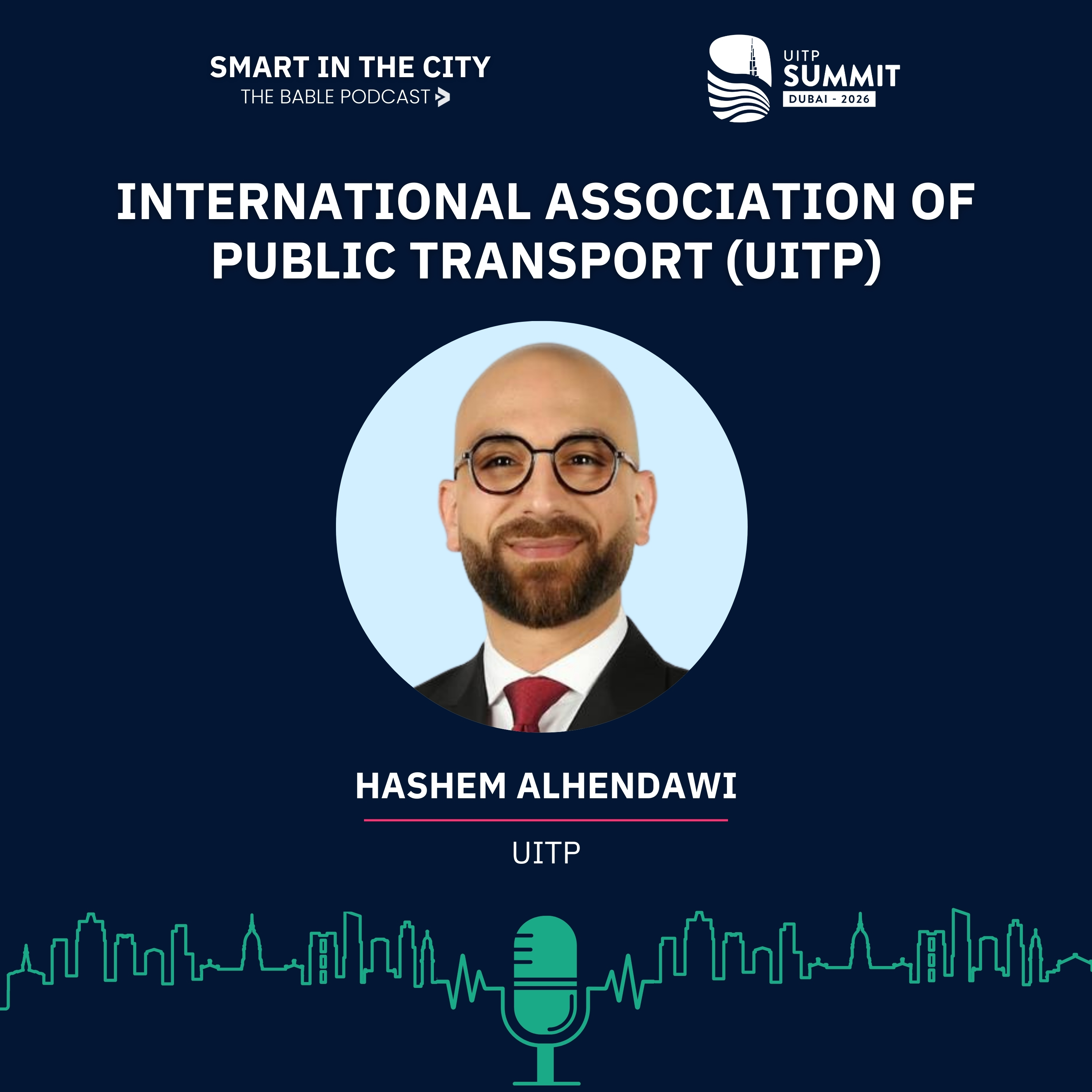
With me today is none other than Hashim Alhendawi. He's the head of the uitp. Mina. Welcome, Hashim.
[00:01:08] Speaker B: Welcome, Salmim. Nice to have you.
[00:01:10] Speaker A: Yeah, nice to have you here.
I'm really excited. This is our second year with the partnership with UITP where you bring together a lot of interesting people around transport, a lot of mobility lovers and yeah. So I'm excited to dig in there and learn more from you about your perspective on all these topics. So we had a partnership last year, as I mentioned, I got the pleasure of interviewing Mohammed, the Secretary General of uitp.
And so for our teaser question, I kind of wanted to ask you a similar question. The same question, I should say, and see how your answers relate.
I want to ask you, can you describe UITP's mission using only three emojis?
[00:01:56] Speaker B: Oh, three emojis only three emojis only.
Okay.
I would go with globe because UITP is truly global.
We connect cities and people across continents.
Every city has different mobility challenges, but the mission is shared.
So this would be my first choice. The second choice would would be maybe bus.
Bus, because it represents public transport.
Not just we are not just moving people, but shaping how cities go, how inclusive they are, how sustainable they became.
And maybe I would add handshake because honestly, collaboration is a everything for us.
UITP is not here to push one technology or one company. It is where authorities, operators, industry and academia learn from each other.
So if I say it in one simple line, it would be this.
Maybe we are connecting the world through better public transport and strong partnerships.
[00:03:16] Speaker A: Very good. And you match with Mohammed's emojis out of two of them. So he said that's interesting. Yeah, that's pretty good, right? He said a bus as well for public transport.
He also had the shaking hands for collaboration. And the only difference that you guys had is you chose the globe. And he chose a happy face because of kind of the result of the collaboration, everything he hopes it brings a lot of happiness. And you chose the globe because of this global perspective. So interesting though, that you chose two of the same ones for sure.
So now we want to dig in a little bit more. I want to learn a little bit more about you as a person and ask you, what is your background? What led you into your role today?
[00:04:06] Speaker B: I often say my journey into mobility was both planned and accidental.
I was born and raised in Amman in Jordan, and I studied industrial engineering at the University of Jordan.
That gave me a systems way of thinking, how things connect, how efficiency can improve daily life.
But what really pulled me in was technology.
Technology that helps cities move better.
Not technology for the sake of it, but technology that solves real mobility challenges.
Then I moved to Dubai in 2013 and suddenly I was in a city. Reinventing mobility in real time.
You could actually see how transport shapes urban growth.
Honestly, that left a strong impression on me. Since then, my career has always stayed linked to mobility in a way or another.
Different segments, different perspectives. But I kept coming back to public transport because this is where mobility becomes very human. It's not about movement, it's about access to jobs, education opportunities.
There is also a nice full circle of my story that I worked for a UITP member earlier in my career.
So I already knew UITP from the outside.
The knowledge, the global network, the influence.
So stepping into the role of head of Mina about eight months ago only, honestly, felt natural for me.
I felt like joining a platform where you can help shape the conversation at a regional level.
[00:06:04] Speaker A: Yeah, very interesting background.
I can see why you feel that public transport is really human, centric and about more than just movement. Right.
I want to also give a little bit of background for those who aren't so familiar with uitp.
What is UITP and what are your main goals?
[00:06:25] Speaker B: That's a great question, because many people actually know our work before they know our name.
UITP stands for the International association of Public Transport. And in simple terms, it is the global network for public transport.
We bring together authorities, operators, industry, academia and policymakers from all over the world. And not to talk in theory, but to share what actually works.
So if I explain it simply, UITP is a knowledge and collaboration platform. Cities don't need to reinvent the wheel.
Somewhere another city has already tested a solution.
Maybe electric buses, integrated ticketing accessibility.
Our role is to share those lessons and make them useful for others.
One main goal is clear, to make public transport the backbone of urban mobility.
Because if cities want to be livable, inclusive and climate resilient, public transport has to be strong and reliable.
And we don't only talk about vehicles or infrastructure. We work in policy, governance, finance, digitalization and people skills.
A modern metro alone doesn't guarantee success.
So you need also good planning, strong operations and trained professionals to do the operation.
In the MENA region, this is especially important because many cities here are growing fast and building networks almost from scratch.
So that is also a gift, I would say.
It means systems can be designed right from the start with sustainability and inclusion in mind. A good example, I would like to say our joint project with the Roads and Transport Authority in Dubai, the center of Transport Excellence.
So we produce knowledge tailored to the MENA context and support capacity building. The idea is simple. We build local expertise, not just import global ideas.
So really, for me, UITP's role is to connect people who move cities forward and to turn global knowledge into local impact.
When cities learn from each other, progress becomes faster and daily life improves for million of people who rely in public transport.
[00:09:20] Speaker A: Yeah, I really love your mission. And of course that's why we've decided to partner with you on the summit upcoming as well.
The UITP Summit 2026 is in Dubai, coming up in April, right?
So why Dubai?
What should the listeners expect?
[00:09:39] Speaker B: Okay, so let me start with a bit of context, because this summit is special for us in several ways.
UITP recently made a strategic decision to move from a summit every two years to a summit every year. The reason is very simple. Mobility is evolving fast and cities need more frequent exchange and faster learning.
So the sector is moving too quickly to wait two years between conversations.
So now we alternate one year in Europe and one year outside Europe.
And Dubai 2026 will be the first summit outside Europe under this new model. That already makes it big moment for us.
It is also symbolic for UITP.
2026 marks the 140th anniversary of the UITP Summit across its different formats over history.
So this is not just another edition, it is a milestone for the whole community.
And the summit is coming back to Dubai after about 15 years.
A lot has changed in Dubai since the last time. If you look at the city today, you can really see the transformation on the ground itself.
What makes it even more interesting is the timeline. Hamburg was in June 2025 and Dubai follows in April 2026.
That gives roughly 10 months to prepare a global summit.
And to be fair, not many cities can pull that off at this scale. Dubai can.
So now to question why Dubai.
Dubai has maybe transformed its mobility landscape in a relatively short time.
Transport here is seen as a strategic pillar of development.
Not just the service, but something that shapes how the city grow and how people live.
So people sometimes think of Dubai only as a car city, but if you look a bit closer, you see a different story. A strong metro network, tram systems, advanced bus operations, marine transport, digital integration, and, and behind all of that, a clear long term vision.
You can feel that that mobility is planned, not accidental.
Dubai is also a global crossroads. It connects regions, cultures and markets. So hosting the summit here naturally brings more voices into the global dialogue. And that diversity makes the conversation here richer.
And to the second part of your questions, what should people expect?
I would say very practical conversations, real case studies, honest discussions about what works and what doesn't.
Sustainability will be central, not as a slogan, but as a daily operations.
Inclusion and accessibility will be key themes because mobility must serve everyone.
Participants, I would say, will also feel the energy of a region that is building many of its systems now, not two decades too many decades ago.
That creates a real chance to design mobility right from the start. And that is quite exciting to witness.
[00:13:35] Speaker A: Yeah, absolutely. I think that there's a lot of exciting things happening in Dubai for sure. I want to play devil's advocate there a little bit because of course I was in Dubai recently and there's a lot of people who have experienced Dubai and they, they know it as a car city.
Right? They know it as you jump in a taxi, you go someplace it's not very walkable, and they don't even think about taking the metro, all of these things.
Can you, can you explain a little bit more on these concrete steps that the city has taken in the last decade to really move forward to a public transport for a system.
And also you said that there's a long term vision. Maybe you can tie that in together too.
[00:14:20] Speaker B: Okay, that is a question I really like, because Dubai's mobility story is often oversimplified.
Yes, Dubai has been known as a car oriented city.
Car ownership has grown around 8% per year compared to roughly 2% globally. That tells you how fast demand has increased.
But at the same time, if you look closely at the past decade, you see very deliberate steps towards better public transportation. First mindset.
And you can actually see that shift on the ground today.
Let's start with something everyone can see. The metro network a decade ago The Red line was the main backbone. Then the Green line expanded into Deira and Bar Dubai. And today the story continues with the Blue line which is under construction right now, connecting more residential and employment areas.
And people are using it. In 2025, metro ridership passed 200 million passengers in 2025. That is not just a nice number, that is a daily mobility for hundreds of thousands of people.
But Metro alone is not the story.
Integration is really where the shift happens.
Dubai's Roads and Transport Authority has worked hard to connect buses, Metro, tram, marine transport and micro mobility into one system.
Unified ticketing, coordinated schedules, easier transfers.
So for passengers it means one smooth journey.
That is what people care about.
They don't think in moods.
They think about getting to work, school or back home.
Another thing I would add is accessibility, which has also improved a lot.
Stations are designed for people of all abilities.
Services reach real destinations.
That matters in daily life. Residential areas, business hubs, schools.
And I can add that there's also a planning shift.
So open growth is not only about highways anymore.
There is more focus on walkable areas and transit oriented development.
That is where you see real long term change when city planning and transport planning move together.
Digital tools support this too. Real time information, smart ticketing, mobility apps. These small things build trust and make public transport easier to use.
So I wanted to add that Dubai is also exploring future mobility. So it is yes, futuristic city, urban air taxis, underground loop systems. But the important point is this.
These ideas are added to the network. They don't replace the core system that moves people every day.
So yes, Dubai is futuristic, but the real future here is practical.
It's about making high quality public transport part of everyday life.
And if you ride the system today, you can genuinely feel that shift. That is what a true transport first transition looks like.
[00:18:16] Speaker A: Yeah, I'm excited to go and experience some of these shifts as well. I want to ask you, moving a little bit out of just Dubai, you also focus in the greater MENA region as well.
From your perspective, what do you think is the biggest mobility shift that's happening in the region that maybe Europe, Europeans or other regions might be underestimating or under informed on?
So maybe to expand the scope a little bit outside of just Dubai, you're also working in the MENA region. I want to hear from your perspective what you think is the biggest mobility shift that's happening right now that maybe other regions might be underestimating or under informed on.
[00:19:01] Speaker B: I would say the biggest shift right now is that many MENA cities are moving from Car based planning to network based planning. And it is happening faster than many people realize.
For a long time, mobility in the region was mostly about roads and lanes expand, highways try to keep up with demand.
Today the conversation has clearly shifted.
Governments are investing seriously in public transport networks, Metro, brt, regional rail, integrated bus systems. And these are becoming core infrastructure for how cities grow.
What many people outside the region underestimate is the speed and scale.
Some cities are building in 10 years what took others 40.
And they are not just copying models, they are learning from global experience and adapting it locally.
If you spend time in cities like Riyadh, Dubai, Doha or Cairo today, you can actually see how fast this transformation is happening.
Entire multimodal systems are being built almost from the ground up.
That allows cities to integrate digital ticketing, electrification maybe and service design from day one, not later. As a correction, I would add maybe another important shift which is mindset.
Public transport is increasingly seen as an economic and social enabler.
It connects people to jobs, education and opportunity.
That narrative is becoming much stronger in policy discussions across the region.
There is also real push towards sustainable mobility.
Electrification of bus fleets, clean energy ambitions, climate targets, and here, sustainability. It's not an abstract.
It is linked to heat, air quality and long term livability.
And many of the most underestimated shift is demographics.
MENA has very young population.
Young people are more open to shared mobility, multimodal travel and digital platforms. Their expectations are different.
They are not automatically tied up to private ownership of the cars.
[00:21:54] Speaker A: Yeah, very good insights. I definitely agree and from what I've seen, but really interesting to get your thoughts on that.
I also want to ask you, there's a lot of companies, innovators that are working with cities, with transport operators, etc and they will come to UITP summit. And you also work with a lot of these different companies as well.
Where do you see the biggest opportunity in MENA right right now for you know, innovation for these companies? Operations, digital platforms, electrification, maybe something else. Where do you see those opportunities in the region?
[00:22:32] Speaker B: If I give a short answer, I would say that the biggest opportunity right now is making systems work better, not just building new ones.
A lot of attention naturally goes to new infrastructure, but cities quickly realize that the real value comes from good operations.
Reliable service, good maintenance, strong scheduling, skilled staff.
These may not always be visible, but passengers feel them every day.
And honestly, you hear this directly from city authorities.
They care about performance, not just projects.
So for companies, operations and capacity building are huge opportunities.
Helping authorities run systems efficiently, train teams and optimize performance can Create impact almost immediately.
The second big area I would say is electrification.
Many cities in MENA have very strong climate and energy transition goals.
So electric buses, charging infrastructure and depot management are becoming very relevant.
But cities need partners who understand local realities.
Heat, distances, operating patterns, not just off the shelf solutions and digital platforms. And the data also matter.
But the real opportunity there is practical integration or not. Because Cities don't need 10 different apps that don't connect. They need systems that work together and make the passenger journey simple.
Also, mobility as a service is interesting, but in many places the priority is still strengthening the core public transport network.
MAAS only works in my point of view best when the base network is reliable. Otherwise it's just a nice interface in a weak system.
And one area people often underestimate is first and last mile solutions.
Safe walking access, micro mobility, feeder services.
Those small links often decide whether someone uses public transport at all or not. If the first or last part of the trip is difficult, people quickly return to the car.
So my honest advice to innovators and companies is simple.
Don't just bring technology, bring understanding.
Cities in MENA are looking for long term partners who solve real mobility challenges, not just showcase pilots.
[00:25:43] Speaker A: Really great advice in there. I was just nodding along and agreeing with everything that you said because it's also what I've said and I think a lot of those lessons of course are really applicable in any region that any company is going to as well. So looking ahead, just as a reminder again about the UITP summit in Dubai as well, what topics do you really think will dominate the conversation? Not just because they're like some trendy topics, but because these are the topics that cities genuinely need solutions to.
[00:26:18] Speaker B: Cities today are less interested in trends and much more interested in what actually works.
So if I look ahead to 2026 summit, which will be in few months, I think the first big topic will be financial sustainability in public transport.
Many cities are expanding networks, but the real question is how to fund operations. Long term fares, subsidies, value capture.
And you hear this almost in every conversation with city leaders.
It is real daily pressure for them.
The second big theme is workforce and skills. The sector is transforming very quickly.
Digital systems, electrification, automation. But none of that delivers results without skilled people.
So cities are thinking seriously about training, reskilling and attracting young talent in public transport.
Because I would say technology alone doesn't run a system, but people do.
So enriching the skills of the people is high element of the success of any project.
Another major topic will be climate resilience.
Only Reducing emissions, but making systems able to cope with heat, floods, extreme weather.
For many cities this is no longer theoretical, they are already planning for it today.
Also, I expect strong discussions on service quality and passenger experience frequently.
So the frequency and reliability, comfort, safety, because at the end of the day people don't ride a strategy, they write a service, and when the service is good, behavior naturally follows.
Data and digitalization will definitely be part of the conversation, but the tone is maturing.
Less hype, more focus on how data improves planning and operation in practical ways.
Cities want usefulness, not dashboards. Although dashboards are important, but if they are not useful they are useless.
And one topic that I personally believe that will be central is inclusion and accessibility.
Mobility must work for women, elderly, people, persons with disabilities and low income communities. If a system work only for some, it is simply not successful system.
So if I summarize it simply, the big themes will focus on making public transportation reliable, resilient and people centered.
Cities are looking for solutions that can apply on Monday morning, not ideas that stay on slides.
And that is really why gatherings like the Summit matter.
They create space for honest conversations about real challenges and shared learning on how to solve them.
And I would say those conversations often lead to real change on the ground.
[00:30:09] Speaker A: Yeah, I'm excited to see how that plays out and having those really practical, practical conversations as well. And now we get to the part where I like to ask you if you have anything that we missed. We already covered a lot of different topics, but here's your open floor if you would like to mention anything else that we didn't get the chance to talk about yet.
[00:30:31] Speaker B: If I may use this open floor, I would really like to mention something that reflects why UIQP exists in the first place. World Public Transport Day.
It takes place every year on 17th of April and this year is the very first edition.
And what makes it special is that this started as a long term dream inside UITP and now it is becoming real.
It has been announced during the UN Decade of Sustainability Transport in New York to having a full identity and a website.
And now more than 100 organizations already preparing to take take part.
You can feel that the idea truly resonates with cities. So mark this day, 17th of April.
Let's all celebrate the World Public Transport Day.
[00:31:34] Speaker A: Sounds great. Now we move into our segment.
Our segment.
We choose a different segment for every person ours that we have for you today is called Inspire us.
Inspire us just a little bit with a story, a quote or anything that has inspired you recently.
[00:31:58] Speaker B: I will share a Simple thought that has stayed with me for four years.
In mobility, we often talk about technology, infrastructure and investment.
But one sentence I heard a long time ago really reframed it. For me, transport is not about moving vehicles. It is about moving people toward an opportunity.
That stayed with me because it's true everywhere.
A bus route can mean access to a job.
A metro line can mean access to education.
A reliable system can mean less stress and more dignity in daily life.
This sounds like small things, but for people, they are life shaping.
And I have seen this in many cities I visit.
When a new line opens, you hear people talk about it. They talk about the time saved, the new jobs options, or easier school trips for their children.
That is when mobility becomes real.
What inspires me today is seeing more cities understand this.
They are not investing in transport just to look modern.
They are doing it because mobility shapes economic growth and social fairness.
And you can feel that shift when you speak with city leaders.
[00:33:42] Speaker A: Now, I like it really about moving people to opportunities.
I love that. Now we go on to the question that I ask every single guest that comes onto this podcast and it is to you. What is a smart city?
[00:34:00] Speaker B: Ah, a smart city.
For me, a smart city is not a city full of technology.
It is a city that makes life easier, easier for its people.
Technology is a tool, not the goal.
And honestly, that is something cities are rediscovering now.
A smart city is one where service works well, where mobility is reliable, where people can move safely and affordably, where time is not lost in traffic every day.
These sound simple, but they shape daily quality of life.
Mobility is actually a good test of how smart a city is.
If people can reach work, school and services smoothly, the city is functioning well. If they struggle every day, no amount of sensors or apps will make it smart.
For me, a true smart city also thinks about inclusion.
Can elderly people move comfortably?
Can children travel safely?
Can low income communities access opportunities?
If the answer is yes, that is a smart outcome.
And you really notice this when you speak to residents about their daily commute, they rarely talk about technology.
They talk about time saved, safety and convenience.
That tells you what smart really means to people.
[00:35:58] Speaker A: Yeah, absolutely. Definitely agree with those points there. And I love the connection, really the, the human centric response that you had with that. That's all I have for you today. I just have to give you a big thank you, Hashem, for coming on today, spending this little about mint of time with me and the listeners. So thank you so much for coming.
[00:36:18] Speaker B: Thank you for having me. I. I really enjoy it.
And yeah, thank you for everyone. Also will be listening to to this discussion. If if this discussion sparked even one new idea or reflection about public transport in your city, then I think it's worth it.
[00:36:39] Speaker A: Yeah, absolutely. And I also have to give a big thank you to all the listeners. This podcast also wouldn't happen without them. So don't for always create a free account on Babel Smart Cities eu. You can find out more about different use cases, solutions and more. Thank you very much.
Thank you all for listening. I'll see you at the next stop on the journey to a better urban life.
[00:37:12] Speaker B: It.