Episode Transcript
[00:00:00] Speaker A: Foreign.
[00:00:07] Speaker B: The City the BABA Podcast where we bring together top actors in the smart city arena, sparking dialogues and interactions around the stakeholders and themes most prevalent for today's citizens and tomorrow's generations.
I am your host Tamlin Shimizu and I hope you will enjoy this episode and gain knowledge and connections to accelerate the change for a better urban life.
Smart in the City is brought to you by Babel Smart Cities. We enable processes from research and strategy development to co creation and implementation. To learn more about us, please visit the Babel platform @babel smartcities.eu welcome back everyone to another episode of Smart in the City. This episode will be hosted by one of my colleagues on the ground, so I hope you enjoy the change of voice and pace and I'll catch you next time.
[00:00:58] Speaker A: Hello everyone and welcome back to another special series of Smart in the City, the Bubble Podcast. This year again we are collaborating with the Urban Future Conference and recording episodes at their 2026 edition in Ljubljena. I'm Greta Schaag, Head of Markets and Partnerships for Southern Europe at Babel and I'm very happy to host the first episode of this series.
In this episode will travel to Madrid to explore the intersection of environmental infrastructure, clean mobility, digital operations and urban innovation.
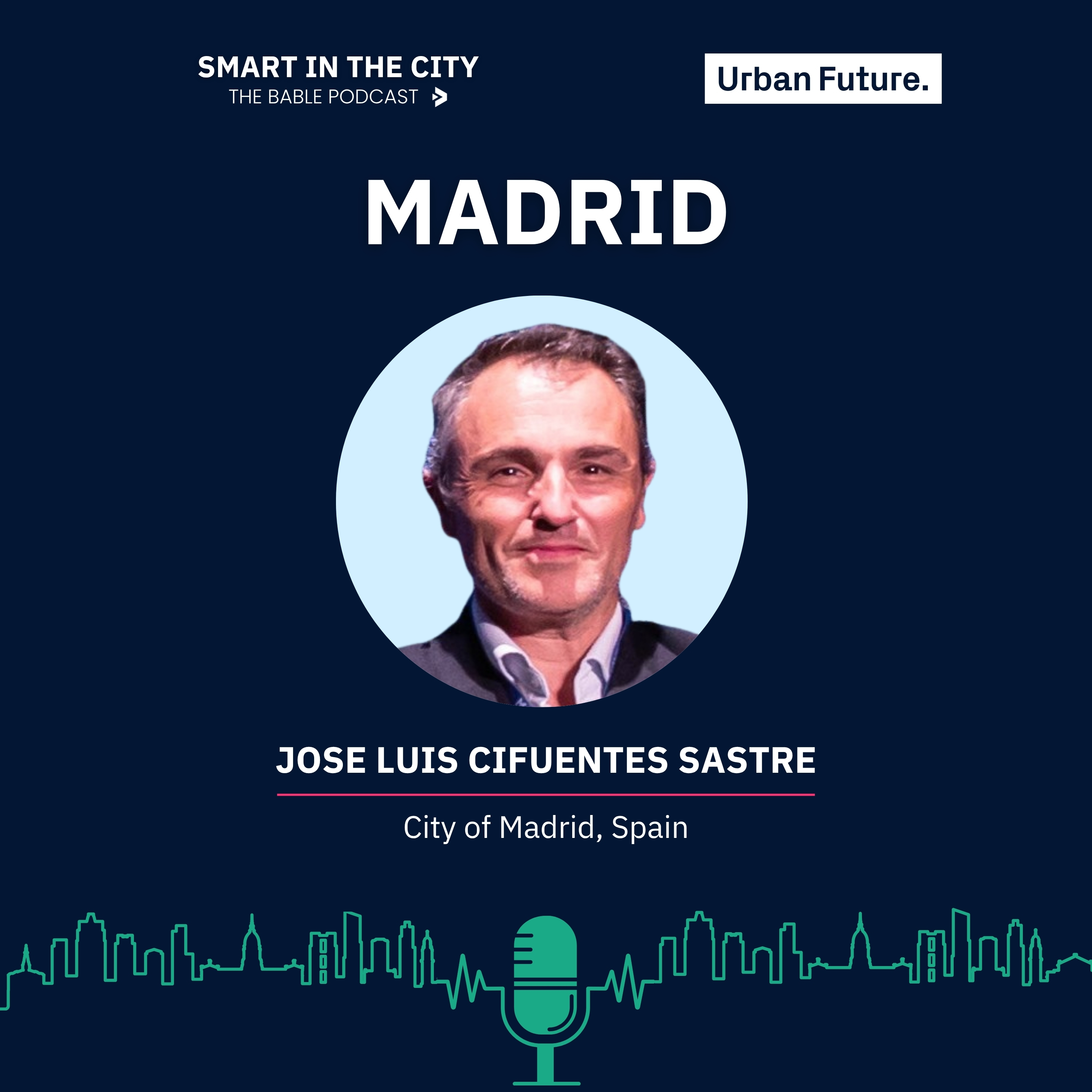
Joining me today for this conversation is Jose Luis Cifuente Sastre, Innovation Promotion and Information Manager at Madrid City Council. Welcome, Jose.
[00:01:41] Speaker C: Thank you so much. It's a pleasure to be here.
And yeah, you describe very well.
[00:01:47] Speaker A: That is the beauty of such a summarizing in a few words. I had a lot of work that you do, so we'll get into that because there, there is a lot that I want to hear about that.
But let me start maybe with a teaser question. We always want to start with something fun. So if you have to say, if Madrid were an animal, what animal would it be and why?
[00:02:11] Speaker C: Okay, that is a difficult question, but if I have to answer from the institutional point of view, I am a civil servant of a city council. I have to say Madrid is a bear.
Bear climbing on a strawberry tree we call madronio, right?
Because that is the coat of the city is represented there in the coat of the city.
But this comes from the old times, the Middle Ages, where Madrid was surrounded by forests and there were a lot of bears there and a lot of madronos, also strawberry trees.
And this was or represents an agreement between the city and the image of the bear just jumping on the trees. It represents an agreement between the city and the clergy which owns the surrounding forest of the City.
And, and it represents a balance between nature, territory and growth, which is kind of a motto, right. For Madrid and is what we try to keep during those. These centuries. And I think it's a good principle to grow, right. This balance and the merging of a territory and the boundaries with this city. And.
But if I have to answer as a citizen, okay. I would. I would say that Madrid is a red fox, okay.
Because it's agile, it's creative, it's curious, adaptive. Okay. And it's always reinventing itself, right. To adapt to what is coming. So, yeah, I think the red fox embodies energy and resilience, which is the, the COVID War. Resilience, right.
[00:04:13] Speaker A: Yeah, yeah, indeed.
[00:04:15] Speaker C: That is the code. So, yeah, for me, it would be a red fox.
[00:04:18] Speaker A: I love that. I love that.
Yeah, that description of like, the, the boundaries, because I think that also goes in line with the resilience, the innovation, the adaptation.
Maybe before we get into why the city, you know, reminds you of those, or why you. You talk about the city with those animals. I would like to start from the beginning and understand what is your background, what led you to this role?
[00:04:44] Speaker C: Okay, so I am an industrial engineer. Okay. My. I'm a. Specializing in industrial installations and industrial processes. Like, it's like kind of a freak thing, right? Very, very, very concentrated in one thing. Right. But engineers are like that. This is our mind. Right. But I have a super creative instinct that has shaped who I am. And I was always, since I remember being attracted by design, industrial design. I'm an industrial design lover by trends, by technology, by imagining new ways of doing things.
And if you add to that communicative vocation which is part of my daily activities in the city council, and also these developed through the years, this portfolio manager mindset, I try to connect projects, technologies, people, and put it all together in a melting pot and try to fit all those things to make the city in the long term a better place.
So that is like super philosophical. I'm sorry.
[00:06:05] Speaker A: No, I actually love it. I'm really glad that you bring that perspective and that you're bringing those ideas, like, you know, how the career has built and led you to this, managing this initiative that you will also tell us more about. So that's great.
[00:06:23] Speaker C: Yeah. I'm a believer that technology is here to help us, and it has happened in the, in, in our history. The printing press transformed the knowledge.
So before the printing press, all the books have to be reproduced by hand, right. And. And the printed press just democratized.
I don't. I Don't know if I'm using the, the correct verb expanse expands that, that knowledge so everyone can, can just get close to, to the knowledge that were in books.
[00:06:54] Speaker B: Not.
[00:06:54] Speaker C: For example, and that was like a huge impact or the, or the mechanical loom, for example, in the Industrial Revolution, right? Yeah yeah, that was a super impact. Everybody was, was, was claiming and, and they had these strikes and, and those things and. But the mechanical loom just transformed production and made accessible the garments that they use for a lot of people because they, you know, low the prices of, of, of just making trousers. Right. For example. No, on those. And, and if you keep looking at the history, there are a lot of moments in history with, with technology, technological innovations that hit that impact the, the, the, the, the our civilization as we know it. And I think, for example, now it's the artificial intelligence era, right?
[00:07:49] Speaker A: Yeah, yeah, yeah. We're at a turn point.
[00:07:52] Speaker C: Yes.
[00:07:53] Speaker A: And I'm curious thinking of Madrid, because Madrid is a city that many people will claim they already know they visited, they already got a feeling. They maybe also have heard of what the city is doing.
But when you think about Madrid's future, what do you think? What part of the city tells best that story? What is like that representation of the future?
[00:08:21] Speaker C: I think Madrid's future is now perfectly visible in the boundaries in the frontier spaces. You remember the bear thing and the trees and those things and that growth and that balancing and the growth and that merging with the environment on the surroundings of the city. So I think that's where the Madrid feature, you can see it there is where city meets these infrastructures and nature and they are pulled together. We have a huge project right now which is, we call it in Spanish, Bosque metropolitano, metropolitan forest. And we are trying to surround the city with a green belt, which is not a park as we know it is a natural concept of this nature spreading, you know, all around the city to give that opportunity of these boundaries to get in the city.
So I would say places like where I work, which is this technology park, the Mingo technology park, and all the southeast corridors and all the developments, the urban developments that we are, that are going to put in the city more than 250,000 souls by 2050, more than the 3.3 million people that we have registered right now in the city. So is going to put a lot of pressure. That means you have to adapt again, being the red fox.
[00:09:48] Speaker A: Yeah.
[00:09:48] Speaker C: Not the bird climbing for the strawberry trees. Right. So you have to be adaptive, you have to be to foresee what is going to happen. And you have to use technology for that. And for that I see, I see the future Madrid is, as I told you, is a regenerative, innovative practice circular, of course, circular, right. And data driven. That is important because data is giving, is giving us the knowledge. We are in an area that we need to transform data into knowledge. That is key data.
I mean to have data is okay, but if you don't do anything with it, it's just data. So it is important to transform data into knowledge. For that the artificial intelligence can help us.
It's, I mean, I think that's a key step that we have to take and for that we can be proactive, not really reactive. That is, that is part of.
If you, if you have the possibility to attend my presentation in like some hours, in two, three hours, I will be presenting these.
How we can, you know, model this into something real.
[00:10:59] Speaker A: Yeah, yeah, yeah, yeah. And I think that it definitely speaks of the capacity that we have these days with technology.
Um, and how do we use it for this adaptive capacity and, and, and for the resilience ultimately of the cities. Um, one more thing, maybe for background for people who are not familiar with it. What would you say it's the role of Valdemingos Gomez in Madrid today. Like what is it playing as a role?
[00:11:29] Speaker C: Okay, yeah. I mean it's key, right.
The technology park is a metabolic engine that transforms waste into biofuels, energy materials and data. Again. Right. And it is essential to keep the city clean, functional and sustainable. 24 7. Right. So the complex is an industrial, huge industrial complex. And I'm trying to transform that into the concept of when we talk about the, and the complex to talk about a factory. Okay. Because all these things that I have described in which we transform the city, I mean the city has a huge waste management system, a comprehensive waste management system. So we collect the waste 247 citizens are enforced by a municipal law to separate the waste in five fractions apart from spatial waste that we have this recycling collection points open for them at 27 days per week.
So we collect this waste separately and we move it with. We have more than 270,000 beans in the city. Okay.
[00:12:45] Speaker A: Yeah, that's a lot to manage.
[00:12:47] Speaker C: That's a lot to manage. And they are all tagged geolocalized and I mean it's a huge logistics system.
And we use a 650 truck fleet moved by natural gas. And we also trying to use hybridization in the engines to see how can we diminish the impact into the into the atmosphere of such a huge fleet moving in the city 24 7. And this fleet moves, comes and go directly from the, from the, from the city because we don't have transfer stations. And they get directly to the technology part where we have eight installations, eight facilities, huge facilities that, that, that do this metabolism with the waste, right? So I mean, it's like everything you can imagine, we do it there. Okay?
So we transform these waste in, in what I told you, into energy. And for that I'll be explaining in my, in my presentation. Sorry for being this marketing moment. My minutes. Okay, so I'll be explaining, explaining how we turn these into circular projects of local consumption, which is, I think it's very important because we, we are, we are like crazy for turning circular. Okay.
And the thing is that if we turn circular, for example, with materials which has been in the, in the, in the, in our system at the bottom, right at the basement, and material recycling is there, okay. It has made us been circular for the past decades. But we have to look forward.
And in this looking forward, innovation is a key role. Has a key role, is key for us. And in this innovation, we are just pointing and looking to this biorefinery concept, municipal biorefinomic concept with this bio, biochemical and chemical recycling, looking for building blocks for different industries. So we are not looking. Okay, material recycling is okay, but it's there. But then we have to look forward trying to find these molecules.
So we are not looking for materials now. We are looking for molecules. Molecules like ectoin, for example, that is very appreciated for the cosmetic industries.
And this comes from the organics. From the organic waste.
[00:15:12] Speaker A: Wow. Yeah.
[00:15:13] Speaker C: That we use certain bacterias to obtain it. Or we can use phas, which is the base to produce bioplastics that can degrade easily into the environment so no harm is done. Or we can just look at keratin or ketosan, which is also very appreciated in the cosmetic industry. The, this nail polishers that you women or some men also use. Okay.
Has this, this molecule, right. We also use it to harden the plastics.
[00:15:48] Speaker A: Right.
[00:15:49] Speaker C: So I mean, this view, right, this view that innovation and technology is there. And I'm giving you examples of what the concept of sandbox, how we perceive the. The concept of sandbox and, and the concept of innovation and, and, and these pilot projects.
[00:16:06] Speaker A: Yeah, and I'm glad you bring up that because these projects, they're opening a new value chain.
So you're just talking about these resources, how they could be useful for different industries.
So how, how does this redefine the role of the city?
What role does the city want to play in this context? Because your role is okay, we treat the waste, we make sure that nothing goes to waste as such that we can reuse these resources. But then what's next as a city? What's your role in this new value chain with these new resources, for instance?
[00:16:50] Speaker C: Okay, yeah, that's kind of interesting because cities have been very focused in the past decades just serving the citizens, which is okay, right? Because I'm a civil servant. I've worked for the public administration and my duty, my role is to serve. Right. Is in the core of my, of my activities. Right. My philosophy as a civil servant.
But the markets in the world is changing so quickly, right? And with this change, it's difficult to adapt.
So what we have had in mind like 20 years ago, as, as I, as I, I told you before, this, this mechanical recycling, okay, this is, this mechanical recycling is what makes us being circular is what is what this, this concept of circularity of secular economy is, is materialized with this material recycling. But, but we, I think we just reach the limit. And the limit is, is, is, is there because the markets put the limit. Okay. Because I am extracting materials, physical materials that are devoted to a secondary raw material market. Okay, but this secondary raw material market is affected by oil prices, for example, right?
[00:18:16] Speaker A: Yeah.
[00:18:16] Speaker C: And if the oil price goes up, my material is worth nothing. Right, but so, so we no longer have the control there. The markets have the control.
And, and seeing that, I mean looking at that is okay, we have to keep going with this material recycling. But to gain control of that situation, we have to look to another place.
We have to look to industries.
What is industries need.
And as I told you, we are trying to transform because we are just looking in the long term what is going to be in the next 15 years.
What will we be doing with waste in the next 50 years?
Will it be the same?
We'll be producing energy in the waste energy plants will be producing biofuels. I mean it does. That's business as usual. There's nothing new, nothing disrupting, nothing that, that is going to, is a game changer. And innovation, that is the game changer that can just gain us or return back to control that. Don't know if I'm answering your question. I'm going off topic here.
[00:19:32] Speaker A: I think you are answering. I mean, I think there is no straight answer to it. And I think part of the process is in the innovation process is to figure out that role for cities like, do you own the whole process? I mean, you are already surfacing that you need to collaborate with the industry.
Who is interested in this raw material? How do you keep the value of what you are bringing? So if you're working on extracting these resources or generating that from waste, how do you make sure that that's placed somewhere as well?
[00:20:06] Speaker C: Yeah, that's key. That's key because this collaboration, this what we call it, is a private public partnership. The PPS is also one of the basement columns of all these things. I mean, we can do our thing as public services, but the industry, again, the markets are just leading the way. And we are not that fast.
We don't have that power, right, to transform things. So we have to bring them here and say, okay, let's go and cooperate and collaborate to try to solve this. And in this collaboration, the public administration should show a clear governance there should be transparent.
This dissemination idea of European projects, it's excellent because you're using the public money, which is. We cannot forget that this is public money. We pay this with taxes and we have to be transparent there. So if I'm using these or that to explore, to scout some technologies, I have to give back, what is it? Because not every innovation path that we start ends up well, I mean, that's innovation, guys.
[00:21:27] Speaker A: Indeed, you try and you may fail,
[00:21:29] Speaker C: and you may fail 80% of the times. But the thing is that what you learn from that, which is the important thing. So I mean, my opinion is that you learn more from failure than from success, right? So probably those projects that are not. That were not as successful, that had not successful ending, but probably taught us more than we thought, right? So bringing this back, also, the public services need to give an operational safety network.
And that is what my colleagues in the digital office of the City Council, the innovation part, also the City Council are doing. For example, we are having this municipal new law, we call them ordinance minimal ordinances, right? I don't know if that makes sense in the Anglo Saxon world. But it is a local regulation. Yes, local regulations, and it's written by the City Council. And in this new regulation, we are opening Madrid to be a huge sandbox, okay?
In this game, valdemingomed, it has been already a huge sandbox, right? Because we have been testing this for the, for the past decades. We are running continuously innovation things. And I have to say one thing.
Innovate or have these. It's not a collection of gadgets, right? Or sensors or data, right? I mean, that's part of a Process you have to keep in mind what are your purpose and what is your objective for that I repeat, the clear governance, the transparency and to give this network is what we can do from the public administrations to ease the way of these companies and merge together. Oh, we had a super interesting project.
I don't know if we have time. Right?
[00:23:36] Speaker A: We do. Tell me all about it. Okay.
[00:23:40] Speaker C: We have these, we call it public information tender process. So we just give the market a challenge. Okay, I need to solve this and you guys, you're going to give me ideas. This is all regulated by the laws. We have contractual laws that we have in Spain. Right. So everything is public. And apart from the technologies and the solutions these companies, companies or consortiums would give us because that's in the private sphere of their knowledge. Right. But we went public with all these. We had these like. It was like 17 consortiums just giving ideas because we wanted to solve one thing we call them.
We have a landfill, a big, big landfill in Madrid. And we are super concerned about the landfill fields. I mean in, in the waste management hierarchy, the landfilling is the last thing you have to do. Right. And I mean if you, if you, if I would have the, the magic Harry Potter's magic wand, I would just wipe out the landfill. We have, believe me, because it's a pain in the neck.
[00:24:56] Speaker A: Yeah.
[00:24:57] Speaker C: Okay, so.
[00:24:58] Speaker A: And the waste that actually needs to. Or end up there.
[00:25:01] Speaker C: Yeah. I mean it's a control landface. Nothing that we would have in mind. Right. But even that is to have a landfill is just imagine a mountain of 87 hectares and like a huge animal breathing, changing, moving. And you have to be controlling it and have a surveillance all the time 24 7. I mean that's crazy. So on the, on that, on this landfill, we run this project because we wanted to have a flock of, of robots equipped with sensors and OGI cameras, optical gas imaging. Sorry, I'm going super down. I mean super long.
[00:25:41] Speaker A: But I want to hear about the project. So.
[00:25:43] Speaker C: Yeah, so the idea is to have these robots just scouting the, the, the landfill continuously 24 7. Right. Looking for leakages, leaks. Sorry, no leakages, leaks, leaks. Because the. The ceiling caps for the landfill, as they move, they broke.
They break. Sorry. And when they break, the biogas just escapes.
[00:26:05] Speaker A: Right.
[00:26:05] Speaker C: We don't want the biogas to escape because biogas has methane. Methane is a greenhouse gas gas. And for this global warming thing is not good, not really good in the short term. And also a lot of molecules of the composition of the waste which transportation others escape Right. So we don't want that. We have to have that control. We degasify the landfill and all those things. But even though the, the landfill, when it moves just cracks the, the ceiling caps. And so the idea was to have these, these, these robots that, that technology is there. Okay, you can buy it. It's not nothing new, but the, the, the new thing was to build an ecosystem, right? And the technological ecosystem was, was composed by their robots just scouting and, and, and, and moving on. Been on the landfill just checking for a lot of parameters and sending these to a platform, to an information platform and transform that data there into knowledge to try to build a digital twin. Right. Of the landfill so we can reproduce what was going to happen.
[00:27:14] Speaker A: Right?
[00:27:14] Speaker C: So instead of being reactive, being proactive.
[00:27:18] Speaker A: Yeah, yeah, yeah. And using that data more in real time or a better understanding of what's going on.
Yes. Reading the signals of that environment before
[00:27:28] Speaker C: the actual rights because probably we will see patterns on the behavior of a landfill and doing so we could just manage to go ahead and to be ready to do whatever we had to do at the maintenance level on the landfill. And finally we get to that point, we had out of these 17 consortiums 12 initiatives that were very solid and we had the money, but finally we didn't get the okay, right. Because I mean it was an accountability thing, right?
Nothing else. Because the money was coming from funds from, from innovation in, in Europe.
So everything was right. We were going to set up pilot project.
It was going to be like 12 month pilot project is huge. Over a surface of 30,000 square meter in the, on the landfill.
And, and finally we could not do it because this accountability guys in the budget part and, and they couldn't see it. Yes. And they say no, it doesn't fix because this money is going to be to, to enter in that depth part of our budgets and we cannot allow.
So
[00:28:51] Speaker A: that is an issue that many cities deal with, that their own structures cannot adapt. Do you have the whole project thought of the partners, the money, everything.
[00:29:02] Speaker C: It was there, right? But they say no, this is pure administrative thing. It's pure redneck thing, right? I mean red color, no redneck red color thing, right? So nothing nothing technical, nothing from the part of engineering. Everything was ready, right? So that is unstopper there and that is what we faced. And sometimes in cities when we develop these innovation things, we struggle with timing, for example, with. Because we have to go into tender processes to go public with these contracts. We have to go through these budgetary issues normally. So now what we have done, seeing that we adapt as humans. Right. So, okay, guys, you don't want the big money. I'm going to go small, right. So I go with small money. So what I have is a cosmos of a bunch of projects that's part of my portfolio as a manager. And we are developing like super interesting things with less money. So it's easier to get into the tax guys and the budget guys and the accounting process is okay. And we are doing cooling things as for example, I'm going to go deep again. Right.
[00:30:30] Speaker A: Can I ask you a question before that? Because you mentioned that the.
This local regulation for the urban sandbox. What. Why did it need to be a regulation? Why did it need to be a law? And what changes does it bring?
[00:30:50] Speaker C: That is a very good question.
You're sure?
[00:30:55] Speaker A: I try to.
[00:30:57] Speaker C: Okay, so the thing is that we have thousands of regulations, regulations in Madrid, right. So for example, if you want to go to these autonomous driving setup, right. You cannot do it in Madrid. I mean, I think it's as in many cities in Europe, the regulations doesn't allow that to you. So doing this sandbox thing is, is allowing you to have these, these, these pilots. Okay.
In a secure area. I mean, everything is real, but you don't have to go through a lot of million permissions to get there. Right. For example, which would be an stopper on those projects, for example. And that, that is going to, that is going to ease. It's very new. It's. It's from like a year and a half ago. So I mean, we are starting now. I mean, it's okay for us because in the technology part, we have been doing innovation for the last two decades.
[00:31:49] Speaker A: Yeah, that was your playground.
[00:31:51] Speaker C: No biggie there. Right? No big deal. No big deal. So, but it will ease us and attract probably more gamers, more and more players to what we want. So it will be ease the way, probably.
And so we are part of this sandbox now.
For example, I have like a million parades. We're using part of the material that goes to the landfill that has a lot of contents in organics because it's all mixed. The granulometry is very, very small. So we are turning that into pellets after a bio stabilization process.
And we are using these pellets to produce asphalt.
And Madrid has a huge asphalting program. Every year we just renew the roads and the streets in Madrid like once, once per year. And it's huge. Hundreds of kilometers are renewed. So if we can just imagine an echo asphalt, right. That you can use that comes from waste. I mean, that's huge.
[00:32:59] Speaker A: That's massive. That's massive. And we do see a lot of cities going into, from pilot to pilot, but the scalability part is usually missing. Or it's so troublesome that they don't yet get there.
What's your process? Because you, you already have the vision. Like you saw the material, you saw a large need in the city. So that would be your, so to say, the scalability path for that material.
How do you make that happen? Because that's where most, like a lot of pilots that are successful, that they prove value, that they can change and provide like positive services and so on.
Don't get into the skill.
[00:33:45] Speaker C: Yeah, I know what you mean.
I've been there. Okay. The thing is that in the end, all these breeds, they have to have an owner.
And the owner should push, right? And you are going to go through these TRL levels and from pure laboratory, which is the first level, to the 9 to 10 level, which is industry level.
When you are piloting there in the, in the, in the, in the industrial plants, we locate ourselves mainly there, right? So probably these things of molecules that I'm telling you are at the first stage in the lab mode, but the pellet thing is up there.
The robots on the landfill is up there, for example.
We have another thing that is like so cool for us. Characterizations of waste are super important. These characterizations are composition analytics of a waste. So we need to know what's in the waste, okay? And knowing that we know the behavior of the citizens, okay?
We know how to design our processes to adapt to this material, which for us is a raw material, okay.
And it gives us an idea of if what we are transmitting in this value chain of the waste is that it starts from the moment we as citizens and just put the waste in the different bins, in the different fractions till the end to the materials that we obtain, the energy, the biofuels or the future we have with this innovation is going well, right? So these characterizations are key for us, for our processes. And this is done manually.
So you can just picture these. This is a bunch of guys through a methodology which is designed in a, in a, in a, in an. In standard, okay? And they just scavenge your waste, dividing it into different materials. So we have these analytics on composition, right? And that's, that's kind of a nasty work, right?
And, and sometimes it's dangerous, right? Because they found quite weird things, the waste, right?
So what we want is to remove the human factor There and do it with, with an automated process.
And we are doing this this year. We are using computerized vision.
Fit it, fit it. Or just putting an artificial intelligence on that to learn. Okay.
And using this computerized vision process, we are going to try to remove humans from that process. If we succeed, the humans are not going to be anymore there. And this is going to happen this year after the summer. And this is a.
Maybe we don't succeed. Right. Or we don't succeed in every fraction, but it's okay in the fractions that we succeed. We are going to adopt that. An example of adoption is.
I told you, I was talking about OGI cameras, the optical gas imaging, which is, I mean they are used in the oil and gas industry. It's quite common.
But we did in two, in 2017 we did an innovation project of saying, okay, we have this idea of taking these OGI cameras that we know they work with some limits because the focal deepness is a limit, the contrast of the background is limit. So how can we just jump that? Can we post process those images to, to solve those problems? Yeah, we can. Let's do it. Okay, but let's go farther there and why don't we mount these on drones and we move those drones on the installations that we have. We have a 280 hectare complex is huge. Right. And so let's do it. Let's do it. And we ran this project through three months.
We were piloting three months and we ended up knowing that the technology on drones was not very successful due to speed, height, flight height. Right. And several other things. Because the cameras didn't see.
[00:38:46] Speaker A: Right.
[00:38:46] Speaker C: So you have to stop the camera to see. But we discovered that putting those cameras with teams working installations worked. So what we did next was to acquire that in our environmental controls. And now we do it in a daily, on a daily basis.
[00:39:04] Speaker A: Right, Right.
[00:39:05] Speaker C: So that is a successful implementation of a piloting. Right.
[00:39:09] Speaker A: And that was actually a rapid piloting. Like it was not a year of piloting. That was three months.
[00:39:14] Speaker C: Yes, it was only three months. And, and it was like €60,000. So it was kind of cheap to, to the return we're having with that technology.
And knowing that we didn't succeed with the drones we are testing this year also another loop on that concept because for us, the drones give us speed.
The teams walk in the stallations, they don't give us speed of knowing what is happening. Right. So we have pictures every 15 days.
Right. But the drone in two, three days can just fly monitors everything.
[00:39:57] Speaker A: Right.
[00:39:57] Speaker C: So we are having this new idea with and the technology comes to help us right now. So we are mounting multi gas sensors in these drones and we are going to try to do the same thing.
Just putting together the OGIs on gram and the drones flying with these multi gas sensors, for example. And this is going to happen this year too.
[00:40:24] Speaker A: Yeah, yeah, yeah. And I also hear from you that there are some projects that you initiate, but there is a lot that you also work with other partners. So you work with companies, universities.
So what gives you that certainty, that confidence that that collaboration will actually work? Many cities can do struggle with building those partnerships and those relationships with organizations that will support them in projects. So how do you make it work? What gives you that hint? This is going to work out.
[00:40:56] Speaker C: Okay, that's, that's, that's also really interesting. The thing is that we run all these transparently, right? That is the key thing. And the players that come to us, I mean we are going to provoke them, right? I don't know if that's a current word to use, but the idea is to. I'm gonna, I'm gonna pinch you, right? So I'm offering you this and we have this, this money. I want to do this. Will you come here and, but you have to know that if you come, we have to go public with the results.
We have to do this dissemination because this is public money. This is no, you know, copyright or copy left or whatever you're going to imagine, right? Or, or no, this is because the idea is that we use this.
So this, this example is what we have in the European projects. All these molecules that I've been talking before with you come from these European projects, right? And it's very important that everybody knows that we have those opportunities.
And we did this, testing this, researching this, that, this, whatever, and we obtain this. And maybe the next step, you take this for you and you develop. And we have an example here which is another project that we are developing with the European Space Agency to control the landfills.
So we are using satellites, 400 km, right? 1.5 seconds. They take a picture and they have a picture of a huge area.
So that's cool for us because you have instantly information, right? But they are not accurate, not precise. So we say, okay, idea, why don't we low down a little bit. Why don't we mount this, these chromatographers that you use in the satellites and put them into airplanes.
Okay, let's go. And we did it. We say, okay, now we are obtaining things and now we can be more precise, but the highest precision we have it on ground.
So the satellite is 1.5 seconds. The airplanes one day more or less just flying by.
Okay. Or over spot.
And my guys on the ground 15 days, you see difference. Super accurate. Not more than 3% error in my measures on the ground, 20 to 30% on the, on the airplanes, 40 to 60% on the, on the, on the satellites.
And we say, all right, let's put all this together.
And we have a consortium of a lot of people that I cannot say because the period is ongoing right now and we are trying to develop this.
How accurate can we be and how can we correct these algorithms of these demos they run on the satellites and airplanes and correcting that, we will be able probably to spread that.
This is public money because it's a European Space Agency. Right. And, and how we collaborate there. There are private companies, universities there. Right? Yeah, that is a super example of this collaboration. And we tend to do this in, in, in with public money in Spain also with public money in, in. In coming from Europe. And, and yeah, I mean that's, that's the, the kind of, of thing I think is, is my opinion is that in the short term you probably as a private company won't see the, the, the revenue or the profits. I'm not going to participate on that because I know, I know this is my knowledge, this is my. Know how. Right. This, I'm not going to share that with anyone and you don't have to share that, but we are going to have to share the results. Okay, so another guy will come or you will come in the next year. So okay, let's take this again because now we have this technology and we, and we just go jumping bit by bit. So in the long term, everybody wins and you have to have that vision. If you don't have that vision, if you are working in the short term, you are not my player. Right. But if you work on the long term, you are the player.
[00:45:29] Speaker A: Yeah, that I think it's a good summary because you need stakeholders or partners that share your vision of transformation and how you innovate.
And at the same time you set the conditions of that collaboration that you need to be very clear.
So you also kind of protect the public value that will be generated out of it.
We always give the floor to our guests to share if there's anything that he would have liked to mention that we didn't touch. Is there anything that you would like to share with the listeners?
[00:46:09] Speaker C: Well, I think we have to see cities as learning organisms. Right?
So when people see stems and data learn together, the cities evolves faster, really fast. Right. And citizens, they feel it. Okay, so there is a, A key concept that, you know, transcends all these layers, which is trust.
Okay. So I would say, I would say complex systems move at the speed of trust.
I don't know if that is an ending to these. Right. Because. Oh, wow. And now the music and the mic is.
[00:47:00] Speaker A: I love that. I love that. It'll come with the editing.
[00:47:04] Speaker C: Okay. You can put that music there. And yeah, I think trust is key, right? So if you take this to the concept of what we. And there is a. That is trend. It's a trendy thing now, which is smart cities concept, right? So smart cities are not.
It's not. I told you before, it's not a museum of gadgets, sensors. I mean, smart cities are much more than that. For, For. For me. Right? For me, the concept of, Of a smart city is, Is. Is a city that learns constantly. Okay. That the listen is super important. You serve people, right?
Cities have to serve people.
You have to anticipate and to adapt. For that you need data, and those sensors are going to give you the data, but then you have something else to transform that data into knowledge so you can be proactive and not reactive. Right?
And I think, I think, right. Probably there are a lot of people that won't be. Don't want to agree with me, but I think technology made us more humans should be like that.
Okay. And, and in the end, it is that thing that if you use this wisely, you're going to move in the right direction.
And guys. Yeah. I mean, waste is not apparently nice, but it's super fun, right?
And visit your cities backstage. Right?
There's magic there.
[00:48:56] Speaker A: I love that. I love that. And you actually just went straight into this question that we ask everybody, what's a smart city? And I think it came very clearly on the cities that become more human.
I think, definitely. I think it resonates with me. This idea of technology is challenging us to think about what is human, what do we want to really keep from, you know, of the processes, our interactions. Where do we want to keep the human in it and where do we want to leverage the technology? And I think that is fascinating and it's also amazing to hear that people like you are behind all this thinking and improving the processes. I think the passion was like, visible through everything you shared.
So thank you so much for the time and for sharing your experiences and thoughts. I think that was a It was great spending the time with you. So Jose, that was absolute pleasure.
[00:49:57] Speaker C: Thank you. Thank you so much. Thank you to you.
Been a pleasure.
[00:50:00] Speaker A: Thank you so much. And to all of our listeners, don't forget you can always create a free account on Bubble Smart Cities EU to find out more about smart city projects, solutions and implementations. Thank you very much.
[00:50:14] Speaker B: Thank you all for listening. I'll see you at the next stop on the journey to a better urban life.
[00:50:24] Speaker C: It.