Episode Transcript
[00:00:00] Speaker A: Foreign.
[00:00:07] Speaker B: The City, the BABA Podcast where we bring together top actors in the Smart City arena, sparking dialogues and interactions around the stakeholders and themes most prevalent for today's citizens and tomorrow's generations.
I am your host Tamlyn Shimizu and I hope you will enjoy this episode and gain knowledge and connections to accelerate the change for a better urban life.
Smart in the City is brought to you by BABLE Smart Cities. We enable processes from research and strategy development to co creation and implementation. To learn more about us, please visit the BABLE platform at BABLE SmartCities EU.
[00:00:46] Speaker C: So welcome back to Smart in the City, everyone. We had the privilege actually in previous episodes of speaking with guests from Kiev, Ukraine about digital resilience, especially in the time of, of course, a lot of disruption and difficult times for the country. And if you missed our episodes with Victoria, CIO of Kiev City Council and Oleg, advisors to the Mayor of Kiev on digitalization, I highly advise also pairing this episode also with those so that you get a really interesting picture of what's going on in the city as well.
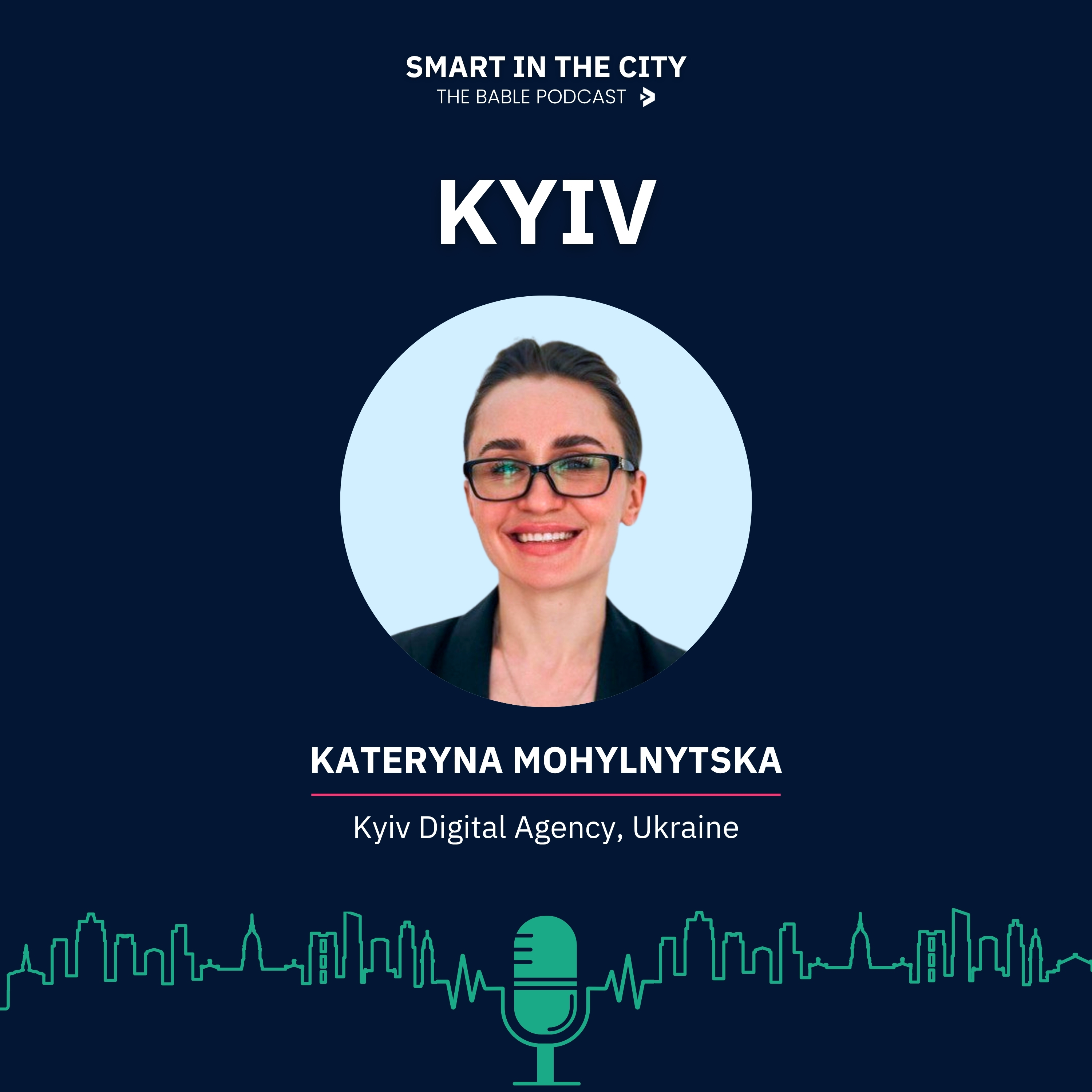
And today we're continuing the conversation. I'm really excited to have the next guest with me today. It's with a little bit of a different angle as well with looking at Mental Guard, which is a city level mental health initiative embedded within Kiev's public education system. So it's going to be a really interesting episode. Without further ado, I'd love to introduce you to none other than Katerina Mohelnica. She's the head of the mental health project and chief communications officer of the Kiev Digital Agency. Welcome, Katarina.
[00:01:51] Speaker A: Yeah, hello. Thanks for having me here.
[00:01:54] Speaker C: Yeah, absolutely. It's a really big pleasure. I'm very curious about this project myself, I have to say. So I'm really excited to dig in with you today.
I have to start us off to get us warmed up into the flow of things with a little bit of a teaser question. We asked Victorian Oleg actually in the past episodes to describe Kiev's journey with digital transformation in three emojis. And I'm wondering if you could describe Mental Guard with only three emojis.
[00:02:26] Speaker A: Yeah, it's a perfect question.
I think that the first emoji will be a brain because Mental Guard is fundamentally about emotional resilience, about mental health and helping children to understand their lives better. The second emoji will be a shield because I our project is about not only support but protection.
And I think that the third emoji will be a heart because Mental Guard is about care about people. First of all and it's one love.
[00:03:06] Speaker C: Ah, I really like that.
And we'll dig into that a little bit more shortly. I first want to ask you about you.
So tell us a little bit about yourself, your role. What led you into this role today?
[00:03:22] Speaker A: Well, I usually describe my work as sitting at the intersection of technology, of social impact and trust. Because I usually help create solutions that don't only digitize services, but their strength in communities.
So my background is in the strategic communications, in reputation management and digital transformation.
So just over the years, I've focused a lot on how cities become not only smart, but human centered. And I always believed that the real strength of any city is not technology alone, but people, especially children.
Because the way a society treats children today, it really defines what kind of future it will have tomorrow.
So what exactly brought me to mental guard was the understanding that mental health is becoming one of the dealing challenges of our generation.
We gave children a world that moves too fast and it's full of pressures, full of anxiety and uncertainty. So we still expect SEN to cope with all of these sins by their own. And in Ukraine, this pressure is even deeper because children are growing up during a war.
So for me, our project is not just a tech or education project. It's about something much bigger, about protecting emotional resilience, about humans, about the ability of children to grow up feeling safe and hurt.
[00:05:03] Speaker C: Really amazing.
I can, I can really reflect on the importance of these types of initiatives in cities across the board. But of course, especially in Ukraine right now, if you could first help us kind of set the seen before diving deeper into the initiative.
What are really the pressures that children, teachers, school communities are facing in Kiev today?
[00:05:28] Speaker A: Oh yeah. As we're still ongoing. So the children in Kiev are growing up with things that no child should ever have to normalize, like air raid alerts, like lessons in shelters, in interrupted sea sleeps, displacements. And indeed, the biggest problem is that children will not say, I am traumatized. They will show it in their own way. Through silence, through aggression, through loss of motivation, exhaustion. And their behavior is like their own language of pain. And our task is to hear this language timely.
Teachers carry these problems too, because they expected to teach, teach to calm, to support even parents. But they need to be strong themselves, often while being exhausted. They also humans. And first of all, we need to support them too. And really, school now is no longer a place of learning, because in Kiev, it has become a place where emotional safety is needed to be protected.
And really, it's not only about Ukraine, because globally, children are Also facing anxiety, digital pressure, living in a digital world, bullings growing disconnection.
But now here will made the crisis sharper because the deeper question is universal. How to build systems where children are noticed before they break down.
And this is really a key point of Mental Guard to bring support closer to children earlier than in their language. So in the mood that we can trust?
[00:07:23] Speaker C: Yeah, absolutely. What is really the gap that it's trying to address? So where do you think this is already handled within society and where does this gap lay? What was Mental Guard put in place to address?
[00:07:40] Speaker A: Yeah, well the gap was simple because schools usually received mental health support too late as help often came only after something serious has happened. So like bullying, self harms major crisis. But children start showing pain much earlier.
Sometimes it's silence, sometimes it's stop learning, stop talking. And the problem was that schools did not have one clear system to notice all the signals early and to act on them.
Teachers overloaded, psychologists don't have enough tools, parents sometimes don't know how to act bad and where to go. And everyone cared. But the system was fragmented and Mental Guard was created to change that because the idea was to help schools move from what to do to how to react.
And we know that for us this is a key shift, making support earlier, closer, more coordinated. Because timing here in mental health change everything.
[00:08:51] Speaker C: Yeah, Makes sense. I think that there's a gap in this in a lot of cities, in a lot of places. Right. That we really need to seriously address and look at a lot closer. So I'm glad we're bringing awareness.
So for the cities that are looking at this as a real issue for them, can you just explain exactly what it does in very simple terms?
[00:09:16] Speaker A: Yeah.
In simple words I can say that Mental Guide is like mental health support system.
It's not an app or it's not a team of psychologists. It's a whole ecosystem that helps city understand what is happening with children's emotional well being.
So our project has three main pillars. This is the early well being assessments, the rapid response groups and digital tools like self help tools or analytics dashboards.
First element is early detections. So schools can use mental state assessments and digital tools to notice emotional risks before they become crisis.
It's too important on the early stage.
The real human support is our trained psychologists who can respond when school faces a difficult situation or when child needs help in our realities. Also when some crisis cases happen.
Also the third element, big element is a coordination and data because we have lots of dashboards who help schools see where Support is needed most and to organize their resources better.
But the most important, I think is that technology does not replace people. It helps adults notice faster and respond earlier in order to support children better. Yeah.
[00:10:49] Speaker C: So it's almost like a citywide infrastructure, right? More than just a service or a one off project or how would you describe it?
[00:11:00] Speaker A: Well, you are right. It's a city level infrastructure because it connects a lot of parts that usually work separately.
Like it's not only a single platform or it's not only a small training. It brings all together and it really what it makes an infrastructure because a single service, it helps in one moment. But infrastructure changes how the whole system works.
And with Mental Guard, a school is not left alone after crisis because teachers have guidance, psychologists have needed tools and child has a safer way to ask for help.
For me, this is the most important because mental health becomes part of how the education system functions every day. Not something that appears only when something trouble has happened.
[00:11:57] Speaker C: Yeah, makes a lot of sense to think about it in this way as really infrastructure for the citizens as well. I think it makes it a lot more integrated across different systems.
Speaking about this, I am remembering the past episodes, right. That we had where we really spoke about trusted digital channels and city services.
How does Kiev Digital's experience experience really influenced the way Mental Guard is designed or communicated?
[00:12:26] Speaker A: Yeah, Mental Guard taught us something very important, that people ask for help only when they trust the system.
And trust is not created by technology. It really comes from how a service feels to people, whether they feel safe, where the old erosion is understandable and human.
So that is why Mental Guard was designed very carefully in terms of communication and user experience.
Because the language here is simple. We work with children. The interaction is soft, supportive. We don't put any diagnosis and don't give them bureaucratic issues. So children are not treated like cases. Yes. They are treated like people whose feelings really matter. And we understand that digital tools should reduce fear and do not create more pressure than we already have.
So participation here is really voluntary, privacy is protected and technology is used to help adults notice risks earlier. Yes. And to not to monitor children or control, but to support them.
And also another important lesson is that trusted digital services must always lead to a real human support. If a child reaches out, there must be a psychologist, a teacher or an adult who can timely respond. So for us, digital part is not the goal, Trust is a goal, and technology is simply like a bridge that helps people reach support fast and safely.
[00:14:14] Speaker C: Yeah, I want to hone in a little bit more on this trust and also privacy. Because yeah, mental health data is probably very, as we all know. Right. Is very sensitive data, especially with children's mental health data.
How do you really approach this from a privacy standpoint, from a trust standpoint, how do you really safeguard in this initiative?
[00:14:40] Speaker A: Yeah, this is probably one of the most important questions in projects like this.
Because when children share the emotional signals, they must be protected and they must feel protected. So from the very beginning Mental Guard was built around the principle of care before data.
We collect only the minimum information that needed to understand risks and to provide support.
Sensitive data is anonymized and analytics are viewed only in aggregated form.
We also very clear about the role of technology. We use AI, but it does not diagnose children. It doesn't make psychological decisions or replace professionals in its role is limited only to navigation, only to providing support tools and early awareness.
But the important things here is that we design the system together with psychologists, with educators and in co creation with children themselves. Because it's really important to know what they want. Exactly. And we constantly asked, does this feel safe? Does this feel understandable? Because safeguarding is not only technical protection. Yes, it's also emotional trust.
And maybe the key principle is that Mental Guard is not built to monitor children. It's built to notice all the risks and understand when a child may need this support.
[00:16:19] Speaker C: Yeah, makes sense.
So really what I'm hearing is it's also.
It's really about prevention. Like early signals, prevention, regular support. Not just being reactive right when a crisis hits or reactive when someone is in bad mental health shape. So how, how can you design a system like Mental Guard that really acts earlier on to detect the early signals and really work towards prevention, not reaction.
[00:16:51] Speaker A: Yeah, you are right that really most systems wait for crisis to become visible and a child stops attending schools. There is some violence, panic and only Zen does support baking. But we try really to act preventive and try to move much earlier.
In our case the idea is simple, that the emotional crisis do not appear suddenly. And the children usually give some small signals or maybe some loss of concentration, some emotional numbness, anxiety that we need to catch. And these signals really I often missed because schools are overloaded. Some support systems fragmented. And our model created focused on early awareness in test assessments and in continuous support. So. So in order not to react in emergent way through these well being screenings, digital self check tools, we notice patterns or some triggers that are on the early stages in order to respond before situations escalate. We also had like a case when we started a pilot of our project, we tried this assessment and found out three critical profiles of children who were really close to some suicidal risks and in order to this case helped us to overwork them and to timely react in order to prevent this crisis. So really such assessments are needed at the early stages and at the same time psychologists, teachers, parents, they are more connected around the child instead of acting separately. I think this is very important when prevention is not only about avoiding crisis, it's about creating such an environment where children feel seen and emotionally safe on a regular basis.
[00:19:04] Speaker C: Yeah, makes, makes a lot of sense. Sense. I'm also thinking about really how do you measure success?
Right. With an initiative like that. Are you looking at access, response time, trust, well being indicator, school readiness?
Yeah. How are you measuring success in this project?
[00:19:25] Speaker A: Yeah, success for mental guard.
I think it's not about numbers, it's about lives, lives saved, lives cared. And also numbers matter too because today the system supports more than 900,000 people across 420 schools.
We have 300,000 students and it's a big number to care and to take into account. More than 250 people have received direct psychological assistance now after some crisis cases.
And we have lots of them after missile attacks, after loss. So in fact a great big job. But the deep indicators I think they about trust and culture.
For example, from the last numbers, the participation in well being screenings increased from 32 to 48%.
And for us this means that people are becoming less afraid to engage with mental health support. And support is starting to make a visible difference. Really success is also when schools stop seeing emotional well being as someone else problems, when everyone know how to react, when psychologists are better connected and when city leaders can see risks before they escalate. So I think this is the kind of long term change we are trying to build.
[00:21:06] Speaker C: Yeah, indicators where you can really see the trust building I think are especially quite interesting and good to track.
I think there are probably some cities listening that are quite intrigued by this, that want to maybe implement something similar in their cities.
What would you tell them to do first? What's kind of the first thing that they should. What's the first step?
[00:21:33] Speaker A: I think that I would probably tell them start with people not with technology because you can build platforms very quickly now in our digital era, but building a system that children, parents, teachers, ecologists, actually trust is much harder. So the first step is really listening talk to schools, to children themselves in as well as in co creation with them and to understand what fear, word stigma, overlord, look like inside the education system.
The second point, I think is to treat mental health not as an isolated service, but as a part of city infrastructure, because schools cannot solve this alone. You really need coordination between educators, between psychologists, municipalities and digital companies to help and then build uppers and gradually start with one real problem, or maybe with early detection, maybe with crisis response, and create something practical that schools can usually use in everyday life.
And really, as I also think that do not wait for a perfect moment, because mental health challenges among children are growing everywhere now. And the earlier cities begin building these preventive support systems, the more lives they can protect later.
[00:23:07] Speaker C: Yeah, really good advice, I think, for any of the cities listening.
What do you think is the next big challenge from Mental Guard or future similar initiatives? What do you really need to accelerate more success within the initiative?
[00:23:23] Speaker A: I think that one of the biggest challenges is scaling, because the need is growing very fast. And as I said, more children are showing signs of anxiety, of trauma, and most schools understand that they need support, but the number of professionals and resources is still limited.
So the next step for Mental Guard is to scale, but without losing quality, without losing trust and humanity. And to accelerate this transition, I think we need, first is more trained psychologists, more trained professionals in order to better support children.
And second is a stronger partnerships with municipalities, with NGOs, with technology partners, international organizations, because without partners, it's difficult to scale.
And also mental health cannot be solved by one institution alone. So we need continuing investments in responsible digital tools, in screenings, in dashboards, in support channels, so the system can detect all the risks early and act faster.
[00:24:45] Speaker C: Yeah, absolutely. I think always the challenge is going to be scaling these type of initiatives, right? And having the right setup, the right partnerships on board to really operate at a larger scale, scale and create more impact. So, but I, I see a lot of potential as well.
So I hope that you can find, find those, those triggers to be able to scale it wider because it sounds like it has a lot of meaningful impact.
So we also, speaking of like partnerships and other stakeholders, right?
We also have, we've been speaking from a city perspective for most of this time. Like, what can cities do? We also have other types of organizations, right? We have companies, solution providers in our audience.
Some of them may be working on digital mental health education, crisis response, safeguarding tools, that kind of thing. So what would be your advice to international or local companies that would like to contribute to or collaborate with an initiative like Mental Guard?
[00:25:48] Speaker A: I would say that if you want to work in this space, start, start by understanding that Mental Health is not just technology market, it's a great responsibility.
Cities do not simply need more apps, they need solutions that are trusted, that are scalable and that are useful in real life, in schools, with children, with teachers and during moments of crisis. So for companies the biggest value is not only to be bring innovation, but to be able to integrate it into wider ecosystem. And technology should help adults notice earlier and support better in order not to replace human judgment. And at Mental Health project, at our Mental Guard we are open to partnerships with organizations that can strengthen accessibility, analytics, digital well being tools or safe support channels. As we believe that this kind of challenge can only be solved through cooperation between cities, between educators and responsible technology partners.
And I think that's not only about Kyiv, because other cities facing stress or pressures, they also could use the experience we are building here.
Mental Guard can become like a small model that is adapted, shared, scaled as children everywhere need systems that notice them before they break.
So like in short, my message to companies is simple. So come not only with a product, but with responsibility and willingness to co create.
This is where real impact begins. Yeah, yeah.
[00:27:41] Speaker C: A good message for all companies and all sectors as well.
[00:27:44] Speaker A: Right.
[00:27:44] Speaker C: I see that across the board that, that this is needed in, in the. In the sector as well. So I know we touched on a lot about Mental Card and everything, but I also like to give you a little bit of an opportunity if you'd like to take it. If you feel like we missed any important point, I'd like to give you an open flow floor if you think that there's any message for the listeners that they should really know about.
[00:28:11] Speaker A: I think that all the most important things we've already touched. But as a perfect message that children should not have to be resilient because adults failed to build systems that protect them.
Childs pains are often quiet and it does not always look like a crisis or something big. But sometimes all these silences and tired eyes.
A child who simply stops believing they can be heard.
This is an important sign to start look inside all the situations to deepen and to find where this crisis is.
So Mental Guard is our attempt to say we see you earlier, we come closer and we do not wait until pain is a tragedy. So really care should not be accidental, so it should be a part of the system.
And I think it's the most important message.
[00:29:23] Speaker C: Yeah, really good message.
With that I want to take us into our segment for today. I think a lot of what you've already said has been quite inspirational, I think for our listeners. But I Do want to bring us into our segment which is called Inspire us.
[00:29:41] Speaker B: Inspire us just a little bit with a story, a quote or anything that has inspired, inspired you recently.
[00:29:54] Speaker A: Something that inspired me, I think it was a boy.
Did like a story of grief in fact because there was also a missile attacked and there was a boy who was treated and the his only words on a video were do not support me. Help to my father who was bleeding and he understood that he should support his like closest and then himself. That was a boy of 12 years. But I think it's a great example of self esteem, of understanding how to support the other.
[00:30:47] Speaker C: Yeah, just let that sit a little bit as well.
Now we come to our recurring question that I ask every single guest and that is to you, what is a Smart City?
[00:31:02] Speaker A: I think that Smart City, it's not a city with just technology. It's a city that uses technology in order to become more human.
Because it's important to notice people's needs and to respond fast.
I think Smart City is a city that does not forget why technology exists in the first place.
Because technology is needed to protect life, to protect trust and connection. And for me truly Smart City is one where data helps make better decisions but emphasis still guides those decisions. So it's not only digital, but really caring, responsive and resilient.
[00:31:51] Speaker C: I love your answer. Using technology to become for the city to become more human. I haven't heard that one before. I don't think I've heard a lot of responses. So I, I really, I really, really love the way that you put this all into perspective also for us, really bringing it back to the human nature.
And of course at the beginning of, you know, of the episode in my in intro I always say that we talk about the themes that are most prevalent for today's citizens and tomorrow's generations. And I think this topic hit the nail on the head there on really an important topic to address. So thank you so much for, for your time to talk to me about this.
[00:32:30] Speaker A: It made me think a lot.
[00:32:32] Speaker C: I know it will be also very impactful for our listeners.
So thank you so much for coming on today.
[00:32:37] Speaker A: Katarina, thanks for having me here and thanks for your great work.
[00:32:42] Speaker C: Yeah, absolutely, anytime. Welcome back on and of course thank you to all of our listeners. Don't forget you can always create a free account on Baba Dash, SmartCities EU and you can find out more about different use cases, stories, implementations and more. Thank you very much.
[00:33:00] Speaker B: Thank you all for listening. I'll see you at the next stop on the journey to a better urban life.