Episode Transcript
[00:00:00] Speaker A: Foreign.
[00:00:07] Speaker B: The City the Baba Podcast where we bring together top actors in the Smart City arena, sparking dialogues and interactions around the stakeholders and themes most prevalent for today's citizens and tomorrow's generations.
I am your host Tamlyn Shimizu and I hope you will enjoy this episode and gain knowledge and connections to accelerate the change for a better urban life.
Smart in the City is brought to you by BABLE Smart Cities. We enable processes from research and strategy development to co creation and implementation. To learn more about us, please visit the BABLE platform@babel smartcities.eu
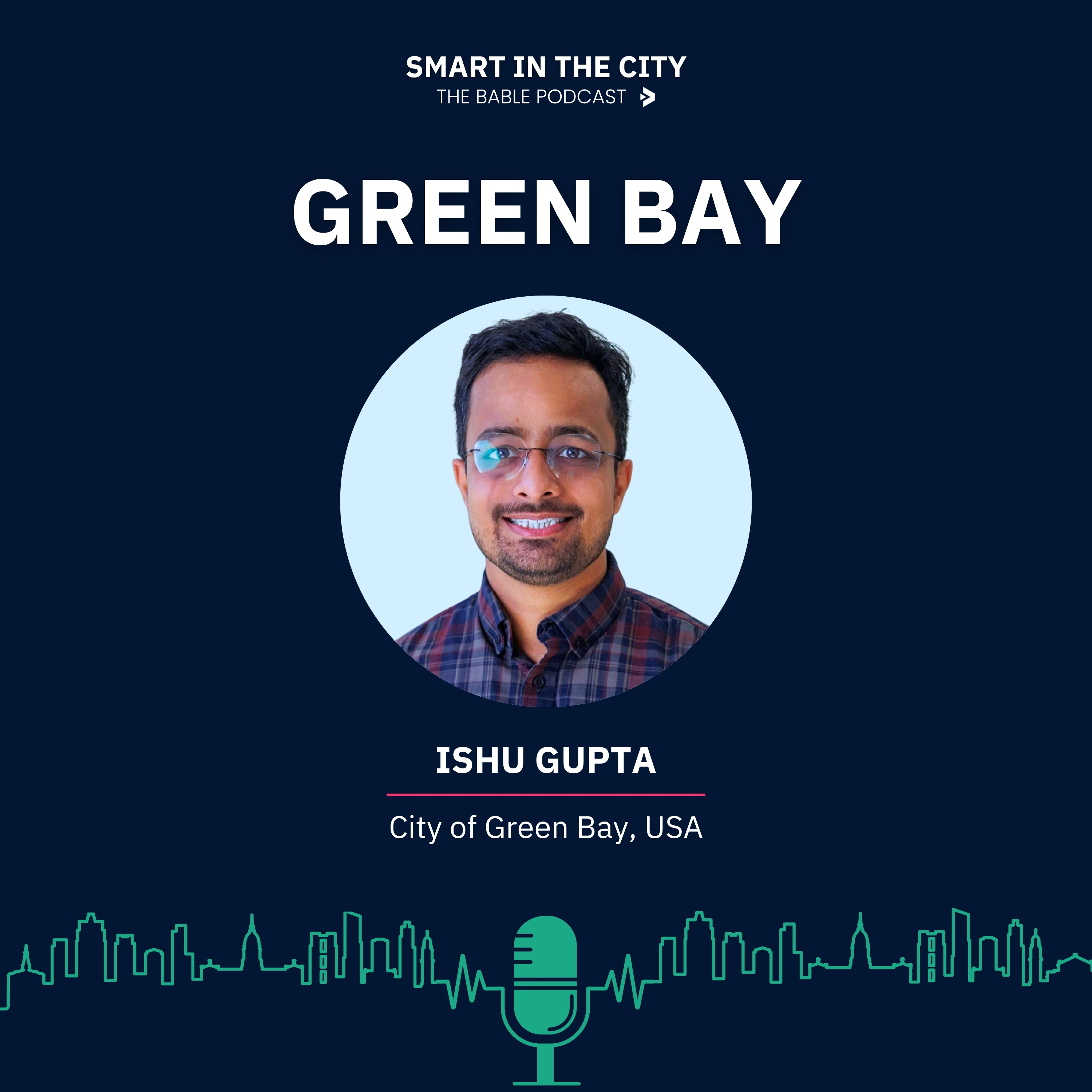
[00:00:46] Speaker A: so welcome back to another episode everyone of Smart in the City. Of course, today we are crossing the Atlantic again and heading to Green Bay, Wisconsin to talk about how a city builds a more intentional innovation culture from the inside out. So with me today I have the pleasure of welcoming our guest, Ishu Gupta. He's the lead of Innovation and data strategy for the City of Green Bay, Wisconsin in the US and also a Bloomberg Harvard City hall fellow. Welcome Ishu.
[00:01:16] Speaker C: Thanks Tamilin and yeah, good to be here. Welcome to Green Bay.
[00:01:20] Speaker A: Yeah, I hope to also be there in person sometime. I'm really happy to have you and I'm excited to do dig into a lot more of what you're doing.
When I had the first conversation with you, I knew you would be a good podcast guest because you're doing really interesting things. I like to get us started with a little bit of a warm up to. To get us started, get us into the swing of things. The warm up and teaser I have for you today is. Green Bay is well known for the packers, but if you had to describe the city beyond football within the three emojis, what would the emojis be?
[00:01:53] Speaker C: I'll use an emoji of, I would say a river, trees and bikes.
[00:02:04] Speaker A: Okay. Very nature. Nature forward. Why did you choose those ones? Why did you choose those ones?
[00:02:10] Speaker C: We have a Fox River Trail, which is a 40 mile long trail where people love to walk and which is basically around the Fox river. And.
And we love the nature. We are surrounded by nature. We have got some very interesting parks and we really care about the way we handle nature around us.
And we are also surrounded by the Great Lakes, so it's like part of the culture.
[00:02:37] Speaker A: Yeah, sounds really nice.
[00:02:38] Speaker C: And maybe I will also use the beer mugs as an emoji because we have very good local breweries thanks to our German sort of influence on our culture. So yeah.
[00:02:51] Speaker A: Okay, well I'll have to be the judge of that sometime.
So before we dig, also into a little bit of the broader work. I would love to get to know you as a person a bit more.
Can you tell me a little bit more about your background? What is the journey that led you into your position today?
Yeah, tell me. Tell me it all.
[00:03:15] Speaker C: Sure. So I grew up in a. In a small town in northern India called Aligarh and largely brought up there. Is there only. And after like 10th grade, I left my home to prepare for competitive exams. India is like super competitive culture around, especially around engineering entrance colleges. So I was like preparing for my engineering exams. And that is where like when I left my city and got into a different city for preparation, I actually got to learn more about like the kind of diversity because I met students from all around India and that is. And I was fascinated by the journeys and the kind of effect this competitive culture wore on each one of us. And that literally changed how I saw the world.
Got into the engineering college and as soon as I got in, I started a small nonprofit to basically create reflective spaces where students could step out of the race and explore what actually interested them.
And that work actually got me exposed to the social and political equations surrounding us so I could break the BABLE and literally engage with the surrounding political equations and social equations. And also on that journey, I found mentors who gave me freedom to fail, which really helped me in terms of nurturing myself, nurturing my interest, which was to basically reimagine the education system and what is it that we can do differently about how we see this overall thing.
Got into organizing around Right to Education. So India has a free and compulsory Right to Education act, which basically mandates every child between the age of 6 to 14 to have access to free and compulsory education.
So I started sort of. And it was the timeline around like which. Around which that act came into place. And when I was into my engineering college was like very, I would say parallel. So that excited me and I started working on it.
So I was organizing like a public fair.
And there was a parent who was struggling to get access to that fair, write for his child. And he asked me, who will listen to us?
And I think that was the question. I didn't have an answer. And it got me to be more sort of to more to sort of, I would say, like to engage more inquisitively and cogently with people and understanding who actually listens to them in the governance systems.
So after my engineering got completed, I started a private tech job.
And that question was still sort of alive in me. And I left that job to basically choose public policy as my career and found mentors to work with. And then local governance came as an answer to it in terms of like, how proximate they are to people.
And the city elected representatives actually belong to the people they are representing in, like, they're very close to it. They're part of the community. So it felt like the obvious answer in terms of saying that how do we nurture local governments which are more responsive, which are deeply engaging and can put people at the center?
So yeah, that is where. That is also what brought me to the Kennedy School where I did my master's in public policy.
And then Bloomberg center for Cities at Harvard Kennedy School gave me the opportunity to learn more about, like, innovation, urban innovation, innovation, people centered governance, and also brought me to Green Bay through their Bloomberg Harvard City Hall Fellowship, which is an ideal place for me because I get a core challenge, a real challenge to deal with. I get autonomy in terms of how I would like to devise the solution or how I would like to frame the problem through conversations. And also gives me the chance to create real impact, which is in ways to test out whatever I have learned in policy school. So I think that is like my journey in a nutshell in terms of like building through to sort of focus on local governments, especially working with city elected representatives.
[00:07:49] Speaker A: Amazing. Really interesting journey. So thanks so much for sharing that.
Now I want to start getting into a bit of the things that you're working on in the city.
You painted us a bit of a picture of the city, but what do you think makes it unique and what should people understand about the local context before we talk about innovation?
[00:08:09] Speaker C: Yeah, I think like, as you mentioned earlier, like most people understand and know Green Bay through football and we are like home of the packers and that's globally iconic.
But Greenway is like a, like a working city with a deep civic memory, I would say because it's a port city, a manufacturing city, we are a paper and a food packaging hub. In fact, like, a fun fact is that we produce about 20% of the world's toilet paper.
And it's also like a neighborhood city. And I think connections matter a lot here.
We are shaped by the history of immigrants and immigration and an ongoing relationship with our indigenous population and Oneida nation. So beer is like part of our social fabric.
It is like local breweries are like, super fun. And I would also say that this is a place which has had its history in urban skepticism. So you can't just like come in with a flashy idea. I would say you have to have to understand the relationships, you have to respect the history. You have to like, really show and like, how innovation can actually help improve people's lives.
So. So the flashy ideas won't work in this city because of that urban skepticism, I would say so I think that is something which is very unique and makes this work of innovation really meaningful in the city of Green Bay.
[00:09:40] Speaker A: Are you also an urban skeptic?
[00:09:42] Speaker C: Depends.
Depends. Because sometimes. Because, yeah, I mean, like, especially like when it comes to like parachuting ideas and copy pasting, I really don't like, sort of enjoy that kind of. Because I feel like there's a character to every place. There's a context in which people have shaped these cities. So there is a lot to be preserved in terms of what we have, and there's a lot to be let go of. And I feel like I will not call it like a skeptic, but I will call myself someone who's like a urban possibilist.
[00:10:15] Speaker A: Maybe that's good. Urban possibilist. I haven't heard that one before, but I might use it again.
[00:10:23] Speaker C: It's not my words. I think I was reading something, but I'm missing something.
[00:10:28] Speaker A: We're quoting someone, right?
[00:10:30] Speaker B: Always.
[00:10:34] Speaker A: So you described your work before to me, kind of sitting at the intersection of change management technology, data.
What does that really look like in your day to day?
[00:10:44] Speaker C: Yeah. So I will give you a little bit of context in terms of when I came into the study of Green Bay, the challenge I was given was to build a citywide performance management system.
Right. Which definitely needs a lot more structured data to sort of come up with and a lot more thinking in terms of what is it that we would like to measure and what is it that our priority is. And so it needs like, horizontal and vertical communication channels as well as structured data which flows across the organization.
And I think the answer to your question honestly lies in, like, how I think of data itself, because I think of data as like, something which is as foundational, as, like, roads or water pipes. I would say because good data is what lets Citi think clearly and do its actual job.
So. And be it like anything, like, it could be evacuation, it could be service delivery, it could be maybe like, how do we allocate resources fairly to, like, different programs? And I feel like all of that is like very.
Data is very fundamental to all of those services and thinking processes.
And the layer, I would say, like, underneath this infrastructure is what generally sort of gets missed out, that it will not work on Its own. We will have to like rethink the workflows around it. We will have to manage the structures. We will have to have management structures which will actually make that workflow work. And also like, how do we invest in our workforce so that they can handle the overall infrastructure? So, and that is where the change management work comes in, which is basically like the larger chunk of the work. So these three circles don't look like equal, because the change management work is the fundamental work. Because you need to like build capacity of people. You have to bring everyone on the table. You have to make people rethink in terms of how they're doing things and learn more about how they do their regular jobs, how do they work?
So it is literally about like one on one conversations, learning about people's work, learning about the context they come from and how is it that they see this innovation helping them or not helping them, so that you can bring actually that feedback into what you are thinking of as like a solution and make them part of the solution itself.
So I feel like data helps inform in terms of saying, how are we working? What is it that needs to be collected? What is it that actually matters? And also get the organization to look inwards.
So my job, when I'm saying data is also about like, how can I use the information that we collect to learn which can help us look inward and not just upward or outward.
So and technology is literally like the last 10% of it, I would say, because once we have people and processes figured out, then it gets easier to figure out what the technology is which should be layered with in these two processes so that it can help people make better decisions and instead of replacing them. And that is also like the buzzword around AI, as we are talking more about AI now.
So I feel like when you have these people in processes and understand the important role they play in sort of overall functioning, then it becomes about amplifying what they do and amplifying their capacity to sort of make decisions as compared to saying that okay, now technology can actually replace them. And I think more and more we do it, we realize that technology can only do some parts of it. But people and processes are going to sort of stay and technology will only work when these two things are kind of sorted. So when you look at my day, most of it is like engaging with the staff members, learning about the systems understanding, taking notes, questioning my own assumptions around like how things happen.
So I feel like. And data also helps in terms of questioning or maybe like taking into those meetings to Help people question their own assumptions.
So I feel like this is like both ways that. And that is how it works. Yeah.
[00:15:03] Speaker A: So is that what. Because you mentioned to me before that you've made significant progress over the last two years in how data is organized and governed. Do you think that that's the main component, the questioning of the assumptions, or has other things changed internally that has really made this progress possible?
[00:15:22] Speaker C: I think like when I'm saying progress, what I mean is like how we have built structures around like sustaining this progress and also realizing how data can be built as civic infrastructure. For example, like we have, it's the first time that the city has built, let's say, a data inventory, which has data, like information on all data sets which exist across the departments in the city hall and people have visibility around it and they can actually know like what exists in other departments and what is it that they can borrow from when they are making certain decisions. So they can actually go into that inventory and have access to it.
We also came up with a three year data strategy plan in terms of laying out the values that the city stands for and how is it that they would like to use tech and data as we build this infrastructure around, let's say digital transformation, managing and using data, building a performance management system. So I feel like all of that has come together. We also, in this process, the data governance team and our data stewards have put together a list of key performance indicators and we have listed about like 200 indicators across the city now, which the city would be tracking on a yearly basis to understand in terms of how we are doing on our strategic goals.
And that is also like the part of the work which I was referring to earlier in terms of like convening this meeting and keeping the table always like full and alive. Because we need to sort of deliberate in terms of what the priorities are. How do we sort of measure those priorities? How does it look like in terms of when that work goes into, like goes to our frontline staff, our mid level management, our senior management. In terms of saying that, how do we make sure that actually it flows into the system and it's not like one person's KPI, but also, but actually tells about how we are performing, how we are delivering, how we are listening to our residents.
And this is like the work of co creation as well, because we need to break down those silos, we need to help people understand each other's work. We need to bring and bring an alignment across different management hierarchies, across offices, across departments, and people have their own sort of understanding of what the work is. So it feels like when I'm saying progress, I mean like what the structures we have created.
[00:17:56] Speaker A: One thing when we were talking earlier was really around that you want to more carefully address what is the actual problem before jumping to see solutions.
And I thought that was quite interesting also because I have that personal tendency to like immediately jump to solutions before actually looking at what the problem is.
What. Why is this a big cultural shift in local government from your perspective?
[00:18:27] Speaker C: Because I think in local governments like we are largely like lean structures and Greenway specifically has like a very lean executive structure. And, and I think the deck is stacked towards solutions always and not because anyone is doing wrong. Because these are structural things. People are naturally inclined for solutions and without thinking about what the problem is and what is it that needs to be solved to really get to I would say like the both parts of the problem which need the adaptive solutions and which need technical solutions. And I don't see them as honestly separately. I feel like the process of change has both parts to it. And I feel like it becomes very important to get people in room and get them to think about what is it that they are articulating as problem and why do they think that it is a problem. Right. And is it like something which they have spoken to or spoken about to anyone who else is who, like who, who is also part of the process or is it just something that they think from the part of the, the process that they do that it is the problem. And I feel like this is a very natural inclination that as. And especially like when someone like me walks into any room, they naturally think of like, I will come up with a solution and they will articulate a problem. And it is always get into a room and ask more questions, be more curious and help people think of the counterfactuals, help people think of the things they are assuming and also in the process open up to like for them to question my assumptions in terms of how I am thinking of the problem and what is it that I am bringing to the table. And I feel like this process requires a lot of work because it's like holding people back from their natural instinct.
Right? And it needs like tough conversations sometimes. It needs like tough questioning sometimes people might think that you are not like trusting them or you're not listening to them and it meets that kind of resistance also sometimes in terms of like, but like what you are talking about, like this problem, that problem, but this is the problem. Like, but no how do you think that this is a problem? And for example. I'll give you an example. We were evaluating our fleet management and the idea was to create a resource pool.
And as I started, I got some data from a risk team. I got some data from our fleet managers and supervisors, and I was bringing the data together. I could see some discrepancies. I started talking to our fleet managers, our technicians, our supervisors, our department heads. And just to understand in terms of what the process looks like, right? In that process, I figured that there are eight different softwares in four different departments which are being used to maintain the same data, right? Because everyone thinks that there is some different problem that they are trying to solve, but everyone is actually leading to the same sort of problem. And they think, like, technology will come in and fix.
And now when you enter into that room and you ask the questions, like very simple ones, saying that, okay, you got this technology, but it is not actually helping you, let's say record your data better or report your data better or even like, bring your own request to the department or the senior leadership the way it should be, since you already have this tool. And more often than not, the answer would be that, oh, but in the sales pitch the vendor promised us, but it actually doesn't work.
And they have a separate Excel sheet which is working in parallel of that tool, which is actually solving or which is actually the tool they're using. It is not the software. They just like, they build that Excel sheet and then copy paste the data because now they have the tool which they have to fill in. It is part of the process.
So it is very important to like. And it was largely similar across different teams. And let's say someone comes from like a different organization or a company they were working for before and they were using a particular tool, they are familiar with it, they will come, they will basically push the city or the team to sort of purchase that tool and have that for their own sort of teams management now. And that becomes. And now every fleet, every department has their own IDs, every fleet identity has their own IDs. And it kind of like.
And that kind of was very revealing to me in terms of why do we need to define the problems first and as we think of solutions, also thinking what the solution should change and what will it change so that we can measure in terms of the baseline from like, where we are. Yeah, sorry, it got a little longer.
[00:24:05] Speaker A: That's okay.
I want to also touch on another aspect that you mentioned to me before, which is around data Informed community engagement, particularly around public safety.
Can you walk us through a little bit on what that process really looks like, from going into a neighborhood to collecting data, designing an intervention.
[00:24:28] Speaker C: Yeah, so this is our neighborhood initiative where we, like, intervene in one neighborhood Based on our 911 calls data and our request for service data. So we select one neighborhood every year, and then we go and knock on every possible door in that neighborhood to understand how people in that neighborhood perceive public safety. And what is it that, like, that they think that will help improve the overall public safety in that region.
And that has, like, I would say, three pro, three sort of sides to it, People, policy, and the physical environment.
So people is like, we engage neighborhood associations, we engage businesses, we engage residents, and then try to survey as many possible people to sort of learn in terms of public safety. And then based on the feedback that we receive, we design the intervention in terms of saying that what is it that needs to be done in that neighborhood? What are people thinking? And also the kind of, like, intervention or improvement in, let's say, like, road safety, their parks, their playgrounds, their, like, any kind of physical environment they would like to sort of see changed.
And then third is the physical environment where we will, like, get people involved into, like, let's say, planting more trees, improving the parks, improving accessibility to sort of common spaces, public spaces, improving the patrolling, if the need be, and then also, like, making sure that the roads are properly signed. So all these things, like, come up in terms of how people are thinking about public safety. And we have had, like, significant, I would say, progress made in, like, the intervention we did last year in one of our Western Avenue neighborhoods. We saw, like, a. Like a decrease of about 71% in the next six months after the intervention was completed in drug violations, and overall reduce of about 22.2% as compared to other neighborhoods in this particular neighborhood and, like, overall crimes. So I feel like when you bring people on the table, you actually learn about the solution, which are rather simple than the complex thinking we have when we are away from the site and people. So, yeah, I think data informed community engagement is largely like collecting primary data, taking the feedback, designing the intervention around feedback, and then working on policy and physical environment to improve the overall public safety in the neighborhood.
[00:27:08] Speaker A: Yeah, yeah, makes a lot of sense, and it's an interesting approach. Also I've seen in other cities as well.
I want to also talk a little bit more about procurement.
Procurement is a challenge that many cities have, and one of the internal challenges, of course, Green Bay also wants to Streamline comes with. Yeah, it's multifaceted, of course, and a lot of studies can learn from each other on different small improvements as well that each other have made.
So from your perspective, your insight into how Green Bay is doing it, what really needs to change?
[00:27:45] Speaker C: Yeah, So I think procurement is a giant sort of subject to sort of handle. And it is complicated. It has sometimes emotions attached to it, attached to it. It also has people eagerly waiting for things to be procured. And I think that is like, all these things are important to this process, and that makes it even more challenging.
So one thing, like City of Green Bay has done that we have now formed like a working group which has representation from Law, Finance, Procurement and Department of Public Works and the mayor's office to basically think about in terms of what is it that we should be picking. So we are like, improving procurement, like, I would say, piece by piece. The first is like improving the overall transparency in terms of, like, who the vendors are, how is it that they're doing, and what are the metrics that we follow. We are also working on building a measurement system of, like, performances of each of our procurement now.
And I think, like, one thing which we have realized over time in procurement is that how do we go beyond compliance and how do we sort of.
Right, because, like, largely like what. What we. What has measured so far is like around compliance, like, which is around in time on budget.
Right. But if it is. But nobody questions if it. The procurement is actually working for the. For the sort of things that we procured it for or not. So I think it is very important to build a system around it.
And some of it might also be very limited to technology procurement because that is where I kind of participate a lot more than other kind of procurements. So we have formed a tech governance group which is basically that whenever there is a technology which is being procured by any sort of department, our IT department are the Mayor's office innovation department.
And all of the departments, at least like, the people who work on technology in different departments should be in one room when that demo is happening so that they can like, raise pertinent questions. They can also see like if that technology can be scaled to different sort of departments and if it is something which is relevant for the city and can, like, so all those questions can come come in one place so that we can start thinking about it. So we have built like a, like a checkbox list. We have built a tech governance group. We have built a process where, like, how do we engage with the vendors and also like a KPI associated with each tech sort of procurement so that we can keep measuring in terms of what we aimed when we started or when we sort of procured something. And, and where are we in terms of like one or two years down the line in terms of like how the, how if it is actually helping us solve something that we aim to solve.
[00:30:44] Speaker A: Yeah, absolutely. I actually love this topic. Procurement is something that we talk about in some degree, but we have not fully recognized the full potential of it to be really a tool that we can use. I mean, municipalities have massive purchasing power. They can influence, you know, economic inclusion, they can influence climate. That can influence so many things with procurement that we're really not tapping into this, into this as its full potential. So I, I like, I, I like your perspective though. And also I think we can even take it a step further right in the conversation on, on really the, the impact that it can have in many municipalities.
[00:31:24] Speaker C: So yeah, I think it can, this can generally change in terms of how you, how you see solutions, right?
[00:31:31] Speaker A: Yeah.
[00:31:31] Speaker C: And it can change the approach in terms of how people deliberate on solutions and problems. And I feel like it helps in terms of, in general like people talking to each other that how problems are interwoven within departments. So I feel like the process should be like the, should be the place where everyone can come together and like question each other.
[00:31:57] Speaker A: Yeah, that's usually not the case. It's usually. That's just the administrative part. Right. Kind of thing.
[00:32:04] Speaker C: Yeah. And I think like everyone who's part, who's going to follow should be like part of the process at some stage.
[00:32:10] Speaker A: Yeah, yeah.
I think in our first conversation we mentioned, you mentioned that you were tired of talking about AI. So naturally I have a question about AI.
No, but I know there's a lot of hype, there's a lot of discussion around it.
And I think what separates the conversation that we can have about AI today is really an AI buzzword type conversation or what does this actually mean in reality for local government on the ground?
So what does that mean to you when we mention AI?
How should municipalities start reframing this in the conversation? How do you see this topic?
[00:32:51] Speaker C: Yeah, and I think, like, to put it simply, I would say like a buzzword conversation like treats AI as something you buy.
And the kind of conversations at least I like to have is when the conversation actually treats it as something that changes how the organization actually works.
And I mean, for example, like a vendor has a product, the product has AI on the box and conversations is like about features and price. Nobody asks what the problem it solves, who will own it, and what it will actually change. For the person who is doing the work, is it going to help him make better decisions or her make better decisions, or is it going to amplify the work that person does? Or is it something which is promising to just replace that work? And I don't think replacement is very easy. So for me, conversation is about.
And I will go to what Stephen Goldsmith from the Kennedy School actually calls accountable discretion.
And I feel like that is where the real conversation should happen in terms of, are we enabling people to make and take decisions? Are we.
Are we using this technology to empower people who are doing the work, have some more time to think of the futuristic problems and build that space where they can actually plan for the future and take some time out from their regular works? Is it helping them reduce the repetitive work they do on the daily basis?
So I feel like, for me, that is something which is useful. AI right now, everything that is being promised or being called a solution is what I feel that that BABLE will burst very soon and people will start asking relevant questions and will start evaluating from the kind of energy it takes, the kind of, I would say, like, the overall return on investment. I'm not saying investment just from the financial purposes, but from, like, a more holistic purposes of the kind of natural resources it needs, the kind of space that it needs. And I will say, like, we will have to account for all of that when we start evaluating AI, especially from, like, the utility perspective for organizations and especially, like, public sector organizations, because the question is not in terms of how efficiently we do it, but also, like, we will have to think of people's centeredness or human centeredness as an essential part of the process, not just from, like, the output perspective, but also from the input perspective.
[00:35:52] Speaker A: So, yeah, absolutely.
[00:35:54] Speaker C: Yeah.
[00:35:55] Speaker A: I was wondering if you could basically unlock one thing that would help Green Bay accelerate meaningful innovation over the next year.
What would you pinpoint as being that thing?
[00:36:11] Speaker C: Oh, that's a tough one because I mean, and also, like, this is the kind of question where if I say, like, budget or like people, then I will defeat whatever I've said so far.
So I would say, like, one thing that I would like Green Bay to have in the next one year would be, like, protected capacity to do this work, because innovation needs, like, protected space where people can come together, reflect.
And I see, like, a dedicated innovation team inside the city. That outlay that outlasts any one person, including me, would Be my wish.
[00:36:58] Speaker A: Yeah, yeah, absolutely. I think that would make a big impact to have that cross cutting function and team. Right?
[00:37:07] Speaker C: Yeah.
[00:37:08] Speaker A: So I know we've touched on a lot of points we didn't get to everything and there's a lot more to discuss. But I would like to give you a little bit of an open floor in case you think that there's any specific point that's important for listeners to know and understand about Green Bay City innovation, the future of data driven governance, any of those topic that we touched on, Is there anything that you'd like to mention to the listeners that we didn't yet get the chance to talk about?
[00:37:32] Speaker C: Yes, I think like one thing which I have realized over the last two years working with the mayor of Green Bay, his name is Eric Kenrick.
Is that like the role of leadership in terms of unlocking innovation and potential? Because I mean the kind of person he is, like, he's very open to like conversations.
He is very like humble in his approach. He is, he's someone who holds like this powerful office, like very gently, I would say, and that kind of just like help people experiment a little more. And he, and I think his role as like leader in the city has helped people experiment and like be more open in their conversations. He's very open to like difficult conversations, I would say. So that has been honestly super critical. He is also at the same time very decisive in terms of what needs to be done. Needs to be done.
And I think this combination is very important.
Of course, technocrats are important in terms of moving this work. But I feel like the role of leadership also needs to be discussed a lot in terms of how, I mean, he's someone who will just go to an AI system and start like vibe coding. He will experiment with like new ideas. He will think about in terms of what is happening in different cities and he will bring those ideas, he'll keep surfacing those ideas in terms of what's possible.
[00:39:02] Speaker A: Yeah, strong leadership allows those to experiment. I like that a lot.
Now I would love to move us to our segment that we have for you. The one that I've chosen for you today is called Inspire us.
[00:39:18] Speaker B: Inspire Us just a little bit with a story, a quote, or anything that has inspired you recently.
[00:39:30] Speaker C: I think there are two things.
One was actually like when I came here after a few months, Mayor and I were discussing something and he said something which has like actually stayed with me for a very long time. He said, embrace the mess.
So which I feel like has like really helped me in terms of embrace parts of the process, which I don't like at all. And also, like, it has helped me, like, look through things much better.
And the other one is a quote from Beth Simon Novick, and she in her podcast said, like, you have to fight for what's possible.
And I think that that's the approach that I want to bring to the innovation team in terms of, like, we have to, like, fight for what's possible.
[00:40:21] Speaker A: Yeah. So really like those.
I love a good couple quotes. Yeah. Embrace the mast and fight for what's possible. Possible.
Good words. Thank you for that. Now I come to our final question. It's a question that we ask every single guest that comes onto the show and it is to you, what is a Smart City?
[00:40:41] Speaker C: Wow, that's a tough one.
Yeah, I mean, honestly, like, there could be no, no one definition, but I feel like a Smart City is a city that thinks clearly and it knows its priorities, it knows its values.
And where people do not have to understand how government works to get their work done, where there is ownership in the system.
And I would say, like, a city that actually, like, sees clearly, acts quickly and cares deeply would be a Smart City for me.
[00:41:24] Speaker A: Very good words. Also to leave us on. So thank you so much, issu, for coming on today, sharing these very practical views of innovation, data, change management, all the above. So I really appreciate our conversation and your time. So thanks so much for coming on.
[00:41:39] Speaker C: No, thank you so much for having me.
[00:41:41] Speaker A: And of course, thank you to all of our listeners. This also wouldn't happen without you. Don't forget, you can always create a free account on Baba SmartC.
You can find out more about different projects, solutions, implementations, and more. Thank you very much.
[00:41:55] Speaker B: Thank you all for listening. I'll see you at the next stop on the journey to a better urban life.