Episode Transcript
[00:00:00] Speaker A: Foreign.
The City, the Baba Podcast where we bring together top actors in the Smart City arena, sparking dialogues and interactions around the stakeholders and themes most prevalent for today's citizens and tomorrow's generations.
I am your host, Tamlyn Shimizu, and I hope you will enjoy this episode and gain knowledge and connections to accelerate the change for a better urban life.
Smart in the City is brought to you by BABLE Smart Cities. We enable processes from research and strategy development to co creation and implementation. To learn more about us, please visit the BABLE platform@babel smartcities.eu.
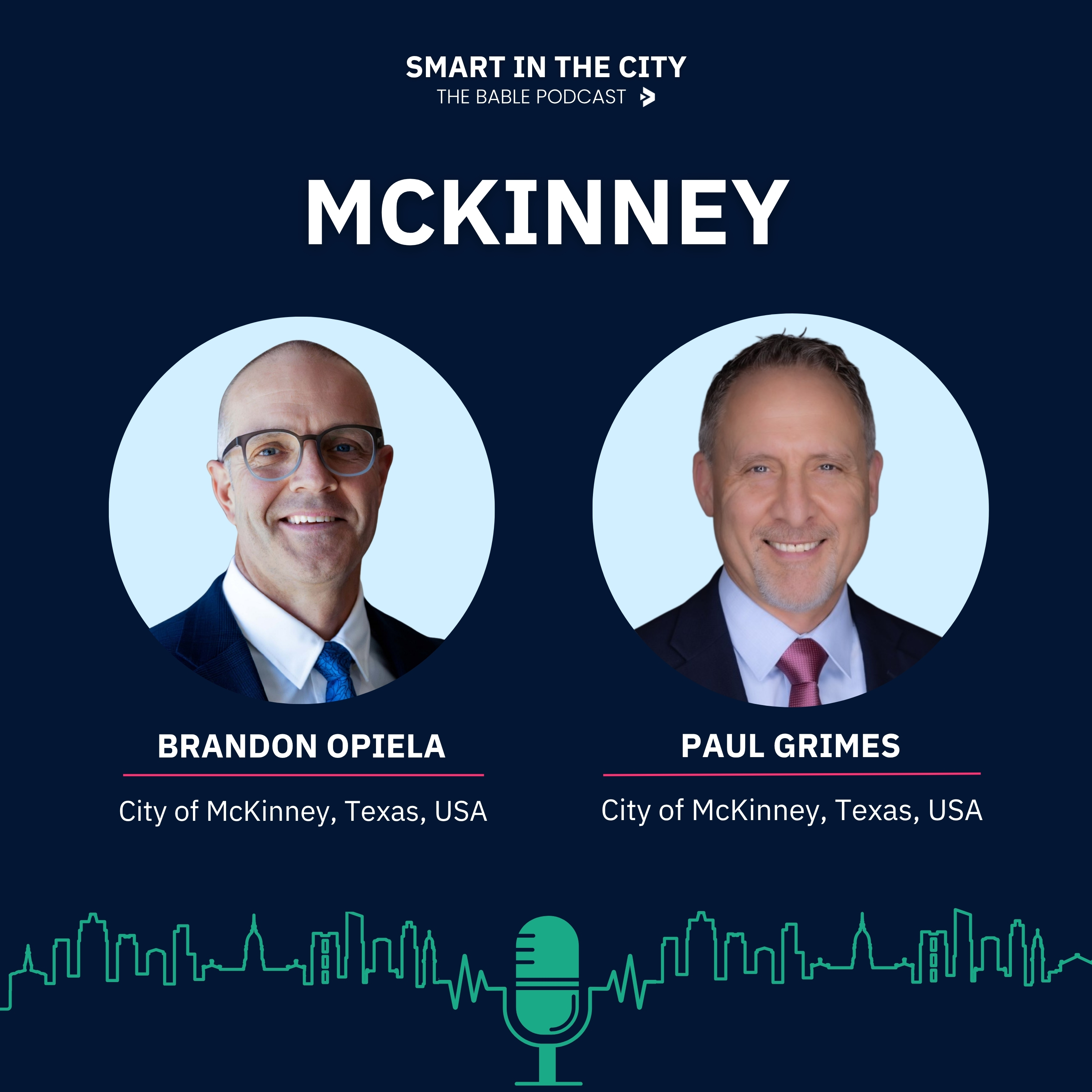
so today we are headed to the city of McKenney in Texas, where innovation starts with culture, not just with technology.
And we're going to dig into that a lot more.
It's really a pleasure to introduce you to our guest today.
First up, I would love to introduce you to Paul Grimes. He's the city manager of the city of McKinney in Texas in the United States. Welcome, Paul.
[00:01:11] Speaker B: Hi, Tamlin. Thank you. Thanks for having me.
[00:01:13] Speaker A: Yeah, really happy to have you. We got to meet actually in Texas when I was there earlier this year. Really keen to learn more about everything you guys are doing. Sounds very intriguing.
And you brought also a colleague here today with you.
We have also Brandon Opiella, the Chief Data and AI Officer for the City of McKinney. Welcome, Brandon.
[00:01:34] Speaker C: Hey, thank you very much, Tamlin. Very nice to be here.
[00:01:37] Speaker A: Yeah, I'm really happy to have both of your perspectives on everything going on on the ground in McKenney. I like to get started with a bit of a teaser question. Just get warmed up into the flow of things.
The teaser I have for you is an oldie but a goodie it is. If you could choose one animal to describe McKinney, which would it be and why? Paul, you want to go first?
[00:02:01] Speaker B: So I don't know. There's so many things. So we have a soccer team here.
It's a soccer season, or football, as you like to call it.
Football season with the World Cup, I would say the Chupacabras, which is our local team, that's a mythical Mexican creature. But I thought, well, that's. We're not mythical. That wouldn't describe the city of McKinney. At the end of the day, I would just come back to the dog. Why the dog? Because the dog, number one, is adaptable. No matter where humanity is, the dog is there. It's been domesticated for thousands of years. Kind of man's best friend, as they say. And someday, when you're driving, we're Riding around in the not too distant future and, you know, vertical vehicles, flying vehicles, or auto driving cars. The car, the dogs will be right there riding with us.
[00:02:45] Speaker A: Yep, Absolutely. You're speaking to the right audience. I'm a huge dog lover. So.
[00:02:50] Speaker B: Okay, so no Chupacabras will stick with dogs.
[00:02:53] Speaker A: Chupacabra sounds great. I don't know what it is, but it sounds interesting.
[00:02:57] Speaker B: We don't either.
[00:02:58] Speaker A: We'll have to Google it.
But okay, we go with dog. I love it.
Brandon, what's your animal to describe? McKinney?
[00:03:07] Speaker C: Okay, so I'd say that McKinney's like a colony of ants, right. On their own. Ants are tiny, but they're famous for being able to build and carry far more than their size should ever allow. Right. That's kind of like McKinney. We're smaller than a lot of the nation's biggest cities, but we're one of the fastest growing in the country and so punching well above our weight and the services we provide and the culture we've built.
Ants typically work off this incredible shared awareness. Right. They each one kind of senses its surroundings and they pass that along so the whole colony can move smarter and faster together. So that success is kind of what really comes from like a network.
Not any single ant, but that's kind of like McKinney. We believe relationships are, you know, how we build those strong and resilient community that we're, that we're after. And so honestly, ants are just resilient. They're resourceful about solving problems. And that's the gritty get it done spirit I see in this city.
[00:04:01] Speaker A: Amazing. I want to dig into that kind of culture and everything in a little bit.
First, I want to ask you a little bit about yourselves.
This is actually sometimes my favorite part of the interview is getting to know people's really interesting backstories and journey into their role.
It's rarely linear. I don't know what your experience is. Paul, if you want to start, what is your background? What led you into your role today?
[00:04:24] Speaker B: Definitely not linear, that's for sure. But I will say my, my fundamentally my background's always been driven toward public service.
You know, I, I've always envisioned myself even, even when I was in high school, I was in student government and involved in ways in the military for some time in the American Navy. And so that just felt natural. Right? It's. So we call that public service motivation. And some people are just wired that way. Right. And that's just how it is.
And for me, that's Just that that's fundamentally my background.
So. But I, you know, typically for city management, you go back and you get a. You study certain fields. So I have an mpa, a Master of Public Administration, which is your typical entry path for city management, although it's not exclusive. It doesn't have to be that way.
And I've done some different things. I've worked primarily in local government throughout my career, but I've done a few other things. But, you know, we. We try to. We. We certainly welcome folks with different perspectives and backgrounds.
So that's really mine. I grew up in the Midwest in a small, little Midwestern town, and. And, you know, when I joined the military, that was my ticket off the small farm town in Indiana. So from that point on, life's been a great journey. But generally speaking, local government management's been my path, and public service has always been something that's kind of how I'm wired.
[00:05:47] Speaker A: I love it. Midwest people are also so nice. So now I understand why you're. You have that background as well.
Good. Brandon, do you want to share a little bit about your background?
[00:05:57] Speaker C: Sure. So I grew up in the North Dallas area. I've lived here almost in my entire life. Made a little short stint in Seattle, but where I graduated from, University of Washington.
But my background is really in urban planning. It's not in data.
It's where I started first in the city. I was in the planning department, which is where I fell in love. Paul spoke about it with that public service kind of aspect. It was an amazing experience being able to help shape development in McKinney during, really one of our highest growth periods. And so, honestly, that fast pace has pretty much continued my whole career here.
We've always run a pretty lean staff, and like most cities, we've never had an unlimited budget, so that means we're constantly looking for ways to be more efficient, whether that means tweaking our workflows or harnessing technology to help do more without adding just a ton of people. Right. And so what I've realized along the way is that innovation and process improvement critically needs data.
And you need data to identify blind spots and to understand your performance.
And when you make a change, you need that data again to know whether that change actually worked. And so, like a lot of organizations, we've had all these different systems and databases that don't speak to each other, which make it generally way harder than it should be to understand the work we're doing. And that's really what led me to the role that I'm in now.
Cities have an enormous amount of data everywhere. But figuring out a strategy and a governance framework to actually harness that data across every department and give the whole organization visibility to that was something that I really got excited to help build for the city. And so I'll be honest, I'm a total data nerd. Getting to help and see others in the organization experience what it's like to have the data that they need to serve our residents well.
Genuinely, it's one of the most fulfilling stretches of my career.
[00:07:51] Speaker A: Yeah. So important and a question that many municipalities are tackling is how do we connect around data, data Dr. Decision making, etc.
I want to now touch a little bit more on McKenna, so maybe Brandon, you can start if you can paint us a little picture about McKenna. What is the city look like, what makes it unique? And Paul, feel free to chime in with any additions.
[00:08:22] Speaker C: Sure. So McKen is a very unique city.
We're a suburb about 30 minutes north of Dallas and we've got around 240,000 people here today with full build out being around 385,000 people. So what's wild though is back in 2000 we were about 54,000 people. And so we've gone through this incredible amount of growth in just a 25 year span and year after year been one of the fastest growing cities in the US and even with experiencing that kind of growth, we're really committed to preserving what makes this place special while still creating that room for kind of new developments. And so I'd say our whole IT factor, if you want to call it that, is that historic charm paired with modern opportunity.
We've got a vibrant historic downtown that's really the heart of our community. We've got beautiful neighborhoods, parks, family fun events, public spaces that just add to that quality of life. Right.
We've got great or strong business, high tech employment, great food, excellent schools.
And later this year we're going to be beginning commercial airline flights out of our McKinney National Airport. So we're super excited about that. At the end of the day, we're a community that's held on to kind of that small town spirit.
And we as and we've done that while we've grown immensely and taken on new opportunities.
So this is the kind of growth that's pushed us to get serious about our relationships within the community, within our stakeholders, about problem solving, efficiency and technology.
Not just because that's trendy, but because it's the only way we can keep kind of providing that Great level of service to the residents without just relying on simply growing the size of our staff. Right, yeah.
[00:10:01] Speaker A: Makes sense. Yeah. Paul feels.
[00:10:03] Speaker B: I was just going to just say, sometimes they say you've probably heard the expression necessity is the mother of all invention. And what necessitated a lot of that adaptability that Brandon was speaking to is the fact that Citi was growing so fast, and in order to keep up, we couldn't just keep hiring people.
Number one, it's hardly hard. It's not that easy to hire a bunch of people. You have budget constraints, you have organizational constraints, you got to maintain your organizational culture, et cetera. So you've got to come up with some systems that allow you to process high, but work at high levels of volume.
It wasn't always the best way to do it. We probably would look back and say, man, I can't believe we were able to get these things done. You know, we did. I remember we did some math few years ago when we were growing. We're issuing, what, 5,000 housing permits a year for a few years, and that's just an enormous number of inspections that have to be done. And we were doing the math on how many minutes per inspection are we actually spending there? I mean, is the quality going to be there?
So those types of things necessitate smarter ways of doing things, and that's kind of how we got where we are.
The data desire. Right. We're in an interesting period of time because now we have the ability to have sensor technologies, whether it's cameras or other types of sensors, to capture data. Right. We didn't have that 20 or 30 years ago. It wasn't affordable. We had them, but it was, you know, usually industrial or military technology, but now it's readily available. So you have the ability to capture the data, you have the ability to store the data, which didn't happen 20 or 30 years ago.
And then you have to have the algorithms of software to be able to process it. When you have those three tools together, you. You've got. That's what's giving rise to the whole AI revolution. And Brandon's role is, okay, how do we make all these things work? And that's really the key is pulling all those pieces together and making it work for us to be able to deliver better services, knowing that we're just not going to be able to keep up on a linear basis for hiring. Right. You just can't do it linearly. It's going to be a sublinear type of growth when it comes to staffing. So you got to figure out other ways to do it.
[00:12:07] Speaker A: Yeah. Which is a good lead into my next question that I wanted to ask you, which is that you've really built McKenna's approach around becoming a high performance organization. HPO culture. What does that really mean in practice? How have you done that?
[00:12:24] Speaker B: Yeah, it's, and, and thank you for the question. HPO actually is a leadership framework. It's not something that's made up by McKinney, folks. It's not some marketing tool. It actually is. There's lots of literature about an HPO organization and effectively it's a dual operating system, it's a pair, sometimes known as a parallel organization, where you basically stand alongside your typical production of an organization and every organization has to produce something.
And it's, and that's typically historically, since at least since the, the Industrial revolution, it's been hierarchy. It's a hierarchical environment. And hierarchy is pretty good for production because it's efficient.
It's not really very good when it comes to innovating, innovation and problem solving.
That's where the parallel organization comes in. That's where you basically create a networked environment of teams.
And it's all built on, I mean, the foundation is trust. You cannot have an HPA organization without trust. And that's where culture comes in. Culture is what sets the foundation for trust in the organization. And you have to have teams assembled. Sometimes they're ad hoc teams, sometimes they're long standing or, you know, sort of semi permanent teams.
And the job of all of them is to help solve problems and innovate. Then you can put those into production and you know, use your, your regular typical hierarchical system for production. But you know that his, through the history of man, most of our work has been done in a team environment or even a solo environment where you're wearing different hats, you're, you're doing the executive function, the management function and the task function. But in, since the Industrial Revolution, we kind of got away from that.
And you know, I would argue that now we have the ability with the technology and the data. And this is such an exciting time to be in an organization trying to figure out how do we reform the way work is done.
And that applies even to the dowdy municipal level.
[00:14:25] Speaker C: Right.
[00:14:25] Speaker B: And when people think of city government, they don't necessarily think of innovation. I would argue that's the ground, that's the testing ground to the proving grounds for an awful lot of innovation because there's so much data and there's so many different needs.
So the HPO I think the whole point of an hpo, a network talent. Think of networking your talent rather than a hierarchy. Think of the city manager's office as one of the nodes in that network. Now, maybe it's an important node, maybe it's a keynote, but we've got lots of nodes in that network and that's how we pull our talents together to be able to solve problems and provide better services or service level for our communities.
And that's the way we're going to be able to navigate some of the manifold challenges that we're going to be facing in the next coming or in the coming decades, along with dealing with enormous data. How do we deal with data? You got to build. First thing you do is establish a unified culture in your organization and then say, now go do it, go figure it out. And by networking our talents or whatever. But it all starts with culture.
[00:15:24] Speaker A: Can you give me an example? I'm just trying to put this into very practical terms. Can you give me an example of culture, how you've actually implemented this? Because now people are okay, we have maybe an innovation team that's integrating across these different nodes. Or how, how do you actually structure this within the municipality?
[00:15:43] Speaker B: Well, it's internal organizationally. So we have the organization itself.
The. So, you know, typically you're organizing the city government like in lots of parts of America or around the world, frankly.
You have your city council and western democracies, your city councils, your elective body, that's your legislative branch, and appoint your professional staff. So my job is to run the organization, the professional organization. So what we're talking about, hpo, is all internally, right? Internal to the organization.
And we have all of your operating departments like everything else. Right. So. And all of our operating departments are. If you looked at an organizational chart of the city of McKen, you're going to see your typical hierarchical type of organizational chart. But embedded within that is the, the idea of the talents in this organization be a network. And that's where the HPO environment comes in. So there's no graph depicting or showing us organizationally. HPO as an HPO organization, we have lots of literature and lots of things I could show you that'll blow your mind in terms of how it works.
But the. You, you basically fold it into the organization at writ large.
And so you have all your, your functions. We have functional areas that the public, the public facing part of the organization. They see parks and rec, they say police, they see fire, airport, all these other ones. What they don't see is the hpo, what they see are the results. They see the culture that we bring, the attitude that our staff has. You know, we, we, we, our organizational vision is building a stronger, more resilient community through the power of relationships. So I always challenge our employees. What relationship did you build today or what relationship did you strengthen today? So those types of things in the way we work, right, Your, your, your sort of org chart is your functional area, but the way we work and how we work is the HPO environment, if you will. And that's all, again, it all gets bound to the culture.
[00:17:41] Speaker A: Yeah, very intriguing. Yeah. So, Brandon, I understand also you alluded to it at the beginning that you're in the process of centralizing a lot of data within the whole municipality.
What does that actually mean? What, why does that matter for AI? Can you elaborate a bit more on what you're doing there?
[00:18:04] Speaker C: So, yeah, so the first thing is that centralizing data is simple. No one's ever really had a hard time doing it. It's something you can do super fast.
No, I kid. It's really a common goal though, for a lot of organizations. But actually dedicating real resources to this effort like we have in McKinney is something that you don't typically see yet in a lot of municipalities. Right. Even for big cities, this is genuinely a hard effort or a hard initiative to pull off.
Different departments each have their own systems, they each have their own workflows, varying analysis abilities.
Many times, you know, their own version of the truth, let's call it. You might ask a seemingly simple question. Even for this podcast, I've kind of was kind of thinking, you know, how many people do we have in the last kind of stated was somewhere population was stated somewhere around 240,000. You might think this is a seemingly simple question, but it depends on who you ask. You might get different answers. Right. And so I really looked at centralizing McKinney's data as a three part approach. And I'll try and be very high level to, to not get so much of the nitty gritty or we'll never finish this podcast. Right? But the first piece was really taking a full inventory, kind of cataloging where all the data actually lives and what was in the data. The second is a really important part, and that's building a governance framework, figuring out how we're going to access it, who should access the data, how we're going to share the data securely across the organization. And that's really where you start to identify policies that you need.
And we Even created two different leadership teams that kind of guide both the overall vision of the data program and our day to day operational decision making of what we do with data. And so once these initiatives were in place, we were ready to pick a data management platform somewhere that kind of like that data lake idea, right? Somewhere that all of our data could actually land and be visible for analysis across the organization. And so we do have a small team that we had to hire, including a data architect, a data engineer that's going to help us build that infrastructure to move our data into that centralized place, which then enables us to organize the data, clean the data, transform the data, and then that gets us to that actual single source of truth. Right? So that when we ask what is the population? We know, we know, we know what that number is. And so why does this matter so much for AI specifically?
Well, AI is only as good as the data you feed it. If your underlying data is messy or siloed or just wrong, an AI tool built on top of that just gives you inaccurate answers and it's a lot more confident about it. Right. Data centralization isn't a separate project from AI, but it's that it's the foundation underneath whatever tool we want to leverage on top of that.
And so one of our significant, most significant, I would say data projects is building a chatgpt like tool that's going to allow all the organization, especially non technical staff, to ask questions of data in normal language, just like we're used to with anything on the Internet that we're asking.
And that's really going to allow staff to kind of harness that power of AI to make those connections between multiple data sets citywide. And so this breaks down the data silos, it increases the visibility and speed to which the organization can reach that knowledge base. So we're pretty excited about that. But really after the centralization efforts, then when your data is ready, and it'll never be truly totally ready, but as ready as you can get it, then that's when you can start kind of leveraging those predictive models and things that will help you look into the future. That is not just reporting back on what we've done, but hey, let's look at the indicators now and know how to move forward.
[00:21:55] Speaker A: Yeah, just a short follow up on that. I'm wondering if you have any kind of tip or anything for someone that's in a similar role as you that's looking at centralizing this, that's looking at, you know, making it easier for employees to access data.
Do you have anything that worked exceptionally well or exceptionally not well.
[00:22:18] Speaker C: I don't know that it's a tip about what works well, but I would say just start. It becomes very overwhelming when you start actually thinking about what it's going to take. You know, in McKinney's case, we've got 200 different enterprise systems that we're trying to centralize all the data.
If you start thinking about the work and you start looking at, hey, this might take us a few years to accomplish this effort. If you just get overwhelmed, you won't ever start. And you just have to start somewhere, right? Start small.
Ask questions of other places that are doing that as well. We've built out relationships with many other cities trying to figure out, how are you doing this? And they're asking us the same things, right? Everybody's sort of in the same boat that's doing this effort and just ask for help. And I think that's probably the biggest tip is there's. There's lots of cities throughout the United States and the world for that matter, that, that want to be doing this. And so let's leverage each other's experiences and things like that to make it happen.
[00:23:13] Speaker B: That's, that's. I just wanted to add, that's one of the really cool things about working in public sector and in particularly city government or local government.
It's usually a very collegial environment. Usually folks are very willing to, to share information.
We have the old adage that plagiary is the sincerest form of flattery.
And so if you call up your. If I call up one of my colleagues in another city and ask them how they did it, almost every time, they're going to say, absolutely, we'd be happy to share that with you. You don't typically get that in the private sector because you're competing or maybe a proprietary information or your systems or your methods, you want to keep kind of to yourself, close to the vest. But in local government and public sector, typically, they're very, very collaborative, and we're always willing to share. We do that all the time. But also we go to. We make road trips to go see how other cities are doing things and try to compare notes. And that's. That's really one of the cool things about this profession.
[00:24:10] Speaker A: Yeah, very important. And I think I see that as well, working with cities across the globe, too, how willing people are to really share their experiences and learn from each other. Yet it still remains difficult to, to replicate successes and, and everything so important that we keep.
We Keep collaborating on that level.
Paul, I also wanted to ask you a little bit more about kind of your leadership style.
You have said that you push decision making down to whoever's closest to a problem. So I guess you're delegating a bit of the decision making.
So not just people with a title, but whoever is actually working on the challenge. Right.
What does that look like? Can you explain a little bit your approach there?
[00:24:54] Speaker B: Well, I mean, part of it's just pragmatic. There's no way a city manager is going to be able to solve the problems in different departments. Right. I don't know. I'm not close to the information. I'm not a subject matter expert. I wouldn't be the know how to deal with a community policing initiative that is unique or how to take certain drone technology and apply it in a public works setting, which our folks are doing.
What I really fundamentally what I try to do is create the space, create the conditions for people to feel comfortable and feel safe in tinkering, coming up with ideas, trying new things.
What we don't want to have are catastrophic mistakes, but we pretty, we have a pretty good set of guardrails to protect the organization from those. So what I tell people is go out and figure it out. Right? Go tinker. Go, go. Create the space for people to be innovative. Sometimes in cities, it's all about the underlying message is efficiency and cutting taxes and cutting costs. And that's, of course, very important to knowing, being mindful of where the taxpayers are and what the community's limits are. But we also have to be able to create space, enough freeboard, if you will, for our employees to be able to be creative and innovative. And you can't do that if you're squeezing everybody down to the point where they, they don't even want to take a chance, right? They don't want to stick their head out of the foxhole, so to speak. And that's not an environment that I want to be in my style. I think Brandon could probably opine on it, but I'm much, very much a facilitative type of leader. It's all about teamwork. It's all about trying to create an environment for, again, building a trusting culture and create the conditions for our employees to be able to thrive and flourish. And flourish is a big deal for us. And you know, from that point, I say, okay, now, you know, I'll cheerlead for you. I'll try to get you the resources. I will sell it to the city council as best as Possible.
But I really rely on people like Brandon and other really, really talented people to be able to come up with the solutions.
[00:27:00] Speaker A: Yeah, I think that is very important when you, when you're talking about leadership to really create that space.
You mentioned tinkering, so I want to stay on that topic a little bit because you talked about how innovation needs tink space.
What does that actually look like then?
How do you provide tinkering space?
[00:27:23] Speaker B: So one, one example, we created a fund, an internal fund. We put a hundred thousand dollars, we set it aside for basically internal innovation. We said internal grant program where departments can say, hey, we have this idea and it's going to cost $15,000 and we'd like to apply for this internal innovation grant. We call it Project Magpie.
I don't know where the word Magpie came, who came up with that, but it's an acronym. Yeah, yeah, but that, that is our internal innovation fund to help, you know, provide some seed money for some tinkering, so to speak.
And that's just one. The other ones are getting our folks out to different, you know, training or training seems I, I always dislike the word training because it sounds so dutiful, but it's learning the ability to expose them to different things and get them the resources to be able to go out and see how maybe the city does it and what if we did this or how this private sector firm does things.
So that's, you know, trying to create that kind of space as well. Send them off to a. I think, Brandon, you went to an event in Miami. It was a, I forget the name of it. It was Cities Today Institute, I believe. And it's kind of their own, the forward edge of innovation. And to go there and be around people like him that are innovating, don't, don't hang around me. I'm not going to be the last person that's going to be able to help him go hang out with people that know what they're doing in this space. And that's just typically how you do it. It's through osmosis and networking, et cetera, that you learn these things. So those are just a couple of examples of how we create that space.
[00:29:01] Speaker A: Yeah, I, I love these examples. I think they give a lot of good ideas for other organizations experiencing similar chall on how to innovate internally as well.
Brandon, I think you're also quite involved in this Project Magpie. Right?
You're sometimes these tinkering ideas, they become good experiments. Then you want to move them, I guess, scale them up into more like funded pilots, et cetera. Can you explain a little bit of that process?
[00:29:31] Speaker C: Yeah, sure. So. So really, you know, we take different applications. We actually kind of are looking more to make it more like a pitch day where you almost kind of come in and pitch your product to a group of fellow employees. Right. And those applications then is where we decide kind of who gets funded, what gets funded, what's a priority. What actually is not just a budget supplemental request, but it's actually an innovative idea that we want to kind of try out. And so, you know, it's really a special way to turn that kind of side project or idea for teams or people, staff that have really no budget to be able to make those decisions. Right. You don't have to be a director. You don't have to have that dedicated budget to get a good idea funded here. It's really. It's fairly new for us though. We've got a few that are in the pipeline. And so I wish I could give you the what happened as the full success mode, but we've got probably about four or five different ideas that we are actively working on. Those pilots now trying to figure out the costing there and then making it happen.
And. And once those pilots are done, then we have to make the decision, okay, was it successful, was it not? If that was successful, is it worth now scaling that and then putting more funds? And now you start looking at how do we transition that into more of those standard budget requests. But what we're trying to do though, is say, hey, this money, although it sounds weird for. For local government to say that, it truly is, you're okay to fail on this. What we're trying to do, though, is figure out what will work and being innovative and creative about it and not just having money kind of be that end all. Well, we don't have the money for it. Can't try it out. I guess we're just stuck.
That's something special that Paul's helped us have that. It's kind of that internal funding mechanism to. To really try stuff out and be creative.
So it's a. It's a pretty special program that we're proud of that we've had a lot of teams submit things. Not all ideas are great, I'll tell you that, but a lot of them are very special.
And we're. And we're moving forward and really looking forward to kind of those success stories of what it led into.
[00:31:41] Speaker A: We'll have to have another episode after a little bit of time. So we Hear about how those all turned out. Right?
[00:31:46] Speaker C: Sure.
[00:31:47] Speaker A: One of my favorite examples, I had a wonderful woman named Lisa on the podcast a couple years ago or so now. And we've also worked together with the city of Helsingborg in Sweden quite a lot.
And they have an award for the biggest failure. So the idea that was the biggest failure. So they tried to pilot something and they do a big award ceremony and everything for, hey, you failed so hard at this idea, but we give you an award for it because you tried and you were innovative and you tried something new. Right.
So I always love that story as well.
Amazing. So you also mentioned training, which you don't like that word, Paul, but I believe you an Innovation Academy, is that linked to, to all of that? I don't know, Brandon, if you want to talk a bit more on that.
[00:32:40] Speaker C: Yeah, absolutely. So Innovation Academy is something we started years ago.
It's modeled after the city and county of Denver's peak academy. So we talked a little bit about kind of sharing ideas or stealing ideas, but they are well aware of that.
We sort of took a best of a best of highlights approach of their highly regarded program to give all of our employees a toolkit, right. That helps them look at their, their work with fresh eyes every day. So it's built on lean process thinking, but we strip out all the jargon, all the complexity so that we can really make it applicable for everyone at the city. Right. So these, the tools will help them answer simple questions of, you know, where's time being wasted? Where are we duplicating work? And then how do we make it better?
So we teach the staff how to map out, how to visualize those processes. And then since they're the ones that know how to identify and improve the issues, being closest to the work, they're in charge. Right. We're not bringing in those outside consultants that are here to redesign everyone's job. We're building kind of that muscle from the inside of the organization. So employees, regardless of your title, you have the tools to make your work better.
The work of identifying issues and having those mechanisms in place really help our staff dream up how it should work. And then it creates those pipelines of challenges that then we can identify and then start tackling.
And then those may lead into a project magpie, you know, initiative. Those just may be something that we, we set aside, those parallel organizations or, or kind of cross functional teams that Paul talked about earlier that can then go and work on those. If they don't know how to solve it or they're not maybe up to speed on all the technology or things that could help them, but it's really a team effort. But it really starts with the individual.
When you have the tools to make your own work better or more efficient or take the frustrating things out, it's really powerful what people can come up with.
[00:34:37] Speaker A: I was just thinking it's a surprise that neither of you picked a magpie now as your animal at the beginning, but that was a side thought or side quest.
Brandon, one last question for you and then I'll get back to you as well. Paul, you also have an AI sandbox as well. From what I understand about staff, Vibe coding tools. So this is about giving people tools. What does that mean? What does this look like? Sure.
[00:35:08] Speaker C: So this is probably my favorite part to talk about.
AI sandbox is something that we're currently working on, which will give our staff that safe kind of governed space where they can have access to various AI tools. They can build applications, agents, and help them, maybe even just help us test and compare AI platforms that the organization wants to use.
So we really look to encourage and enable those eager, we'll call them power users for this time to try out these tools in a responsible way, keeping our data secure.
So think of it like an AI playground with minimal restrictions, where you can build and experiment and pilot things with real city data, but nothing sensitive ever leaves. Right. So Vibe coding, though, is now the most fun that we're kind of having, doing some of the work that we're doing. We're seeing a lot of departments start to play with Vibe coding platforms. And so Vibe coding, if you haven't tried it, it's literally magic.
It allows employees with zero coding background to leverage those AI tools to build dashboards, to build working applications that solve a real problem in their own department. So we're currently working on kind of that set of security and process guidelines that Vibe code applications will need to follow, which is going to help us take their creations from idea, just idea, to now enterprise level. And. And that is not easy.
That is very kind of complex to understand the security of software that maybe we didn't create and a normal vendor didn't create.
But my hot take on this whole deal is that within two years, I think we can be in a position to be able to develop most of the software that we use in house. That's going to save time, future dollars compared to the typical procurement process software subscriptions that we're all very used to. Right. We can now build those custom apps that support Our teams with the exact process that they need without having to conform to a third party software, a third party's workflow that they kind of, you know, the, the square peg and a round hole type thing.
That's leadership at all levels for real. No one needs a computer science degree to build a tool that can make their job and their, and their team's job easier.
You just need someone that understands the process and can describe it in normal language and they can just tell the platform what do they want the software or the application to do and it does it. Like I said, it's magic. I work in it all the time and it's literally magic. Every time we create something, it never, it kind of never loses that spark.
[00:37:46] Speaker B: And it is a small example of how work is changing. This is the revolution and how work is changing because it was that you were, that you had to rely on certain specialists or special skill sets for people to be able to design your software program, for example. And in this case, Brandon and his team are working on the ability for us to be able to do that ourselves as laypersons using what is probably going to be our future next big general purpose technology, which is AI, and using it in ways that are going to help us deliver services better, smarter, faster in a resource constrained environment. And that's, that's exactly what, you know, we're, you know, we're tasked to do, if you will. That's, that's what makes it so exciting, actually.
[00:38:32] Speaker A: Yeah, it's exciting times for sure.
Paul, I want to ask you, and feel free to chime in, Brandon as well, I want to play a bit of devil's advocate, right, because, you know, all of this sounds amazing to me, what you're doing with the culture, building, building and tinkering time. But you've also mentioned, right, you have limited resources, you're tight on time, you have a city to run. Right. Just the operational tasks of a municipality are vast.
So what would you say to people that say it might be a bit of a distraction to actually running and operating a city?
[00:39:11] Speaker B: Yeah, that's a great question.
I would say that, you know, if you don't adapt and if you think that either adopt changing your culture to be more, you know, based on sort of a culture and an idea to allow people to be able to innovate from their place, you're going to have a hard time adapting to all the challenges, the manifold challenges that we have coming forward.
We want control.
Sometimes elected officials want control, there's community wants oversight, et cetera. Et cetera. And those are all very important. But the key is if you can trans, if you can be transparent about it, and you say, this is the why, here's why we do this. If you want us to be able to provide services, continue the level of services we have in our community, or even enhance them, then we had better come up with new ways to do things. And you got to give us some space to be able to be innovative and creative to do that. Otherwise you're not going to change and it's going to become very ossified and very brittle. And then the community is going to be very mad when they get their tax bills. And they say, and our level of services are archaic compared to a neighboring community who's able to do this and that and that. That's not a position that I'd want to be. Have to be in as a city manager, but I don't think I'd want to be in that position as an elected official where I have to defend, you know, an organization that doesn't adapt.
[00:40:41] Speaker A: Yeah, absolutely.
I want to ask you as well, on a community level, what do you think is the biggest challenge you're facing today?
And what would you need, what kind of tools, what would you need to help solve that challenge?
[00:40:58] Speaker B: Yeah, I mean, we all face challenges of resources. You know, in the state of Texas, we have a legislature, a state legislature that is very anti city right now. So the, the environment in which we work is very negative towards cities. Our cities in Texas are actually very well run. We have long culture and history of council manager form of government, professionally managed cities with, with professional staff. But we have a legislature that is very nativist and, and has made it difficult. That's a big challenge for us. And, and subsequently, what they're doing, not only with cities, but even with school districts is it's. They're making the environment even more resource constrained.
So we're having to adapt. We also have, you know, the federal government in the US is desperately in debt.
[00:41:47] Speaker A: Right.
[00:41:48] Speaker B: I mean, the future does not augur well when you look at various federal funding programs because the federal government is an enormous amount of debt. That means we're going to have to live off the land a little bit more. Right. In local communities, we're going to have to kind of figure it out ourselves.
Again, more reason for us to be adaptive and innovative rather than waiting and just kind of sitting around.
So those are big needs. And then just here in McKinney, we are still a very rapidly growing community. So we have lots of Demands for infrastructure development, roads and sanitary, sewer and water lines, et cetera. Your typical utilities.
Adjusting to affordable housing.
Housing is expensive everywhere. Has gone up everywhere in America, but I think it's even a Western European thing, too.
Affordable affordability of housing is a big, big problem. We're seeing it right here in our community. So, you know, we have to find better ways of. Of delivering on housing product and, and yet stitching together a quality community, a community that's going to flourish and setting those conditions for not just economic capital, but social capital and cultural capital to thrive here in McKinney.
Yeah.
[00:43:05] Speaker A: Some common challenges that, of course, many communities have across the US and across global. Globally as well.
To both of you. I asked Brandon earlier a little bit if he had a tip as well, but I don't know if you want to build off of that. There's a lot of, you know, cities listening, people that work in municipalities that listen to the podcast from across the world.
Do you have any piece of advice? What would you tell them to kind of do first? I know, Brandon, you said just start, which I think is a great piece of advice.
Maybe, Paul, you want to add anything to that also, Brandon, feel free.
[00:43:45] Speaker B: Well, I would just say it's. The old ad is you eat an elephant one bite at a time. So you got to start.
And, you know, two years down the road, if you start now and two years from now, you're going to probably have made some pretty good progress toward where you need to be. The key is you need to need. You need the road map to where do we go? How do I start? Well, ask around.
Reach out to people.
If you can't do it yourself, have some folks on your team do it.
But that's what I would do if I were starting just from scratch in some community and they said, hey, Paul, go figure this out. I would have. I'd find the best team members I could get, the best talent I could get, get the right people on the bus and say, let's. Let's fan out and figure this out and pull the best examples we can get together. And by the way, AI helps with that.
AI can help with that. So, yeah, that would be my advice.
[00:44:38] Speaker C: I'm not quite certain I know what you're talking about when you say the word AI. I haven't heard that word before.
So the only thing I would add, I agree wholeheartedly with what Paul was saying, and I would go back to something Paul said earlier, and then I'm going to kind of merge it with what I said. About starting small.
[00:44:53] Speaker A: Right.
[00:44:54] Speaker C: But don't start with technology. Start with trust and culture. If your leadership and management teams aren't willing to give people room to try something and occasionally fail, no tool or platform will fix that. Right.
We've been working on our culture and organizational performance for nearly 10 years and it's not easy, but it is that foundation for progress. And so we're just now focusing on those structures and systems throughout the organization, including how to build strong programs for data and AI. But regarding, you know, how to start from scratch, it really is, is, is the same advice I give every time for someone starting a massive undertaking. Start small, find a few really low risk pilots and then, you know, just see what you can do. And if it works, then try and scale it. Nothing builds momentum for a significant shift like a few visible early wins for staff. Right. And, and it has to be something that they can touch and see and feel and relate to. We can talk about how powerful these tools are all we want, but until staff experiences that for themselves and they try it themselves, they don't really understand the power of that. But that's where you start. You start small. If it works, keep going, keep building on that momentum and don't worry about how long it's taking. It will take a very long time. It will take longer than your leadership wants it to take.
But as long as you're moving with, with kind of that direction and the strategy, you're going to be, you're going to be making some small wins and even large wins along the way. And it's pretty exciting.
[00:46:26] Speaker B: Tamlin, one thing I would just add to that is be transparent about it. Right? Communicate all of this with the organization. Communicate it with your food, the food chain, as we call it. You know, your elected officials and community leaders. Make sure they know what you're doing.
You don't need to have.
You don't want your team, your employees thinking that you're doing something behind their back that's going to take their jobs. That's not the intent. The intent is not at all that it's to help make their jobs better.
And again, this is an unbelievably exciting time to be living frankly in spite of all challenges and uncertainties we see around the world. It's also very exciting. And bring everybody along with you.
[00:47:10] Speaker A: Yeah. Very good pieces of advice. Thank you so much for that. With that, I want to move into our segment of the day.
This segment is called Flip the Script.
Flip the Script.
You are the one asking the questions and I'll be the one answering them.
It's great when I have two interviewees because then I can sit back and enjoy some coffee and basically let you guys ask each other a question. I'm sure you ask questions to each other all the time, but you all come up with the best questions, usually for each other.
So I'm wondering, Brandon, do you have a question that you want to ask Paul and vice versa?
[00:47:54] Speaker C: Absolutely. So this kind of a softball and I hear Paul kind of moan and groan about some things all the time. But if, if AI could take over one task on your plate tomorrow, what would you gladly hand off?
[00:48:10] Speaker B: So I, I, I get hundreds of emails every day and it, I feel like I'm going through sorting from just some, you know, random email that's very low priority, if at all could be spam.
Our systems are pretty good about filtering spam, but there's still some that comes through.
But I'm having to, you know, step away from, you know, in between meetings or whatever and in the margins try to keep up with my emails. If I had a system that could help me figure out how to keep on top of my emails and serve as a personal assistant and sort of a tickler file all those things. Oh, by the way, this email that you, you ignored three days ago for, for good reasons, maybe it wasn't the priority. It still needs to be addressed like something like that to remind me. That would be amazing. That would be like a sublime place to be is help me with my emails.
[00:49:03] Speaker C: I feel like that just gave me more work to do.
[00:49:06] Speaker B: Yeah, they've already been, they've, they've already been tinkering on some stuff which is very cool.
What, but the thing is, is what's really neat is that might actually, that the process of doing that might actually have an application that's effective somewhere else in the organization or with a few twists and turns in a different, a different use, a different application.
[00:49:25] Speaker A: So I think everyone would be very grateful if you found a solution for how to deal with overflowing inboxes. Right. As well. If you find that solution also let me know too, please.
Paul, do you have a question for Brandon?
[00:49:40] Speaker B: Yeah. So Brandon's obviously in the world dealing with the world of technology and data etc. He's a data nerd, as he likes to say. But what is the most old school thing, old school technology or method that you still like to do?
[00:50:00] Speaker C: That's a really great question. Okay, so I think I'm going to answer it with two. The second one is just More for fun. But the first one goes back to those process improvement, process mapping days where we could go way back to post it notes. And post it notes are killer, but those are really hard. They fall off. You lose track of those and what have you. But let's just talk about dry erase boards. I love to be able to map out something big.
You know, we could use a digital whiteboard or have a slideshow that has kind of a graphic, a finished graphic. But there's something about the journey of drawing and talking through the connections as you're kind of drawing and talking together.
And. And it just makes it. I. I don't know, it feels nostalgic or something more.
[00:50:44] Speaker A: Yeah.
[00:50:45] Speaker C: Concrete. Or we're like. We're doing real work or something like that.
[00:50:48] Speaker B: That's why we have our. We have a whiteboard out in our.
I just scribble on there to make people think we were.
[00:50:54] Speaker A: I see one behind Brandon as well. I know the listeners can't see it, but I see a lot of words that say data on it. Not surprisingly.
[00:51:01] Speaker C: Not surprisingly.
And then a big Alexa for the viewers that can't see this either. I've got a big Alexa because we really want to create a tool that you can just talk and just ask questions out loud, and it will just provide those across the city's knowledge base. So that's really. You know, when you do digital whiteboard, it ends with someone saying, take a picture of that. Which isn't a great digital artifact. It creates more work. But, you know, you only live once. So I want to draw it on the board.
[00:51:26] Speaker B: So I love drive boards. That's great. That's great.
[00:51:29] Speaker C: The second one, though, this one is super nerdy, but I have to say it. I love to click the button that manually updates software or firmware.
Every morning when I log onto the computer, I see if there's an update. I read the update notes. Could I turn on auto update? Yeah, absolutely. But then I lose the satisfaction of clicking the button that saves my computer creator's life every single day.
[00:51:52] Speaker B: That's a cry for. I think that's a cry for help in an automated world. I still want to have. I still want to have control. I still need some sort of control. That's right.
[00:52:01] Speaker A: I love that you read that. Who reads that?
[00:52:03] Speaker C: Yeah, Me.
[00:52:05] Speaker A: You. Yes.
[00:52:06] Speaker B: That's. That's great.
[00:52:08] Speaker A: I love it. Now, I have a final question for you. Just very briefly, in, you know, one or two sentences to you, what is a Smart City? It's a question we ask every guest, right Brandon, you go first, you're the AI guy. And then we'll finish off with Paul Strong.
[00:52:24] Speaker C: Oh, man. Two sentences. Okay, so man, that's tough to break that down into two sentences.
[00:52:29] Speaker B: You can do a little bit more.
[00:52:31] Speaker A: I allow it.
[00:52:31] Speaker C: I'm going to say a Smart City isn't primarily about technology. Technology is just the enabler.
A Smart City is one that listens to staff, residents, stakeholders, and that empowers them to be creative problem solvers.
I would say that out of those ideas and out of that problem solving, that's where we really see that kind of togetherness or that relationship building. And those are the things that really bring a community together.
And I think I'll probably leave with Tech should just be a silent backbone that helps us deliver a great experience. It's not something that gets in the way. But a really Smart City without a bunch of sentences to describe a really Smart City is one that is trying to deliver and prioritize the needs of its citizens and stakeholders first. Not just have cool stuff that automates and have devices and things like that. If they help, great. If they don't help, get rid of it to the side. That's right, yep.
[00:53:39] Speaker A: Yeah, absolutely. Paul.
[00:53:41] Speaker B: Well, we start with the ends in mind. So the end is coming up with a better service.
Either a new service, a better service, or more efficient service for your community. And that typically in a Smart City, you know, when you go to Barcelona for the annual congress or any other events, it's typically going to marry, as I mentioned earlier, you're going to marry your sensor technology, your ability to capture data, the ability to store data, then the ability to process it and mine the data to deliver a better service. I mean, that's typically what a Smart City does.
But Brandon's absolutely right. It really starts with listening to what your community's needs are and trying to figure it out. And it may just be some recombinant innovation, some, you know, combining some new technology with some very old stuff.
Putting a camera on our garbage trucks to help find, which we're going to be doing with our partner to identify our level of contamination in our recyclables.
We have, you know, our public works department is using drone technology combined with some really interesting space based radar technology that we buy. We procure that from a vendor and it comes back with a radar signature on water, like where, where potential water leaks might be. And then we send, use our own drone technology to go out there and isolate it and find it. And then we send our old fashioned trucks to go out there and fix it. So that's the cool stuff of smart cities, but technology's given us the tools to do it better and faster and cheaper.
[00:55:13] Speaker A: Yeah, sounds great. With that, I just have to give you a big thank you for spending this last hour with me. I learned a lot from you. I really enjoyed our conversation. I'm sure the listeners will also learn a lot from you. So thank you so much.
[00:55:26] Speaker B: Thanks for having us. It's our pleasure.
[00:55:28] Speaker C: Thank you very much. That was a lot of fun.
[00:55:30] Speaker A: Yeah, absolutely. Anytime. Again, I would love to hear about the successes also from Project Magpie in the future. I also have to give a big thank you to our listeners. It also wouldn't happen without you, so thank you so much. And don't forget, you can always create a free account on Baba SmartStudies EU. You can find out more about different use cases, solutions and more. Thank you very much.
Thank you all for listening. I'll see you at the next stop on the journey to a better urban life.
[00:56:03] Speaker B: Sam.