Episode Transcript
[00:00:00] Speaker A: Foreign.
The City the BABA Podcast where we bring together top actors in the Smart City arena, sparking dialogues and interactions around the stakeholders and themes most prevalent for today's citizens and tomorrow's generations.
I am your host Tamlyn Shimizu and I hope you will enjoy this episode and gain knowledge and connections to accelerate the change for a better urban life.
Smart in the City is brought to you by BABLE Smart Cities. We enable processes from research and strategy development to co creation and implementation. To learn more about us, please visit the BABLE platform at BABLE eu.
Welcome back everyone to another episode of Smart in the City. This episode will be hosted by one of my colleagues on the ground, so I hope you enjoy the change of voice and pace and I'll catch you next time.
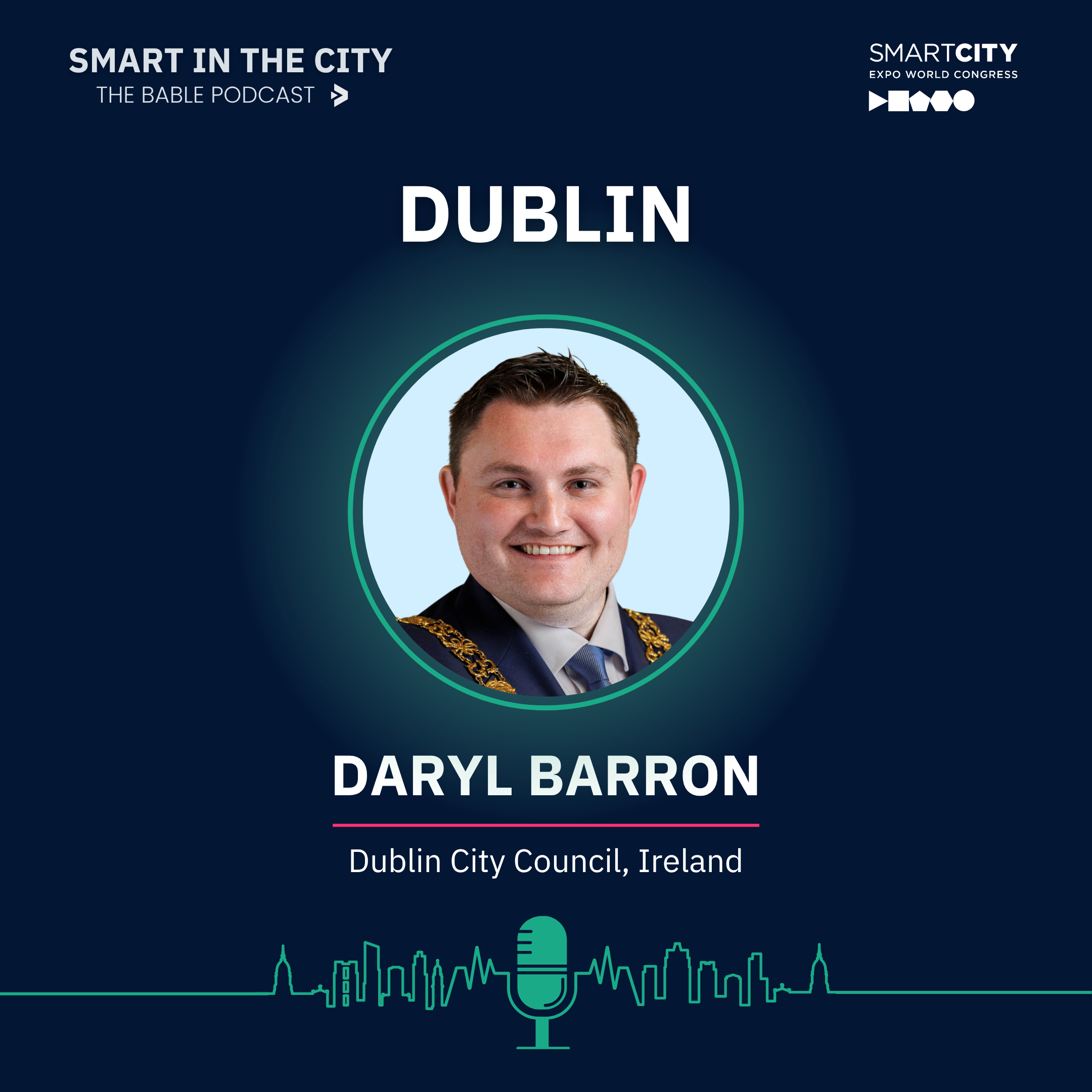
[00:00:59] Speaker B: Hello everyone, my name is Naomi Milstein and I'm pleased to be recording this episode for you. Live from Smart City Expo World Congress 2026 in Barcelona. As part of our media partnership with Fira Barcelona, today we're traveling to Dublin in Ireland to talk about how a capital city is getting ready for the years ahead.
So without further ado, it's my pleasure to introduce you all to Daryl Barron, Lord Mayor of Dublin. Welcome, Lord Mayor.
[00:01:24] Speaker C: Yeah, thank you very much for having me. Delighted to be here in Barcelona.
[00:01:27] Speaker B: It's great to have you. If you had to describe Dublin with only three emojis, which would you use and why? We'll start with a little teaser question.
[00:01:36] Speaker C: I think emoji wise, and I use a lot of emojis in particular because I have a lot, a lot of texts. But I think for me, as I said, the thumbs up is always the one that gets a lot of use.
There's a couple of other ones now, mind you, that get used and you know, it depends on my humor, but that was the sad face as well as a couple of other, you know, angry faces every now and again when, when you get a heated debate, you know. So I think emojis are a way of quick and, and fast ways of, of communicating with people. And I think it's my generation particularly using them and even younger now, you know that they use them to communicate without even using words.
[00:02:20] Speaker B: And if you had to describe Dublin with an emoji, do you have anything in mind?
[00:02:25] Speaker C: For me, it's, I don't really have one as such for Dublin, but it's probably one of those landscape ones with a beautiful scenery because Dublin and with the river running through it all in the landscapes, because it is a beautiful place with the Liffey running right through the middle of it, you know, it's a beautiful scenic place. Yeah.
[00:02:46] Speaker B: So I would first like to learn a little more about you. What is your background and what was the journey that led you to where you are today.
[00:02:53] Speaker C: So for me, I'm a city councillor now since 2019. I got the youngest elected councillor, 26 in 2019 across Dublin. I was elected this year as Lord Mayor of Dublin on 29 June at 33 and the fourth youngest Lord Mayor ever of the city. I'm in a long line of lord mayors and 359th lord mayor to end the chain of office.
And for citizen of Dublin, which is incredible, big honor for me and you know, my family, I come from a rich history from staff. My father and my grandfather worked in the City council. So very proud of that and I'm very proud of what the organization does day in, day out. So for me, as I said, my background is finance. I've worked in finance for over 10 years with politics as well and as a city councillor for the last seven years and now Lord Mayor of Dublin.
[00:03:49] Speaker B: So Dublin City Council looks after many parts of daily life in the city, from streets and homes to public spaces.
So how does the council approach innovation across all of that?
[00:03:59] Speaker C: I think for me and I very much think of the way Smart Dublin and our smart cities initiatives are working.
I think we need to very much innovate. We need to continue to look at ways. I think are we getting it all right yet? No.
We are such a broad organization.
People even in Dublin don't know the half what we do day in, day out.
And I look at so many things right across the organization that I could pull my hair out and use one of those emojis and pulling my hair out because you know, I think we let ourselves down sometimes because we don't innovate fast enough. I think about some housing pieces, the practical things, the day to day things.
We are starting to get there through our Citizen Hub and our digital transformation journey. But I think there's a lot of things that we need to do to transform how we do our business and how we conduct ourselves, but also how we optimize, how it makes it easier for staff within the City council to get to grips with their job.
[00:04:58] Speaker B: So many cities are now using data and digital tools to really test ideas before they build anything. So how does Dublin use technology to plan in a way that brings real value to residents?
[00:05:09] Speaker C: And I think I've just said it about Citizen Hub. I think that that has been A transformational piece that has worked, worked with the likes of residence associations, community groups. You can now if you're at a side of a bin, you can cure scan code a bin to say it's full and the guys will put it into the CRM system. Then that again is all regulated through the digital transformation piece we're working on. The Citizen Hub is there to, you know, for illegal dumping or for other issues around collection of waste. There's been so many things we've added already and I think there's a lot of good things that we're doing to connect, you know, from A to Z, how we connect. There's no longer need to ring the area office for instance, and one of the local area offices in Dublin City Council, they can do it all online.
We're not trying to remove human contact. What we're trying to do is to make it more efficient, that there's always other ways of optimizing and making it easier so we can free up then people to do other work within the City council itself. And I'm forever talking to officials from public domain to environment to transport how we're using these different services now, the city council council to connect with people that normally wouldn't have connected with us. And that is what's great about it now is that and I think some citizens feel a bit more connected to the council. But also you have to be respectful, mindful too that there is people of an older generation and vintage that do not know how to use computers, do not know how to use Citizen Hub and they will continue to ring and that's okay too. But I think it's important as we move forward as a city, how we transform as a city, how we innovate as a city. It's very, very important that we look at all these angles and look into, explore how better are we? Are we fair 100% of what we're doing? No, we can get a lot better, we can do a lot more. But we've only tipped the iceberg of what we can do from a transformational point of view.
[00:07:04] Speaker B: AI is becoming part of the tools people use at work and city halls are no exception. So as you know, together BABLE with City Council kicked off Dublin City Council's AI capacity building training here at the Smart City Exp. So what role do you see for AI at Dublin City Council and what does it take to bring everyone there working together?
[00:07:25] Speaker C: I think as a city council we are faced with AI and AI is something that has very much come to the fore in the last few years and Dublin City Council cannot be the exception. We need to embrace it, we need to utilize it and utilize the service it is being used. Copilot, for instance, has been used internally in the city council for some time through the Microsoft systems and I think as of any other organization.
But I think from my point of view, I think it's important that AI is used to support the work of city council officials already. I think there's ways of enhancing and bettering how they're doing their current work, how they're working day to day, how they're working or doing reports for the city council, how they deal with the mundane issues of issues around emails, how they collate emails.
That piece of artificial intelligence AI is the future. So we need to embrace it as a city council. We have over 6,100 staff within the city council and I think it's important that each and every one of them would embrace it, look at it and say, right, how can we optimize their roles? Can we optimize them working within the city council? I think it's a tool, I've used the tool myself and I think it's important that we embrace it, we look at it and see how we can use it as a city council to become more efficient and also drive ways. I think thinking outside the box and I think it's for us as a council, we're no different to any other organization around the world, around the city, around Dublin.
I think it's important we as a local authority use it because I think it'll help us and enable us to do further and more stuff within the city.
[00:09:03] Speaker B: Just so our listeners know, the program starts with AI Fundamentals, which is a program that's open to all council staff. These are short, self paced modules built on examples from council work.
When a city uses AI, residents want to know if it is used with care, what does using AI responsibly mean for Dublin and what should always stay in human hands.
[00:09:23] Speaker C: I think AI always, must always remain in human hands and I think we always must need to be in control of the knowledge and obviously the data is everything and I think that's very, very critical. I think people always need to be reassured of that and as a city we need to be very, very mindful of that and be respectful to people's wishes. And I think AI is like anything to do with data protection now is very, very important.
Fundamentally we need to be very, very careful of how we use AI as well. And AI is changing all the time. So we need to look to the industry leaders, we need to look to people that are talking about AI every day, about how we use it and how best to use it, best practices and things. Very, very important we keep within the best practices as a city.
It's paramount that we continue to do that and keep it in human's hands. And I think that to me is very, very important that we continue to learn we can to foster it, but also be very mindful of what it is and what the tool is. It's a powerful tool, so we need to appreciate it and also respect it.
[00:10:29] Speaker B: Homes and neighborhoods are at the heart of daily life in any city. How is Dublin working to create better homes and neighborhoods?
[00:10:37] Speaker C: I think about housing as a city. Housing is fundamentally one of the most important issues now of the next generation for Dublin city, as is for Ireland. And I think how we create housing, but also how we create communities is the piece of how we get to get right. And I've been talking to colleagues here from Barcelona to other mayors, but how we use data and how we use AI to better data and to use and explore ways of using AI to better enhance communities, communities better enhance neighborhoods. I think that there's a lot of merit and reasoning there to look at that and see how as a city we explore them options, explore what we do as a city with AI, because I think we need to start thinking outside the box.
And we're always collaborating and trying to work with others around that. And I think it's very, very important that the city council uses AI to see what, what is the other narrative? What is the other way of doing it, how is other cities doing it? And I think working with the likes yourselves and BABLE I think it's important that we look and see how we better that. And I think, as I said, housing is critically the most fundamental issue, I think of my generation, the next generation in Ireland and in Dublin. And for me, as I said, what does that look like for housing? How does AI help and support us to foster how housing can look like in the future and how, how it helps us to better innovate in as a city? From a housing perspective,
[00:12:09] Speaker B: the decisions cities make today will shape the next generation's lives. How is Dublin bringing young people into its innovation work?
[00:12:17] Speaker C: I think, you know, for me, and I'm 33, so I'm, I would say relatively still young, but I think, you know, from my point of view, I think you're seeing younger and younger people using technology.
There's kids that are 12, 14, 16, years of age that are using technology to a very advanced level.
I was very happy and content as a child with a Game Boy. So like, you know, the world is changing. We need to be very mindful of that, that the generation that are before me, the generation that are after me are all now on different playing fields when it comes to technology.
So we need to be mindful of that, but also use that as a tool and use that as a way of, you know, the next generation are going to be sharper, quicker, faster at using technology with AI. And they're already using it, you see it day in, day out. A lot more usage of AI is used and consumed by younger people. So I think that is a great opportunity for the city council to bring new people into the city council that have used it and utilized the use of AI. And I think that's the future.
It's the future of using it, but using it for a common purpose or using it for a narrative or purpose, you know, effectively. Your purpose is to get to the end goal. But how AI is used to get to that can always be much quicker. And I think it's using it and optimizing or trying to be efficient at what we're trying to get out of it
[00:13:41] Speaker B: is the Smart Docklands youth initiative. Can you talk a bit about how that's an example of bringing younger people into innovation work?
[00:13:49] Speaker C: I think it's great. In particular, the Smart Docklands has been there for a very long time now. And it's the original smart cities, well over 10 years now since it's been there.
For me, as I said, it's a way of again bringing people around the table, bringing people in to discuss areas of innovation, discuss areas of transformation, areas of. But again, I think it's important that likes of children and people that are coming involved with that.
I think it's important that you're listening. We're engaging, but we're engaging within a community that allows people access to facilities like this, allows facilities use of AI, use of technology, use of data, use of ways of innovating. And I think as a city, it's important that the smart cities initiatives right across the four local literature is so important to connect with an audience that may not necessarily already connect with. And I think that is exactly how we're trying to enable as a city council, trying to bring these people in to work with people in a local community.
[00:14:57] Speaker B: Let me play devil's advocate for a second. Some might say that innovation in cities mostly benefits people who are already comfortable with technology, while Others will miss out. What would you say to them?
[00:15:09] Speaker C: I think, you know, people that use it is great, it's a great tool.
But I think the people and bit to the point that we made earlier on, that the people that still don't use it, there's still a way of engaging with the city council. But what I would say to them, people, and I've said this to a lot of people, don't be afraid to embrace change and don't be afraid to embrace AI.
Something that I use, even cautious as a politician to use in case of repercussion. But I think it's very, very important that you use it very much. As I said, as you said, devil's advocate, use it as a way to help maybe bounce something off that maybe you don't have someone bouncing off questions and answers about or why I should be talking about this or why I should be doing this. It's a great way of bouncing back and forth questions and answers with AI and I think people older, I think as the technology evolves, I think it's going to only help people that are actually older, not younger. It'll actually help them. People probably transform their lives in some way or another. It might be something very small asking about the weather or asking about something, but it could be something very small in their life that it's very, very meaningful. And I think that's the piece where as a city, and I think we need to look at this and how we explore how our city libraries operate and I was speaking recently to someone about that, that we need to explore as a city how we help people within communities. We have computers in libraries, but there's no reason why we can't engage with older people to try understanding what AI is and what it's about, what the purpose is of it.
[00:16:49] Speaker B: Looking ahead, where do you see Dublin heading in the years and what would help the city get there?
[00:16:54] Speaker C: I think for us, Dublin is the engine room of the Irish economy. We're doing very well as a city.
Is there problems? Yes.
And I'm very much, very much been in the media about then issues around safer, cleaner Dublin or tackling vacancy and dereliction. I think there are areas where we really need to be very, very transformative but also be brave as a city and be bold as a city to make hard decisions. But when I think about AI and I think about how we should be very much using them tools to try seeking to support us as a city, as a city centre around o' Connell street, for instance, I'm sure AI can help support us on that.
And I think as a city council we need to be brave in what we have to do as a city. And I mentioned already about the housing situation. Housing fundamentally is the single most important issue of my generation within Dublin. I'm in Ireland and probably Europe and it will be the generational issue for a long time to come. And I think us as a city, how we interact with AI, how we interact with it is very, very important. I think how we future benefit from it, I think could be very, very useful. About how all them issues interlink, do I know what it looks like yet? No, but how we use the tool to advance the city and to advancing on issues like that I think is very, very important. So I think the thought I would have is in the question I will have to my team in the city council, to the staff in the city council is how you use these tools to better enable the city to thrive and to thrive in a good, positive, interaction, interactive way.
[00:18:29] Speaker B: So it's time for a quick shout out,
[00:18:33] Speaker A: shout out.
Mention a person, an organization or a city you think deserves more recognition in the field.
[00:18:45] Speaker C: I probably haven't had a thought about this, but you know, I think there is cities around the world that are using AI far more than Dublin.
You know, you see what Barcelona are doing here, you see, you know, it's the Smart City Expo is, is, you know, has been here for a good amount of years now and they're very focused on it and I think they're very focused on, from an innovative point of view of bringing people together, collaborating.
So that has to be commended.
I think I haven't done enough research to tell you which local authorities or which cities are innovative or they have looked at how they're using AI. I think as a city there's ways and means to look at it. I know, as I said, there's very much been conversations this week around collaborating what they're doing in City Council.
I know my staff here have been chatting with the likes of Madrid City Council and Barcelona City Council around what they're doing. Are they ahead of the game when it comes from a digital transformation point of view? Yes.
And that is something that to me is very, very important. And when I'm asked them what are they doing on this or what are they doing on that? We can see very clearly, for instance, the examples that were given to me in Madrid. We're not even at the races yet. So I think that's the piece of collaborating to look at what other local authorities are doing. Around the world, but also within Europe, because they're closest to us and connecting, joining them dots. And I can see very much. There's very good examples in Madrid that are well in advance.
[00:20:18] Speaker B: A final question that we like to ask every guest. What does Smart City mean to you?
[00:20:23] Speaker C: I think for me, it's been a livable city, a city that's transformational, that a city that thrives, that a city that uses technology and uses innovation for greater means.
And that's very broad in the sense that I think for me looking at it, we need to use the data more efficiently. We need to use data, be more mindful of that and collaboration with the data. I think as a collective, sometimes we don't collect the data as efficient as we should. But I think using innovative tools and potential other tools within the city, I think it's going to be very, very good to very much enhance how the city operates.
From little things to small. There's so many ways I think of, for instance, our big belly bins that are in the city center, how they tell us when the bin is full and we then log it as a point in time to change out the bin.
These are little things that might be very, very small, but in fact, it's so, so important. And I think how we optimize, how we become more efficient as a city, it's something that for me, for instance, on the big belly bin front, is something that I'm very much pursuing because that data, that smart data is the future. If we don't use it, we're not, we're not, we're not even at the races. And I think that's the future. The future is using the data in a very, very, very sharp and clever way to optimize for the whole of the city and hold of the city council.
[00:22:00] Speaker B: Thank you, Lord Mayor. It's been great to have you on the podcast.
[00:22:03] Speaker C: My pleasure. Thank you.
[00:22:04] Speaker B: And to all of our listeners, don't forget, you can always create a free account on BABLE to find out more about Smart City projects, solutions and implementations. Thank you very much for tuning in.
[00:22:18] Speaker A: Thank you all for listening. I'll see you at the next stop on the journey to a better urban life.
It.