Episode Transcript
[00:00:00] Speaker A: Foreign.
[00:00:07] Speaker B: The City, the BABA Podcast where we bring together top actors in the Smart City arena, sparking dialogues and interactions around the stakeholders and themes most prevalent for today's citizens and tomorrow's generations.
I am your host, Tamlyn Shimizu and I hope you will enjoy this episode and gain knowledge and connections to accelerate the change for a better urban life.
Smart in the City is brought to you by BABLE Smart Cities. We enable processes from research and strategy development to co creation and implementation. To learn more about us, please visit the BABLE platform at BABLE eu.
[00:00:46] Speaker A: So today's episode is part of our partnership with Urban Future and we're recording live at the 2026 edition in the lovely city of Ljubljana in Slovenia.
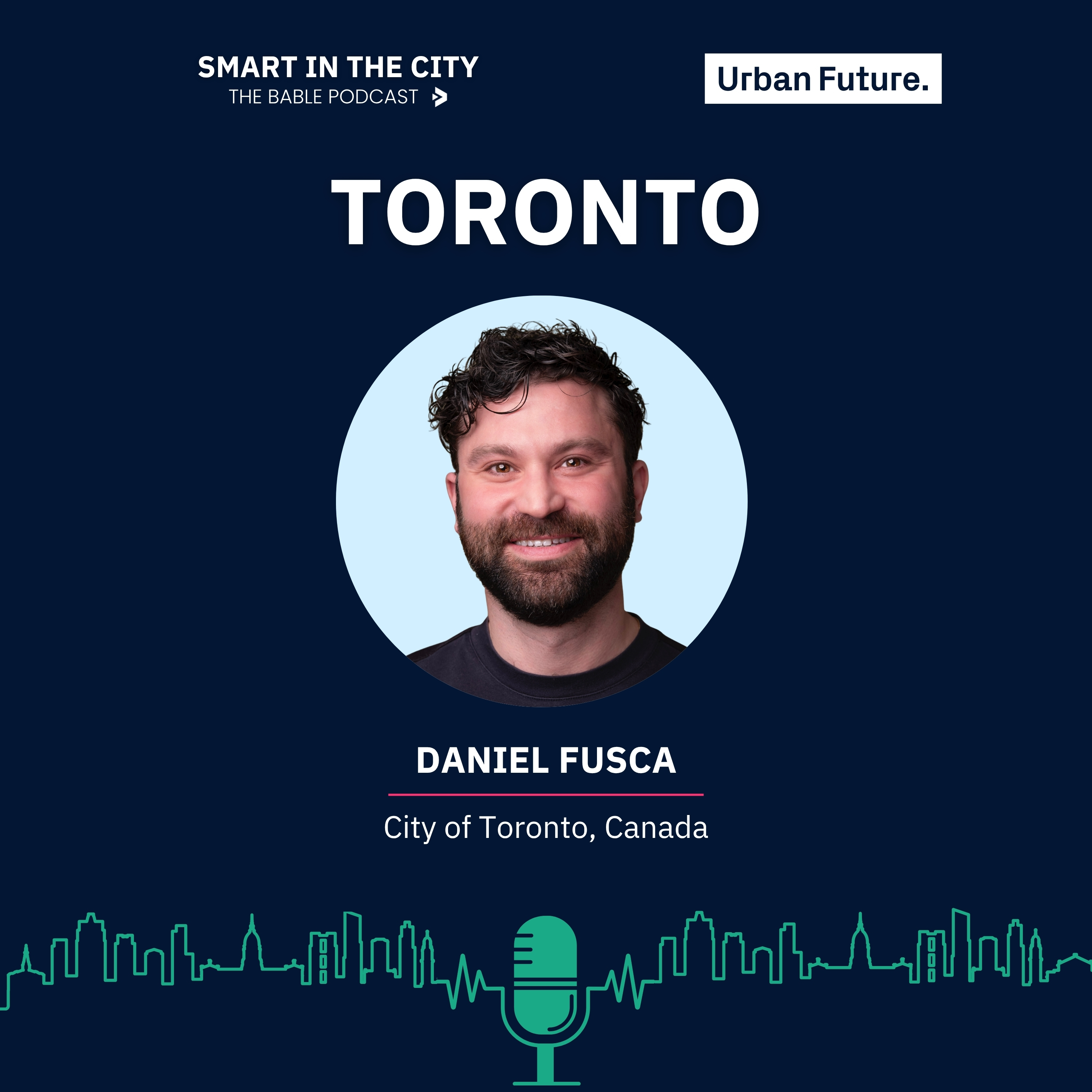
So first off, thank you, of course, to Urban Future for the great partnership over all these years. Many great series, many great interviews with incredible speakers that are here at Urban Future. Every year we have another one for you. With this episode, we're turning our attention to the city of Toronto and how this Canadian city is using more deliberative approaches in municipal practice.
So with me today is none other than Daniel Fusca, Manager, Public Consultation, Parks and Recreation at the City of Toronto, Canada. Welcome, Daniel.
[00:01:31] Speaker C: Thank you. Hi, Tamwin.
[00:01:32] Speaker A: Hi. Nice to see you again. We actually met last year at Urban Future. We did and have been talking a bit ever since and everything. So I'm really excited to dig in even deeper into your work, learn more from you, and I know that you'll have a lot of really interesting insights to share with the audience as well. I like to start with a bit of a teaser to, you know, get us thinking a little bit. So if you had to describe Toronto using only three emojis, which ones would you pick?
[00:02:01] Speaker C: Oh my. Which three emojis would I pick?
I have to go for my phone and see what the emojis are. I would pick a heart emoji because I love Toronto. I'm a Toronto file.
[00:02:13] Speaker A: Are you born in Toronto?
[00:02:14] Speaker C: I am born in Toronto, yeah. I would pick. Is there a beach emoji or like.
[00:02:19] Speaker A: Yeah, like the sand emoji with like the umbrella or something.
[00:02:22] Speaker C: Yes, because it might surprise people that Toronto is a beach city. World famous, world famous beach city.
But we have many beaches. I think there's like 13 beaches in Toronto and my favorite place in Toronto is one of our beaches. So I'd pick the beach emoji and then, you know, maybe, maybe I'd pick the. The head exploding emoji. Because sometimes it's a city that can drive you crazy. But so can every city, right?
[00:02:50] Speaker A: Yeah, yeah. Yes, absolutely.
I'm surprised that you didn't pick a park of some sort. But, you know, we'll get beaches apart. Okay, true.
[00:02:58] Speaker C: Technically.
[00:02:59] Speaker A: Oh, true. Okay, Fair play, fair play. I've been. I stand corrected. So let's go into it. I want to learn more about you besides the fact that you like beaches. I want to know about your role.
What led you into your position today? Where did you come from? Tell me more about yourself.
[00:03:17] Speaker C: Sure. Well, I am trained as an urban planner and I became really interested in public engagement as I was studying, studying my. My master's degree and ended up working in the private sector at a planning firm called Dialogue, where I did a lot of work, where I thought about how we were engaging the public in our projects.
And that sort of focus ultimately led me to working at the City of Toronto in the Chief Planner's office under a former Chief Planner named Jennifer Keysmatt, where I was the stakeholder engagement lead.
And.
And so my career has followed that path track ever since and did some work in policy for a little bit after that. And now I'm a manager of public consultation in the Parks Department, which has been a really phenomenal experience for me. I've gotten to build my team, my practice, from just me. We started in 2020 and we are now a team of. I think we're 18 and constantly growing.
So that's been really exciting. And I also, I teach at the University of Toronto, and I'm also an urbanist in residence at the University of Toronto's School of Cities this year, where I'm helping to share tools to support other public servants in better engaging people in their work.
[00:04:50] Speaker A: Oh, cool.
Sounds like you get into a lot of people engagement. What makes people click, what, how to engage them more. So want to get into that a bit more, but I first want to kind of set the scene a little bit more. I mean, I think most people know about Toronto, They've heard the name, maybe some people have been there, quite big city, well known. But what do you think people should know about Toronto and about the work that you're doing in Toronto?
[00:05:20] Speaker C: Sure. Well, I think people may not know that Toronto is a really big city.
There's 3 million of us in Toronto. It's the fourth largest city in North America after Mexico City, New York, in Los Angeles, and it's also potentially the fastest growing city in North America.
So until very recently, things are a bit different right now, but we were adding like a hundred thousand residents a year to the greater Toronto area.
So it's a very dynamic city because of that. Um, it's also the most diverse city in the world.
60% of us are non white.
And more than 50% of Torontonians were actually born abroad.
[00:06:07] Speaker A: Wow. Okay.
[00:06:09] Speaker C: And there's like 160 languages spoken in Toronto.
So it's a. It's a melting pot, but also a mosaic. And, and you can get any food that you might desire in Toronto. And it's just a really vibrant, dynamic, awesome place.
[00:06:27] Speaker A: Yeah, really nice.
I had no idea that it was. Yeah. I mean, when you think of, like, diversity in melting pots, I think of New York City, but Toronto is even more than that. Right. Like, people. Most people probably think New York. So lots of fun facts also that we're learning about Toronto beaches, 13 beaches, all this. So I'm learning a lot already.
I want to dig in a little bit more.
Living through.
Yeah. Difficult times right now, I would say living through moments of declining public trust in government, of course, growing polarization and a lot of democracies.
What do you think is really the root of that?
[00:07:09] Speaker C: Yeah, I mean, I think it's a bit. It's a bit layered. I think at the root of it is that we don't know how to talk to one another anymore.
And part of that is social media and echo chambers and just the effects of communication online.
But I think another part of that is also.
I think about this a lot, actually. It's.
Our democracies were never really set up in a way to systematically kind of support democratic life.
You know, our institutions aren't really designed to support and reinforce democratic life. You know, we don't really learn about how to be small d Democrats in school. We don't learn.
We don't learn the skills that you need in order to participate meaningfully in democratic society.
And, and our institutions don't. Don't work to reinforce democratic norms in many ways.
So I, I really think that we've been kind of lucky for these last 200 or so years that our democracies have. Have flourished.
And, you know, we're at a moment now where, where that's being challenged in a real way.
[00:08:36] Speaker A: Yeah, absolutely. It's.
Yeah. Without going down too much of a rabbit hole, of course. It's. It's a profound time in, in our cities and also in. In the world, of course.
What do you think about how that relates to the work that you're doing on the ground right. In Toronto?
Can you, for example, bring a product to life for me where there Were know, some clear trade offs or how do you bring residents into grappling with those trade offs instead of just giving opinions? How do you see this with your work and public consultation?
[00:09:16] Speaker C: So in the work that I do, we really try to give the public a meaningful role as a, an actual partner in the delivery of our projects.
My team works primarily, exclusively in the Parks and Recreation Department at the City of Toronto. We have until now supported the capital program of the division, which is quite significant again because Toronto is fast growing city.
We are building a lot of parks, we're renovating a lot of parks, we're building community centers.
My team supports like 80 projects a year.
So, so we're doing a lot of work and we've done a lot of work thinking about how the public can play that really meaningful role in those projects. And so what we do is,
[00:10:14] Speaker A: and
[00:10:14] Speaker C: not for every project it really depends on it is those projects that have more complicated, that have more of the trade offs. So it's a brand new park or it's a brand new community recreation center.
And I do recognize that the stakes are not that high with these, with these kinds of projects, you know, we're not solving world hunger.
So the level of controversy isn't usually that high, although sometimes it can be.
But what we'll do is we actually run a process that includes both broad participation where we're asking for the public's opinions, and then we bring together representative groups of residents that we select through a lottery process that we call a civic lottery that look like the community that we're building the facility in.
And we work with that group to actually sort of work through the feedback we've gotten from the wider public, think through the different trade offs, think through the opportunities, the constraints, and actually develop directions like a vision statement, design principles, what we call big moves, or just like design measures that are then used to advance a project's design.
[00:11:34] Speaker A: Okay, really interesting. I think that's a really good framework because a lot of times I think when people think public consultation, it's like, hey, what do you think about this?
What does this look like for you? Like, do you like this?
But really thinking about this in a more integrated way. Right.
Can you walk me through maybe a time when engagement genuinely really influenced the decision?
[00:12:05] Speaker C: Well, I'm going to say all of our projects include engagement that genuinely influence a decision when.
But one process that I will highlight was a process that we ran several years ago to design a new community recreation center in the West End of Toronto. And this community recreation center is being built incorporating an existing heritage building. It was a factory.
And in front of the factory there is a. There's a public square that the community had fundraised to construct and was very active in programming.
And so when we embarked on the process to design this building, the community was very concerned that the design, the. The design of the building would impact that square. And so they, you know, they launched a bit of a.
A campaign. They had, they had a YouTube video. I remember they had little buttons like Save our square.
And we were very concerned that the project was going to get off to a. A rough start.
[00:13:31] Speaker A: Yeah.
[00:13:31] Speaker C: Because of that.
And we wanted to make sure that the community was on board with the, with the process.
So this was very early on. We didn't follow exactly the same process that I've described today, but, you know, we did develop a vision statement, we did develop design principles, one of them being that the function of the square should. Should be maintained even if the square could change itself.
And then we did something we've never done before, which was we actually involved the public in the selection of the building envelop.
So actually in, in deciding what the shape of the building should be.
And so we had our architects develop five different options.
Each of them were options that the architect team and the city team would have been comfortable advancing.
And we presented them to the public using an online tool.
We presented trade offs.
Most of them were trade offs around public space.
How each option impacted the public space differently, the way it interacted with the street.
And people used this tool to select their option and then also identify certain criteria that they thought were important.
And then the tool spit out. It spit out the option that it thought you would have preferred based on your answers. And it showed you where you sat in the spectrum of public opinion.
[00:15:05] Speaker A: Interesting.
[00:15:07] Speaker C: And the, the option that came out on top of that process was called the Angler. And it's the option that we ended up advancing. And what was really interesting about that was that the community, which had until then, you know, been a little bit, as I said, tepid about the, about the process, they were supportive of the idea of the community rec center, but they were also concerned.
They embraced it and they started to promote the process and started to promote the project.
You know, they would do videos on YouTube promoting, you know, how things were going and talking about, and talking about the process. They really took ownership of it. And I think that's really what we want to see.
[00:15:46] Speaker A: Yeah.
[00:15:46] Speaker C: With public engagement, we want people to feel ownership over the outcomes. We want people to Feel trust in the process because that ultimately leads to, you know, what I like to call a resilient decision. A decision that can withstand scrutiny later down the line.
[00:16:04] Speaker A: Yeah.
[00:16:04] Speaker C: And. And so that's a process I'm really quite proud of.
[00:16:07] Speaker A: Yeah, I love it. I actually have a little follow up on that. I was just thinking about what would happen, for example, in that process. You said, okay, you put five options on the table that everyone was comfortable with. What if one gets chosen? But then later on you realize, oh, wait, this is not the best option. How would you hand that public consultation if they very clearly said, no, we want this, and then later down the line you, oh, this is a bad option for xyz.
[00:16:38] Speaker C: By being transparent about it. By saying exactly that, you know, we, by. I think it's. It would be important to demonstrate that we tried. Yeah, yeah, we, we explored it.
And then actually bringing people into the complexity of the decision is really important.
And sharing with people why exactly this couldn't happen in this way.
And also, you know, whatever the alternative is, hopefully would also be grounded in.
Maybe it was the second choice or something. Right. So ensuring that the alternative is also grounded in what we'd heard. Yeah, I think that that's how I would handle that.
[00:17:18] Speaker A: Okay. No, it's really interesting.
So you mentioned civic lotteries.
I've also heard you mention citizens panels.
[00:17:27] Speaker C: Citizens assemblies.
[00:17:28] Speaker A: Citizen assemblies. Can you talk a bit more about these concepts, these tools that you use and where they've been applied?
[00:17:37] Speaker C: Sure. So a Citizens assembly is a tool that is gaining a lot of support. It's being used a lot in. In Europe.
It's actually a sort of a Canadian invention.
[00:17:53] Speaker A: Made in Canada.
[00:17:55] Speaker C: Made in Canada.
The very first Citizens assembly was in 2003 in British Columbia. And it brings together a group of randomly selected citizens, or don't love the word citizen residents.
[00:18:11] Speaker A: Yeah.
[00:18:14] Speaker C: Who represent the demographics of the community it's meant to rep. To represent. So in this case, the demographics of the province of British Columbia.
They come together over a period of weeks, months, and they learn about an issue in depth.
Oftentimes they hear from experts. Oftentimes, you know, they might also be an element of public consultation with the wider public as well, to understand the public's positionality on things.
[00:18:48] Speaker A: Mm.
[00:18:49] Speaker C: And then the group deliberates. So they talk about it, they discuss the trade offs, they discuss, you know, what they like, what they don't like, how it would benefit them, how it would not benefit them, and together they come to a collective decision and recommendation.
So in the first Citizens assembly that was done by the province of British Columbia. The topic was electoral reform.
So should we change the, the way we elect our, our representatives?
In Canada we use a system called first past the post, which is a system that means that whoever gets the most votes wins. Right. So it's not, it's not like in Europe where you have sort of representative, more representative way of selecting candidates and members, candidates, parliament or whatever.
Um, and, and so the, the group came to a recommendation and then there was a, there was a referendum afterwards to decide if their recommendation should be implemented. And unfortunately it just, just lost. It had a really high bar. It was like something like 60% of people in like every district was supposed to vote in favor and came very close, but it didn't actually pass.
But the tool has become very popular. It's, it's now been sort of adopted quite widely in Europe, in the European context.
And it's been institutionalized in many contexts as well. In Belgium, in Paris, in Milan, there are lots of cities and regions that are using citizens assemblies, both as long term bodies to support governance and also to address specific questions that are controversial.
[00:20:50] Speaker A: And where have you seen it be the most effective? And have there been times when it hasn't been effective?
[00:21:00] Speaker C: Well, I think in a European context it's been pretty effective.
Paris has won, has a sort of a permanent Citizens assembly as I understand it. And recently the Citizens assembly wrote a bylaw or a legislation to address homelessness and the Paris City Council adopted the legislation as a whole.
In the Canadian context, it's been a bit more of a mixed bag.
My first introduction to citizens assemblies came when I actually created one myself.
I, we, we created a citizens as sort of a Citizens assembly when I was working in the City Planning Division called the Toronto Planning Review Panel. And it turned out to be potentially one of the very first standing citizens assemblies that deliberated on a variety of different topics over an extended period of time.
And so we created the Citizens assembly to bring more diverse voices into the planning process and get that kind of input from more of a diverse group into our projects, our planning projects, our strategic planning initiatives.
Because despite how I said earlier that Toronto is one of the most diverse cities in the world, what we have found is that the people who show up at meetings tend to be white homeowners.
[00:22:40] Speaker A: Yeah.
[00:22:41] Speaker C: Over the age of 55, in the case of city planning, that, that leans a bit more male.
With the parks, the work that we do in parks, the demographic is a bit different, it's a bit younger, probably because parents care A lot about parks. So you get more of like the 35 to 55, you get more women, but it still skews towards white people. It still skews towards people with higher education, people with higher incomes.
And so a citizens assembly uses a tool called a civic lottery, where people are sort of invited randomly often and then they volunteer and then they're selected randomly, but they're controlling for these demographic factors.
And, and so it's a tool to help.
One thing that it does is it helps to bring more diversity into a conversation and ensure more diverse perspectives are there. So the planning review panel was in some ways very successful.
The, the feedback was that, that we. The conversations that happened at the panel were very nuanced, they were very constructive.
People react very.
The way people show up in a citizens assembly is very different than when they self select to participate in a process. They come with a lot of humility.
They come with a very different attitude. It's like, interesting.
You know, I thank you for picking me.
It is an honor to be here. And I want to make sure that I'm thinking about my neighbors.
[00:24:15] Speaker A: It's not like they're trying to get out of jury duty or something.
[00:24:18] Speaker C: It's not. And they're not. And they're not there because of some self interest. I mean, they're still self selected in a way because they volunteer, but it's a bit, it's a bit different than, than when you show up because you're angry about something, for example. Right. Which is usually what drives people to show up.
[00:24:34] Speaker A: Yeah.
[00:24:36] Speaker C: So it was really, it was really positive experience in that sense.
It eventually was.
The experiment sort of ended after two terms, so after four years.
And I. And in, in, in thinking back on it, I think that that happened because the panel was, it was never really integrated into decision making processes.
So it was this experiment. We were trying it out, we were seeing how it would work.
And so it was this thing that was happening on the side.
And I remember that I always used to have to like convince my colleagues that they should come to the panel, especially at first, because they didn't know what it was. And they thought this is just like another consultation that I have to do now.
But every time they came, they were like, wow, this is great. We're getting really good feedback. Like, this is where this is really helping us advance our projects in meaningful ways.
But, you know, it was difficult to align project schedules with the schedule of the panel because it sat, you know, it had regularly scheduled meetings and growing city, lots of projects.
[00:25:50] Speaker A: Yeah.
[00:25:51] Speaker C: So, you know, projects couldn't, you know, for it to work really well, you would want to bring a project through the course of the. Its life to the panel, like in an iterative way.
[00:26:01] Speaker A: Yeah.
[00:26:02] Speaker C: So that wasn't always possible. So they would see a project late in the. Late in its. You know, in its life cycle or just once or.
And so ultimately it did. It did end up shutting down.
But I took the lessons that I learned from that experience, and I've been integrating them into my work ever since.
[00:26:25] Speaker A: Amazing. It sounds like a really cool process. I'm just wondering how more cities could potentially integrate more of this. And I also want to ask you, we mentioned before that there's a bit of a loss of trust in government, and I'm wondering, a lot of these approaches seem like a really good way of rebuilding trust. I'm wondering if there's any other insights that you have from your work on how we can rebuild trust.
[00:26:55] Speaker C: Yeah, I mean, I really do think it comes down to what I said earlier about our institutions not being designed to support democracy.
So, for example, as. As a municipality, I think we have a responsibility to step in and facilitate a conversation when there is conflict, when.
When there is disagreement. You know, I think that it's, It's. It's important that. That institutions and democracies play that role and don't shy away from controversy, but step into it and. And actually facilitate robust conversations that, you know, hopefully will help to resolve those. Those conflicts. Those questions.
[00:27:52] Speaker A: Yeah.
[00:27:53] Speaker C: Because it's, it's through conversation and through interaction.
[00:27:59] Speaker A: Yeah.
[00:28:00] Speaker C: That we build trust.
[00:28:02] Speaker A: I like the saying step into the controversy.
Most times governments want to stay out of that. Right. They don't want to get in the middle of things. So I like that. That perspective.
I also wanted to ask, because we. Obviously, a lot of this information is very useful for cities who are looking to engage more effectively with the public.
But we also have a lot of companies that listen to the podcast, and they need to understand better how they can get involved with cities in a more productive way, how they can become reliable partners for cities. I'm wondering if you have any perspectives to share on that.
[00:28:44] Speaker C: Well, I guess thinking back to some of the partnerships that I've helped to facilitate in my career, I always.
I found that the. The partnerships that have been most successful are the ones where we've found a shared objective, like some shared benefit.
[00:29:04] Speaker A: Yeah.
[00:29:05] Speaker C: To the partnership. Right. So whether it be a partnership with a local university where, you know, their students are learning, you know, something, and we are achieving Some other objective at the same time, you know, like a synergy.
I think I get a lot of proposals, often that, you know, random proposals from people that are about more about like something that they're offering.
[00:29:33] Speaker A: Yeah.
[00:29:34] Speaker C: And not really thinking about the shared value. The shared value.
[00:29:38] Speaker A: Yeah. No, that's a really good tip. To always be thinking about the shared value from the beginning and not about what product you're trying to sell.
[00:29:46] Speaker C: Right?
[00:29:47] Speaker A: Yeah, absolutely. I also like to give you a little bit of time on the open floor if you'd like to take it. We talked about really interesting topics, but maybe you also have something else that we didn't get the time to touch on yet that you would really like to share with the audience.
[00:30:03] Speaker C: Yeah, I just think that this idea of the public as a delivery partner is one that I just want people to, to, to. To go away with.
We tend to think of the public as an obstacle in decision making.
We have to get through the consultation. Let's just get through it.
But that is not how you build trust. That is not how you build confidence in an outcome.
And a good public process will do those things.
And I think that when you think of the public as a delivery partner, when you invite the public into the complexity of an issue, they will rise to the occasion.
And there's, and there's something about what happens when you bring diverse people together to really think about an issue in detail that is pretty magical.
And the, the, the way people interact with one another, the empathy that is built.
These are the things that our democracies need.
[00:31:11] Speaker A: Yeah.
[00:31:12] Speaker C: And so, and so I think just like just that idea.
[00:31:16] Speaker A: I really love that.
So with that really nice note, now I have to take us into our fun segment of the show. And the segment that we have for you today is hot take of the day.
[00:31:34] Speaker B: Hot take of the day.
We want to hear an opinion of yours that may be slightly controversial or debated.
[00:31:47] Speaker C: My hot take is actually that democracies don't necessarily need elections.
[00:31:56] Speaker A: Okay. That is a hot take. That's kind of the profound part of democracies. Right. As we know it. So walk me through that.
[00:32:04] Speaker C: Well, I mean, the whole concept of a citizens assembly. Citizens assembly.
[00:32:08] Speaker A: Right.
[00:32:08] Speaker C: Is this random selection?
And Athenian democracy was really more about random selection than about elections. Elections in Athenian democracy were considered, like, aristocratic.
So if so there were elections for some positions, but those were not considered to be like, open to necessarily, necessarily anybody. You know, you had to have money, you had to already have connections in order to be elected.
[00:32:36] Speaker A: Yeah.
[00:32:37] Speaker C: And so the, the whole principle of random selection is that everybody gets a chance, everybody has an equal chance to participate and have a say.
And I'm not saying we need to do away with elections entirely, but a lot of places are experimenting now with additional layers of governance, you know, like a senate, but, but randomly selected.
And what, what we're finding is that when you, when you remove that self interest from the process, the conversation is different and the outcomes are different.
[00:33:21] Speaker A: Interesting.
I have to think about that one more, but you've definitely sparked some interesting thought.
Now we get to the final question.
[00:33:30] Speaker C: Okay.
[00:33:30] Speaker A: The question that we ask every single guest that we that comes onto the show and the question for you is to you, what is a Smart City?
[00:33:42] Speaker C: Maybe this won't be a surprise. Yeah, I think a Smart City is a city that captures the collective intelligence
[00:33:47] Speaker A: of its residents very beautifully. Simply put. And no, it doesn't come as a surprise, but in any case, very well put. So I love that.
With that, I just have to give you a big thank you for coming on, spending the last half an hour or so with me.
It was a pleasure to meet you already last year, to spend time with you this year and to spend time with you, get to know more about how you think about public participation and more on the podcast. So thanks so much.
[00:34:13] Speaker C: Thanks for having me.
[00:34:14] Speaker A: Absolutely. Anytime. And of course I want to thank you, thank again, Urban Future for being the partner here and connecting me with so many amazing speakers.
And of course, I have to thank the listeners this also wouldn't happen without them.
Thanks so much for listening. Don't forget, you can always create a free account on BABLE SmartCities EU you can find out more about Smart City use cases, solutions and more. Thank you very much.
[00:34:42] Speaker B: Thank you all for listening. I'll see you at the next stop on the journey to a better urban life.
[00:34:50] Speaker A: Sam.