Episode Transcript
[00:00:00] Speaker A: Foreign.
[00:00:07] Speaker B: The City the Baba Podcast where we bring together top actors in the smart city arena, sparking dialogues and interactions around the stakeholders and themes most prevalent for today's citizens and tomorrow's generations.
I am your host Tamlin Shimizu and I hope you will enjoy this episode and gain knowledge and connections to accelerate the change for a better urban life.
Smart in the City is brought to you by Babel Smart Cities. We enable processes from research and strategy development to co creation and implementation. To learn more about us, please visit the Babel platform @babel smartcities.eu.
[00:00:46] Speaker C: welcome to Smart in the City, the Babel Podcast where we bring together top actors in the smart city arena, sparking dialogues and interactions around the stakeholders and themes most prevalent for today's citizens and tomorrow's generations.
I'm your host Tamlin Chamizu and I hope you enjoy this episode and gain knowledge and connections to accelerate the change for a better urban life.
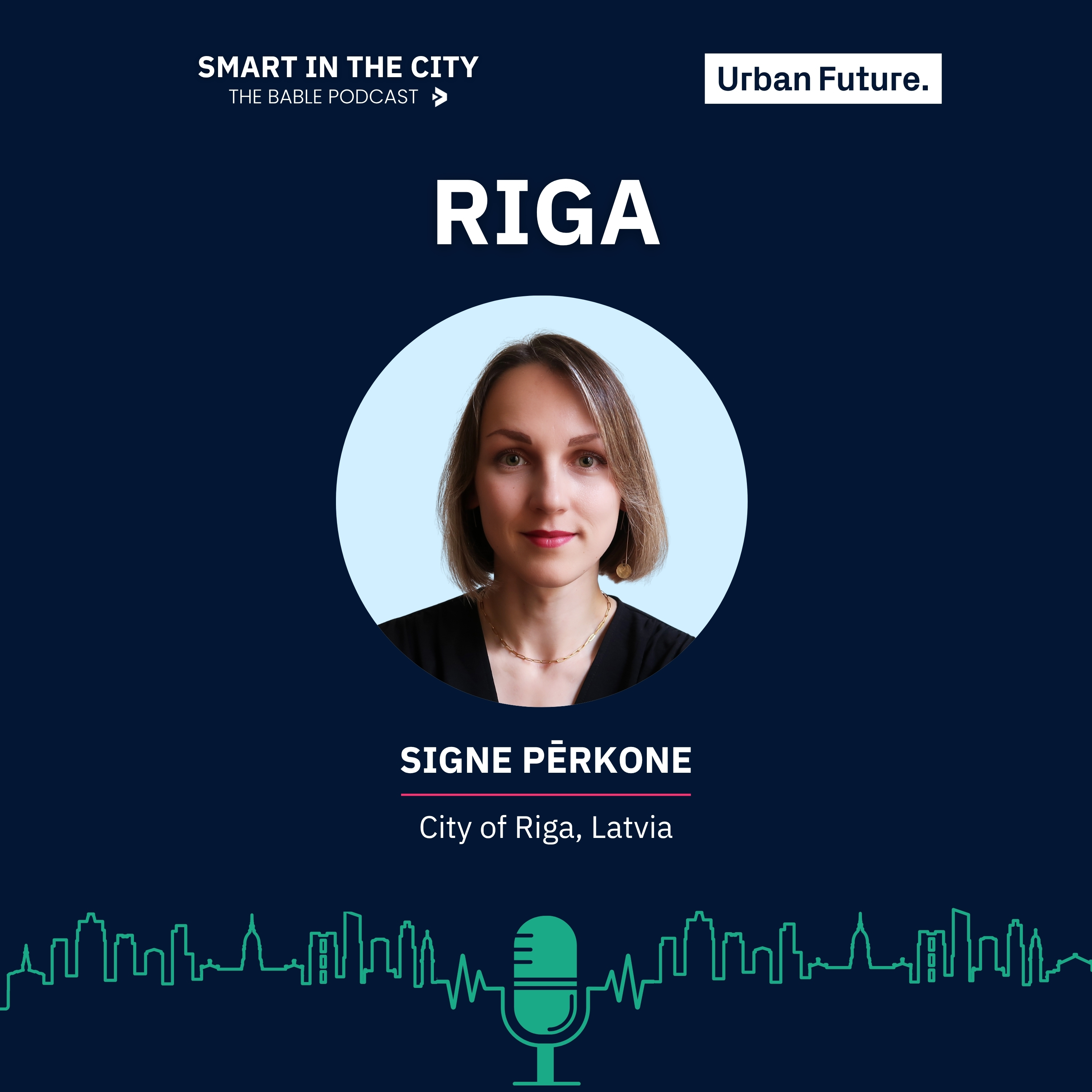
So welcome back to another episode for our Urban Future Partnership series, recorded here at the 2026 edition in Ljubljana, Slovenia. So first I have to give a big thank you to Urban Future. They've been allowing me to do podcasts here and partnering with me for, I think, five years now, and it's always been a wonderful experience, getting to really sit down and dig in with a lot of the speakers, understanding their stories, projects, learnings and more. So today we have the city of Ria in Latvia and so it's a pleasure to introduce you to Signe Pekone. She's a senior project leader and architect at the City Development Department for the municipality of Ria. Welcome.
[00:01:48] Speaker A: Thank you. Thank you for having me.
[00:01:50] Speaker C: Absolutely. It's our pleasure. I'm really excited to learn more about Riga. I think we've done a couple episodes, as you mentioned, with Vilnius, and I'm trying to cover the whole region. So Riga is definitely one that I wanted to talk to first. I'd like to start off with a bit of a teaser question to get us warmed up into the flow of things.
The teaser I have for you today is if you had a superpower to help you with your daily work for the city, which one would it be and why?
[00:02:20] Speaker A: I think my preferred superpower would be teleportation because that would make site visits much more easy.
I could just be much more on the ground because I think we architects and spatial planners, we get sucked into maps and sitting at our computers and analyzing data.
Man, often I wish I could be more on the ground and actually just casually chat with people more and just Feel the vibe of the place I'm studying and doing a project for in different times of day of the year.
[00:02:50] Speaker C: Very good answer. I think that's mine. That I would pick too. I would love to travel. I would love that more than anything else. So agree with you there.
I want to learn a little bit more about you as a person. What is your background? Where did you come from? What led you into this role?
[00:03:06] Speaker A: Today I'm architect by training.
I studied actually in the UK in Manchester School of Architecture for my bachelor's.
But I always had my heart back home in Riga. So I was in summers going and working for architecture offices and after my bachelor's as well, I worked there for a year and then I went to University of Delft, Delft Technical University for my master's and then afterwards I went to Mexico for a year.
So still wanted to see the world and see how things are done elsewhere. But after that I returned home and I've been in Riga now, working for six years, I think.
Yeah. And just gradually drifting from architecture more to the public side of things, to urbanism, to public space projects.
Because when I went to UK to study architecture, I realized I haven't really experienced good architecture because you laugh, but I grew up living in a Soviet housing block and my school was just a regular building. And there weren't that much good public architecture in Riga back then. Only I could experience museums and buildings like that. And when I went to travel, I was lucky enough to have a chance to go to some European capitals, but it wasn't enough to even imbue me with the sense of what is a good space, what is decent architecture.
And then you also. I don't know if you've had a lot of architects on, but you realize very early on that it's quite a difficult career.
You end up putting so much of your heart and soul into it. You do all the long nights, the all nighters and kind of you're expected to, because the work is interesting, to also do it at your free time and it kind of cuts into your life.
And it was brilliant education. I wouldn't change it for anything. I loved it. It was so interesting. We got to think about so many things. But in practice it narrows a lot, what you get to do. And you realize you're putting in all the long hours, all the hard work in detailing a project and bringing it to fruition. And in the end it might be just for some rich person behind closed doors, you know, the gate closes and actually you don't get to see much.
And I was lucky enough to get a chance to work on some tactical urbanism project kind of interventions. Just kind of summer streets in Riga back when I soon after I came back from Mexico and it was kind of much less design and much more kind of maybe fighting with different parts of the municipality to make this kind of non standard thing happen.
And yeah, it wasn't even kind of 100% successful, you know, there was still public backlash and a big drama on social media. But at the end of the summer I cycled through the streets and I realized, wow, change can really happen, you know. And that really inspired me to go and move more towards this public space. And eventually that's how I ended up really working more permanently for the municipality because I felt, okay, I'm going to go where the help is more needed, where I can set the brief and work on this kind of the process of how change happens in the city.
[00:06:39] Speaker C: Really interesting journey. I like how you have transitioned from maybe more private architecture to really the public space focus. And I guess here at Urban Future you're also diving into a lot of more holistic topics as well.
Can you set us, set up the scene for us a little bit with Riga? I think most people probably heard of it. Maybe some have visited, maybe some not.
What type of city is Riga? What is most important to understand about the city for how it develops?
[00:07:10] Speaker A: Yeah, Riga is an old city. It was established in 1201, so the very beginning of 13th century.
It sits on a river, Daugava river and. And it's quite big. It gives a very spacious character to the very center of the city because it's kind of symmetrical almost on both sides of the river.
Yeah. And in scale it's much larger than Thames or this Ljubljanica river that runs through Ljubljana, where we are today.
And yeah, it had the medieval town kind of the historic city center, the old Riga, which still exists, a very well preserved and we're very proud of it. And then around the turn of the 20th century, kind of the end of 19th century, the city grew a lot and a lot of art nouveau architecture was constructed. It's also very beautiful. It's a UNESCO World Heritage site. Some beautiful parks as well. Kind of the old city battlements became a beautiful park around the old town of Riga.
And at the same time there were some kind of satellite villages, more workers villages with some wooden architecture. And this heritage preservation has been quite strong in Riga in recent years.
And so quite a bit of it is preserved and valued. So you can see different types of historic architecture in Riga. But then of course, Latvia was occupied by the Soviet Union and made one of the Soviet Republic. So also a lot of the. The kind of large scale housing districts were built and still most people live in them. And we have this kind of heritage as well and this part of the urban fabric.
So that's more or less how the city has developed. And of course when we regained our independence in the early 90s, then there was this rapid shift to market capitalism and the deregulation and just kind of this feeling that, yeah, we should just let the market be free and it will solve everything.
Of course, what you get is kind of the sound controlled development on the fringes. Shopping malls arriving, more and more traffic, everyone very keen to get their own car and a second car. And of course, with all this kind of congestion and the fact that Riga has developed so concentrically, kind of all roads leading to the center, it becomes untenable over time. It's because you have to be in these traffic jams. And precisely people start going out of the city because Latvians love their nature. You know, they're always escaping. And everyone has a grandma in the countryside village with a house and so on. And so people try to get out of these kind of housing blocks and just get out of the city and be closer to greenery.
But you know, they take their tax money with them because where their taxes go depends on where they live. And when they live just outside the city limits and still come to Riga for all the city services, you know, it becomes harder and harder to maintain.
And another defining feature is that Regas and all Flatv's population is declining. You know, it must be one of the fewer, the only capital in Europe where the population is still declining or declining now.
[00:10:29] Speaker C: Yeah.
[00:10:30] Speaker A: So that's. That makes it very different. You know, when I'm in this kind of conferences talking to colleagues, I can just hear, oh, we need to solve this and that because the population is growing, we need to provide and we need to act and act boldly. But in Riga it's a very different context because also we feel we need to do something. But then there's much more discussion and a clash around we need to do this to keep the people or attract the people. No, if you make this change, then people will flee even more.
It's an argument on both sides. When you're having this fight, I think it makes a bit harder to implement this bold change.
[00:11:06] Speaker C: Yeah, absolutely. That's a really unique case actually for shrinking cities because Indeed, every, almost every city I have on here talks about the housing pressures, talks about this immense pressure on cities to provide more and more for more people.
So in a shrinking city, what does smart consolidation then look like on the ground for your work?
[00:11:32] Speaker A: Yeah, it means precisely choosing carefully where to invest.
And I think this thinking should be quite strategic because precisely you can't fix everything.
And this may be an example of that is what I've been working on for the past couple of years, which is the neighborhood Center's development plan.
It's inspired in large part by this 15 minute city idea that services should be accessible locally and you shouldn't have to commute to have a decent life in the city.
But maybe we feel that since the territory of Riga is quite large compared to the amount of inhabitants, we can't quite promise to make it a 15 minute city everywhere. But we have to start by making almost pilot projects in the neighborhood. So kind of consolidate where is already a central area in the neighborhood and there are already some services there. And we want to create these places, make them better, you know, really improve the public outdoor space, kind of focus more on this third space that, you know, thinking that everyone more or less has a place to live and somewhere to go like school or work.
But the city wants to add to this third place so that you have somewhere to meet other people, you know, to create friendships, to spark ideas, and where the city can show that it cares about its inhabitants, you know, that you don't have to leave, you know, this is also a good place to live, a different kind of place.
[00:13:13] Speaker C: Yeah, absolutely. And you described to us before that this development, spatial development plan is used also as a negotiation and coordination tool. So what does that really look like? What do you mean by that?
[00:13:28] Speaker A: Yeah, so Neighborhood Center's development plan was at first a policy document, but that set out what we mean by a neighborhood center, what it should have.
And it set out the territories. So Riga has 58 neighborhoods. It's quite a lot. And they are based more on the historic identity of place or looking for identity and kind of maybe natural boundaries set by urban form. And the neighborhoods weren't per se, conceived as administrative units for providing services.
So in the neighborhood centers development plan there were 33 neighborhood centers assigned in the more populated neighborhoods and kind of seeing how we can more or less cover everywhere that is populated in Riga in the territory.
And this policy. So it sets out the locations of the neighborhood centers, the territory and four action areas, which is mobility, small business support, public outdoor space, which focuses More on the green areas and identity and community.
And this basically these four action areas, they cover everything that the city, the municipality does in its own land, in its own scope of influence, kind of for all these different actions, from really reconstructing a park or adding recreational activities in unused green areas and just doing streets and sidewalks and all the basics to more kind of one off things like just placing a community notice board or some Christmas decorations or a public art somewhere or city seller stands for markets.
And so this was all set on the policy level. And then it moves into my sphere of work, which is the master plan. And the master plan kind of takes the territory and all these actions that we can do in them from the city side and creates this integrated spatial plan in which we try to think in layers and see where we can bring interventions together to achieve a kind of cumulative outcome.
So what the city does doesn't feel so much as putting out fires, but it has this strategic purpose of bringing things together to create this sense of place and to address needs that people have.
And that brings me to how we then use the master plan. And that is in kind of creating the vision, listening to people, working together with people also in various ways and at various stages, and also working together with those who will implement it. Because I'm from the city Development department, which focuses more on strategic and spatial planning. And then we partner, pass on these ideas to implementing departments. You know, one department's responsible for streets, one department responsible for parks, and one department responsible for art and culture.
And we cannot get into how complicated that fragmentation is, you know, but yeah, we have to essentially sell and negotiate this vision, both with the people on the ground and with these implementing departments. So you kind of talk with one, talk with another, try to integrate these needs and comments. So it's, it's a really a negotiated plan that we agree to implement that this will be the best for the city. And then the master plan needs to set out also a clear structure for implementing it, because this is the crucial bit, because good ideas die in not having a clear route to implementation.
So in kind of also fragmented public outdoor space management situation, we want to very clearly visually set out what needs to be done where and in what order to actually make this vision happen. You know, and this is maybe different to this architecture work, urban planner work in practice, because normally it's just one vision and it's someone else's job to implement it.
But we're really trying to, yeah, set out kind of this clear scheme so that the implementing department can Take this line in Excel that. That says the project name and how much it costs and when you're supposed to start it. And they're like, okay, what do I do now? And then they can open this very visual booklet and see the overall vision, the goals, and how that translates to actions actually on the ground and who else they have to coordinate with and so on.
Very interesting.
[00:18:11] Speaker C: I love the way that you think about planning. You've also argued for planning that it stays more flexible and not as legislative.
Why does that matter? What does that mean for you?
[00:18:24] Speaker A: Oh, yeah, I think it's crucial. It's something that's on my mind a lot because Riga hasn't in the past employed so many of these more flexible forms of planning. So we have the territorial plan, which is a legislative document which sets the planning rules, kind of what type of building goes in which block. It's very large scale.
Every city has this, I think. And then there can be detail plans or local plans which set out more kind of on a site level, where the street should go, what the function is of the plot, kind of where the buildings are, where the connections to infrastructure, things like that. And they are also approved as a kind of law, you know, and then can be also some thematic plans focusing on some issue. And all this kind of very strict approval processes tend to make it that if there's not a clear enough strategy for implementing, if there's not money at this time and it gets pushed back, then it can end up on a shelf, you know, or some something changes on the ground that makes some part of the plan invalid, then it's all invalid.
So we were really trying to kind of innovate along the way and look for ways to create the spatial plan and have it. This is why this negotiation part is so important, you know, because we're not planning just from the top. Okay. This is now law, and you have to implement it, no questions asked. No.
Since it's not going to be this kind of very strict law, then this negotiation is very important.
And yeah, we are still testing how it's going to work, this flexibility aspect of it. But one way we try to do that is that from each neighborhood center master plan that comes several projects. And there can still be different scenarios in how they get implemented. And maybe in some there's also a kind of temporary phase, so we end up kind of prioritizing different actions and seeing which one is most necessary and which is the kind of nice to have layer.
Yeah. And I think it just needs this human oversight that we can't trust that good ideas will just magically self implement. I just don't believe in that. I'm sorry.
The municipality was a well oiled machine without any of the human element. Maybe it could be, but since you have to be, you know, passing it on, I think it's important that you can kind of go back and forth and still kind of adjust along the way because you just cannot foresee everything, you know, you cannot foresee all the circumstances.
So even though I did this, the master plan that sets out the projects, let's say where we need to, okay, for this park, we need to then develop an architecture project, then it will go to building. And I have the wonderful opportunity to step still sit on in these meetings where this architectural project is developed. And I can put my input to say, okay, kind of from the vision side and how we talked previously with some of the stakeholders or the inhabitants and how maybe to adjust it. And I'm learning a lot along the way. So I'm always trying to keep this kind of learning mindset that I'm learning from everything I see around and just try to improve the process of the planning as well.
[00:21:56] Speaker C: And I can imagine that one of the pain points of this process is this handoff to implementation, right? So you've done all this planning, you've tried to make it flexible, set up this perfect, hopefully perfect, package for those that are going to implement, right. But then you have to hand it off.
What do you think is those determinants of success for the handover into implementation?
[00:22:26] Speaker A: That's a great question.
I do think it's a very delicate moment because I think good ideas are carried on some level of passion and it's not always kind of so easy or possible to sell your passion to someone else who has to continue it.
So I think it's the structure, like a clear structure of how these things move along. Like a structure, like a governance structure and a plan that is agreed and funding, funding has to go along with it. Because initially when this plan was conceived on the policy level, it was like the implementing departments, they are already doing these things all over the city, like putting pedestrian crossings or cycling lanes or this kind of notice boards.
And let's just make sure that it happens in strategic locations.
But there are always more fires to be put out than you can really address.
And when the implementing departments have their own plans and then you're trying to come in with your great idea about this strategic interventions, it can be a bit of a clash.
So actually having dedicated funding for Implementation is necessary.
This is also what I see a lot in the conference that I feel so boring myself because I'm listening to wonderful ideas and I'm thinking, money, money, money, money, money. Where's the money? Where's the funding coming from? Where is it going? How is it structured?
Because this is where I'm hitting a wall sometimes that we've had to fight to create precisely this implementation structure. And it's an ongoing kind of process, to be honest.
[00:24:16] Speaker C: Do you think that that's your biggest challenge you're facing at the moment, or are there other challenges or other tools or mechanisms that you need to really accelerate the change that you want in the.
[00:24:27] Speaker A: In the city?
Yeah, definitely. The implementation is one on all levels of the city planning and city works, because it's just a big, big structure, you know, and then kind of making really sure that the interventions are strategic.
I think that may be this. Prioritizing different initiatives, because what I'm talking to you about is just one initiative of many. You know, there are also different parks being developed that are not in neighborhood centers, and different streets being built, different bits of infrastructure elsewhere because of other prioritization criteria. So I think it's important to kind of bring all those strategic layers together to have a kind of maybe guiding principles in these higher conversations.
Yeah. And I think one thing that we've heard talking about this neighborhood center plans is that we should not only be looking at the public outdoor space layer, but but also include other type of services.
So this would be really a direction to look at in the future, I think, and also how to negotiate better with private landowners or investors or developers.
Because since we wanted to make this a very realistic and achievable plan, we are focusing purely on the land owned by the city and what the city can do in it.
You know, we're not entering in these huge negotiations with the private sector, and we don't actually have a lot of experience in public private partnership.
And I think this would be also a direction to explore, definitely. That's why we need some. Some learning and some practice, I think.
[00:26:17] Speaker C: Yeah, absolutely.
Now, I just want to give you also the space.
We talked about a lot of things, and I want to give you the space also, in case we miss something, give you the open floor. Is there anything else that you can think of that really want the audience to know about your work, about Riga? Anything that you can think of?
[00:26:42] Speaker A: I think what I would like the audience to know is that they should come visit RIA and experience it for themselves. You know, It's a beautiful city and there are lots of cultural events in the summer. Especially the summer in the Baltics is wonderful. You know, everything is quite close. So you can enjoy some concert or some exhibition in the city in a nice place, warm evening, and then go out to the sea, because Riga is also by the sea. Or have a walk in a forest or see some beautiful castle in some smaller town.
Yeah, I don't know. I have a love for my city.
I believe in it, even though it can sometimes be depressing, this declining population and one battle after another and funding issues.
But I think we should just all keep going one step at a time to kind of make just sensible, achievable change.
And I think it's important also in the sense to question our own process, because with this neighborhood center plans, at first we were doing them one after the other.
And we have worked in five different neighborhoods now, but there are 33 centers. It's like, when are we going to even do this, right? Like with these five centers, we have planned projects that the municipality has capacity to do in five years, maybe.
What are we doing? Are we stopping the planning or are we waiting? Are we getting rid of some projects, canceling them?
And then we thought, okay, we need to look at kind of on a larger scale, not zoom in so much to one neighborhood center, but look at several neighborhoods together, maybe. So we can start addressing also this service layer and plan some interventions that are more smaller, like kind of this one off intervention, such as placing street furniture or making pedestrian crossings or placing some like event notice boards or community notice boards, these kind of, kind of smaller things that we can do those thematically. You know, we can look at like 10 neighborhoods and find these places for them. And that's like one procurement, you know, and then mark the areas where a complex project is needed. You know, a park or a section of the street that we need, the building project. And then we leave the developing of the vision closer to when we know that it's going to get implemented. Because we want to keep this kind of connection with the people on the ground.
And if we go and talk to them and ask them, okay, what do you want? What are your problems?
And then it takes a really long time for anything to happen. We're losing credibility, we're losing the trust. And that's what really we should be careful about.
And we should be very upfront with people about what kind of things they can expect and in what time frames. And they never want to hear it. And you're never the Good guy with people.
It's a shame sometimes, but still, I mean, it's sensible. Desires they have their children get to enjoy a neighborhood park instead of growing up without it and then it appears.
Yeah. So we are just also adjusting the way we do this and just looking for ways constantly to improve the process and be in close contact both with the needs on the ground and how things work from the implementation side.
Makes a lot of sense.
[00:30:19] Speaker C: Thank you so much for sharing. Now we move into our fun segment. The segment that we have for you today is one of my favorites. It's called Roll with the punches.
[00:30:30] Speaker B: Roll with the punches.
Answer this or that questions quickly and with your first instincts.
[00:30:40] Speaker C: I think I'm going to know your answer to the first one, but I'm going to go through them pretty quickly.
Winter or summer in Riga?
[00:30:49] Speaker A: Summer.
[00:30:50] Speaker C: Historic charm or modern edge?
[00:30:54] Speaker A: Historic charm.
[00:30:56] Speaker C: Pencil and paper or digital notes?
[00:30:58] Speaker A: Pencil and paper.
[00:31:00] Speaker C: Permanent intervention or temporary test?
[00:31:06] Speaker A: Like I have to follow one another. You must know this, but. Okay, let's start with the tempero.
[00:31:12] Speaker C: Okay. One flagship project or many smaller neighborhood wins.
[00:31:17] Speaker A: Smaller wins.
[00:31:19] Speaker C: Calm consensus or creative chaos?
[00:31:25] Speaker A: Since I feel forced to say calm consensus because I work for the municipality, we are not good chaos managers.
[00:31:33] Speaker C: Formal stakeholder meeting or walking conversation on site.
[00:31:37] Speaker A: Walking conversation on site.
[00:31:39] Speaker C: Big vision or quiet consistency?
[00:31:42] Speaker A: You need the big vision.
[00:31:43] Speaker C: All right, good. Do you want to explain any of your other answers?
[00:31:49] Speaker A: It's tricky. Sometimes I feel like my. My personal kind of preferences clash with the role I have to play in the city.
But yeah, it's. I think we need to bridge a lot of these things.
[00:32:02] Speaker C: Definitely.
[00:32:03] Speaker A: It's not one or the other. Yeah, it's often, you know, it's often the other side that contributes a lot to what your first choice might be. For example, there's a beautiful new park was built in Riga last couple of years and it has a wonderful skating track that goes through it. You know, that can be.
You can go in summer with your rollerblades and other type of whatever you might want to be doing that has little wheels. And in winter it becomes a skiing track. You know, you can rent these cross country skis.
And I went there with my 4 year old on one sunny, wonderful, extremely snowy winter day. We had a lot of snow this summer. Winter, Jesus.
And it was great. I was like, I don't have to go out at time the same city. I can enjoy winter in city finally. So definitely we are coding into the tasks for these neighborhood centers. Also consider all seasons so it's not just for the summer.
Because a lot of people still want to escape the city in the summer also get even closer to nature.
So it needs to work in all seasons.
[00:33:19] Speaker C: All seasons.
[00:33:20] Speaker A: I love it.
[00:33:21] Speaker C: Now we come to our final question. It's a question I ask every single guest that comes onto this. Obviously, I think you also have a very unique perspective to this. The question is to you, what is a smart city?
[00:33:34] Speaker A: I think a smart city is a city that has a grip on itself in terms of management and has a connection to its people, has clear routes for people to tell the city what they are feeling and experiencing, what they need.
But the city has to have kind of understanding also from the data level, from the ownership, management level of what is where, who is responsible, and things like that that sometimes feel like they're still lacking in this maybe fragmented urban space management that we have in Riga. But I think this is where we can get smarter and it can make a lot of difference. And I think that will help us bring this connection to people more closer to also change in the city itself.
[00:34:31] Speaker C: Yeah, very good, Very well put.
In general, I love the way that you talk about this. I can tell that you're very passionate. So thank you so much for taking the time out of the conference also to come talk to me, share a bit of your experience, experiences and insights. I really appreciate that. So thank you very much.
[00:34:50] Speaker A: Thank you for having me. It's been a pleasure.
[00:34:52] Speaker C: Anytime. And I hope to also visit Vega one of these days.
[00:34:55] Speaker A: I hope. I'm selling it.
[00:34:56] Speaker C: Yeah, you've sold it. You've sold it. I also have to give another big thank you to Urban Feature for the partnership, for making it possible to record here today. And of course, a big thank you to all of our listeners. It also wouldn't happen without them. And don't forget, you can always create a free account on Babel Dash, SmartCities EU. You can find out more about different use cases, solutions, implementations and more. Thank you very much.
[00:35:19] Speaker B: Thank you all for listening. I'll see you at the next stop on the journey to a better urban life.