Episode Transcript
[00:00:00] Speaker A: Foreign.
[00:00:07] Speaker B: The City the Baba Podcast where we bring together top actors in the Smart City arena, sparking dialogues and interactions around the stakeholders and themes most prevalent for today's citizens and tomorrow's generations.
I am your host Tamlyn Shimizu and I hope you will enjoy this episode and gain knowledge and connections to accelerate the change for a better urban life.
Smart in the City is brought to you by BABLE Smart Cities. We enable processes from research and strategy development to co creation and implementation. To learn more about us, please visit the BABLE platform at BABLE eu
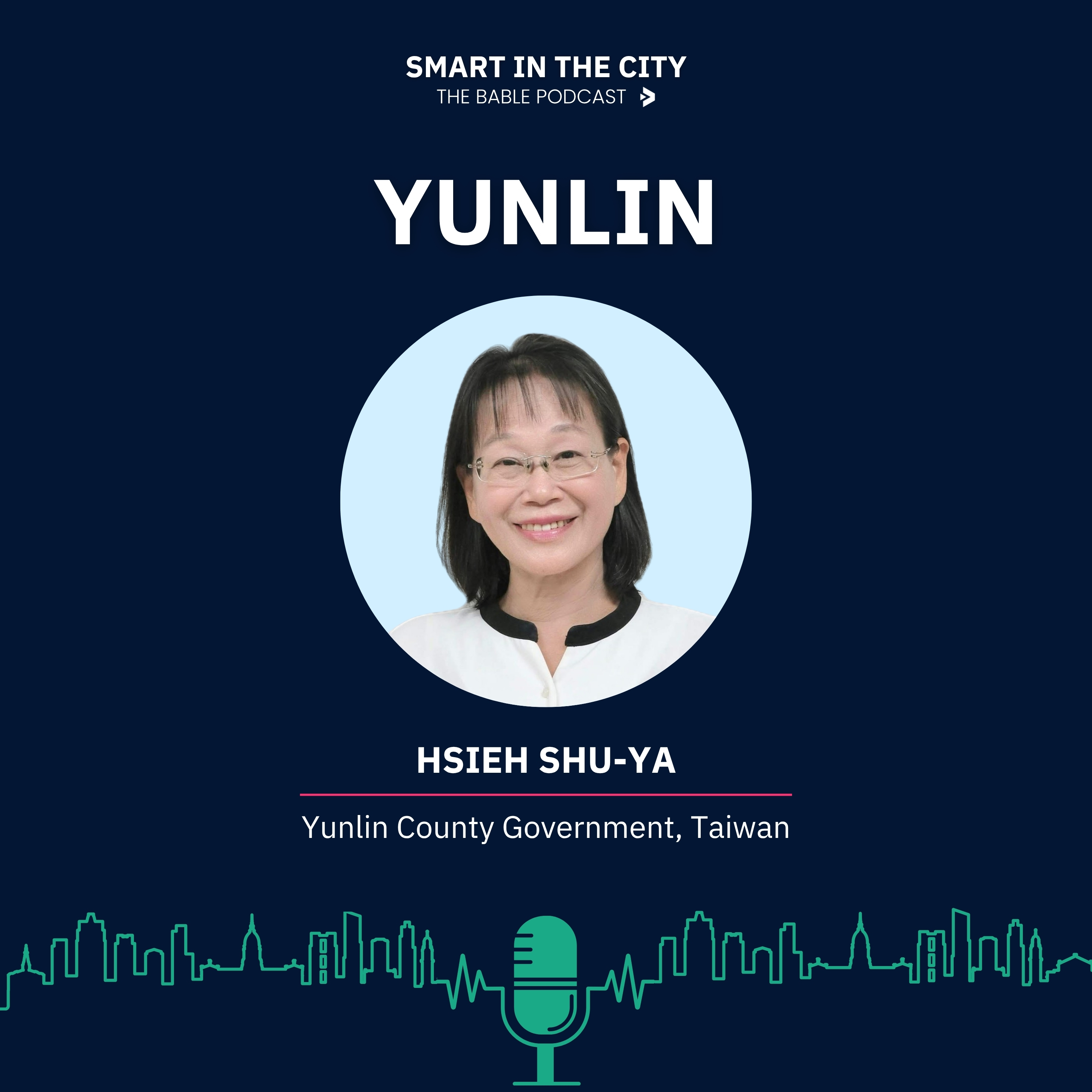
[00:00:46] Speaker A: so today we are traveling to Taiwan, a country that has recently become a top favorite of mine as I visited a couple months ago and I'm sorry, specifically traveling to Yunlan county, which I also had the pleasure of visiting and it's Taiwan's largest agricultural hub.
In this episode we'll explore how Yunlan is really transforming agriculture through smart technology, sustainability and strong infrastructure. We'll look at how the county connects to some of the key themes we often discuss on the podcast. Data driven operations, transforming waste into innovation, financial sustainability, and the future of rural regions.
So with that, I have a very special guest with me today.
So I'm really excited to introduce you to the Deputy Magistrate of Yunlan county in Taiwan, Shei Xu Ya. Welcome to the podcast.
[00:01:43] Speaker C: Oh, thank you Thandi. It's my pleasure to share Yun is a story with the BABLE Podcast listeners.
People used to think of Yulin as just a traditional farming county, but we are actually transforming our agriculture through a smarter technology, sustainability and solid infrastructure.
[00:02:07] Speaker A: Yeah, it's really amazing to see how these rural counties are transforming into innovation.
Really not a typical innovation hub like in a city, but really using innovation within those agricultural practices to start us off. I would like to warm us up a little bit with a lighter question.
So the question I've chosen for you today is if you had to describe Yunlan in just three words, what would they be?
[00:02:38] Speaker C: Oh, the words that immediately pop into my mind or center around our people. I would say warm, vibrant and innovative.
First one in union, people truly care about each other.
It's a very close, genuine convention between our citizens, making it feel like one big family. Second vibrant. We are incredibly proud of our leadership and our strong focus on youth development. We are actually bringing young people back home and injecting fresh energy into our communities.
And the third one, Vative.
It's not easy for traditional agricultural county to transform, but we take this as a great opportunity. We are open to smart technology to tackle our changes Headlong and going forward together with our citizens.
[00:03:46] Speaker A: Yeah, great adjectives. I can agree with those adjectives as well. I really felt this warmth. I really felt the innovation when I went into Yunlen. So I definitely agree with your adjectives as well.
Now, before we get into some of the key topics of today, I would love to learn a little bit more about you as a person.
So, Deputy Magistrate, can you tell us a little bit more about your background and what led you into your role today as Deputy Magistrate of Yunlan County?
[00:04:20] Speaker C: Thank you, Tamdi. Yunli is my home and my career has been deeply rooted in local property service.
Seeing the everyday struggles of our people that residents in rural Gu camp being cut off by the broken heart county routes 149A for over 20 years, that's truly broken my heart. My motivation is very simple. I want to solve this fundamental everyday problems. By building solid infrastructure and reconnecting our communities. We can keep our youth here and have our agricultural thrive and share Yun is a true beauty with the world.
[00:05:06] Speaker A: Yeah, absolutely. I. I can agree with that.
And. And so we've started to paint a bit of a picture of Yunlen. I was wondering, you know, I think a lot of our listeners don't know Yunlan yet. Can you paint us a little bit more of a comprehensive picture of the county? What kind of place is it? What role does it really play within Taiwan?
[00:05:29] Speaker C: I'll be very happy to. Yuni is widely known as the Taiwan agricultural hub and experiment.
In fact, one out of every three vegetables or picks on a Taiwanese dining table comes directly from Yunning. However, Yunning is so much more than just a traditional farming county.
Today we are activated farming into an agri and industrial commercial tech city. By connecting our rich agricultural roots with smart innovation and sustainability.
For example, we are championing a circular economy by turning agricultural waste like oyster shell, pineapple leaves and kitchen waste into high value textile, organic fertilizer and green energy. We are also developing smart culture, logistic parks and successfully splurging our local agricultural brands to international markets like Japan, Singapore and the Middle East. We are taking the very best of our traditional land and operating in four the modern global stage.
[00:06:52] Speaker A: Yeah, I think we'll dig into some of those topics a little bit more. I want to start with the infrastructure. So when people hear the word infrastructure, maybe they think of, you know, highways, fiber networks, 5G et cetera. But in Yunlan, the foundation for innovation really seems more connected to like the agricultural farmers daily reality. So waterways, rural roads, machinery access, logistics, those types of things.
So how do you define infrastructure for a more agricultural region?
[00:07:29] Speaker C: Yes. First, agriculture infrastructure is the absolute definite lifeline for our farmers.
Over past few years we did not just build city roads. We invested over 4.2 billion anti dollar upgrade 1963 agricultural waterways and rural roads. That's about 866 kilometers equivalent to traveling the entire length of Taiwan back and forth.
We also push for mass of farming consolidation in our coastal areas.
Optimizing low land of modern farming machinery can easily assess the fields. Without this solid physical foundation, advanced agricultural technologies sifu cannot enter farms. Once the physical groundwork is laid, we can build advanced facilities and digital networks on top of it. Physically. We are planning the Donan, a small logistical coltrane park to connect our local agricultural products to global markets without losing quality.
[00:08:50] Speaker A: Yeah, absolutely. I want to touch a little bit more now on the data. So we're in the age of, you know, data AI.
One thing that stood out to me as well is that Yunlan is really trying to move AI and the use of AI from pilot projects to really everyday operations and policy within Yunlan County.
Maybe could you give us a very concrete example of how a farmer might use this information differently than how they used to use it in the past?
[00:09:24] Speaker C: Okay, no problem. As extreme weather impact farming, we move beyond small scale pilots and implemented the Union Digital Agricultural Mobile a platform as a policy level.
Regardless of experience, farmers can now make decisions based on market and weather data. The preform uses AI to predict the harvest times and prices for nine types of short term leaf vegetables, effectively preventing market crashes.
We even adapted a platform to line an app commonly used by everyone, including our farmers. This allow us to push real time climate warning directly to their phones so they can make a precise data driven decision on when to irrigate or harvest.
[00:10:27] Speaker A: Yeah, I've really loved learning about the different applications and I think that's a very good use case using data and AI within a more agricultural setting.
I want to also talk about the products themselves. So producing high quality products is one part of the story. Right. But bringing those products to wider markets I know is also a goal of Yunlen.
How does Yunlen really support farmers in building market competitiveness and sales capabilities?
[00:11:01] Speaker C: Maybe you can elaborate there dance and that's a really good question. Produce an accident. Produce only half the battle. We recognize that many small scale farmers sell at growing quality crops. But like the expertise to market sell globally. That's the reason why we established Uni Goods is a comprehensive support initiative like Trends and builds up our format sales and marketing mindset and the capabilities any goods serves as a bridge between production and the global marketplace. We provide a structured training in digital marketing, brand storytelling and export logistics and Indonesian business practice.
More importantly, we help farmers understand consumer refurbishes quality standards and prices and strategies across different markets. We have developed a collective channel that enables more farmers to for their products a share of marketing cost and a collective each international buyers winner through e commerce, a platform, trade show or directed B2B partnerships. Through this integrated approach combining AI powered production intelligence with market driven sales capabilities, we are transferring Union farmers from commodity producers to competitive global agricultural brands.
Data driven farming ensures quality and efficiency. Union goods ensure they have the market presence and the sales channel to monetize their quality on the international stage.
[00:13:13] Speaker A: Yeah, I think what Yunlan is doing is really a good lighthouse example in some of these cases for a lot of rural regions that a lot of these regions can take a lot from what you're saying. Now I want to also touch more on the circular economy because I know Yinland is doing a lot and has very memorable examples.
How is Yun then really turning agricultural and municipal waste into new value?
[00:13:43] Speaker C: Yeah, that's a very very good and important issue in Yunning.
This is something we are extremely proud of. Union's circular economy operates on multiple fronts. First of all municipal west we partnership with partner with the Alpha Mosa Prostate group. We process a 60 tons of a daily household os into highly thought of organic fertilizer called Uni fertilizer within just eight days. This also completely help prevent Africa's wine fever from entering pig farms. And the second one for agricultural waste we transform discarded oyster shell from our coastal area which is to cause trouble outers using narrow technology into seaweed. This is a patented and eco friendly yarn adopted by a global brand like Uni Kudal. We also turn decades of highly semi waste water from pickled cabbage production into a nutrient liquid fertilizer from aquaculture. We even collect biogas from pig manu to generate 500 kilowatts per hour of electricity daily at the husbandry farm. We are turning mental burden into green competitiveness.
[00:15:30] Speaker A: Yeah, such cool use cases I think for for how we can use waste from agriculture to to create new products. And I everyone should be thinking in that direction because it not only has good benefits for our planet but also for competitiveness of regions as well.
And what I find interesting is that these examples are not just environmental projects.
[00:15:53] Speaker C: Right.
[00:15:53] Speaker A: They also create new products. They create these new partnerships new stories to tell as well.
Can you talk a bit more about why circular economy is especially important for Yunlan's broader international narrative.
[00:16:07] Speaker C: Yes, sure, you hit the nail on the head. Products like our uni organic fertilizer, seawall textile and green electricity are just for results. The real driving force.
As new partnership and cross sector collaborations we have built as a global government with a government with limited resources. Our role is to be the ultimate bridge. For instance, we form a public private partnership with Nanya Plastic, a bridge of Formosa Plastic Growth, one of the largest petrochemical companies in Asia. To tackle our country's footwest, we collaborated with the Acreatech Textile Ltd. Corporations and universities like Shijin University to run interactive studies turning discarded oyster shell into a patented fabric. We even team up with National Taiwan University researchers to transform parametric solar cabbage wastewater into valuable aquaculture nutrients.
These collaborations are crucial to our international narrative. They show that rural regions can turn local environmental challenges into global value through innovation.
[00:17:46] Speaker A: Yeah, absolutely. And I think a big part of this as well is around the partnerships.
Innovation in agriculture can be really expensive when you think about the upfront cost for farmers.
Yeah, especially when farmers or small, small businesses might need new facilities, new equipment, new systems.
Can you tell us the example that I learned about with Formosa Goose and what it teaches us about the financial sustainability?
[00:18:16] Speaker C: Yes.
Formosa Goose limited coveration is a very, very good example of this. In agriculture, innovation is often necessary, but it can also be financially risky. So after the Avilian flu outbreak in 2015, traditional goods farming in Taiwan became very vulnerable. To protect the animals and reduce this disease risk, the founder of Formosa Goods decided to build Crow smart purchase houses.
But this kind of facility requires a very large investment, tens of millions of NT$. So the question was, how can this become financially sustainable and adjust the high risk cost for the farmers? The solution was to combine agricultural infrastructure with renewable energy.
Farmers goods partner with the energy companies to install solar panels and aloof all the purchase houses stable green energy revenue over 20 years and helps subsidy the cost of the smart facilities.
For us, the lesson is that financial sustainability can come from combining different value streams. In this case, the farm is not only a producing disease, it's also producing renewable energy. That makes the business model more stable, reduces risk, and helps farmers invest in safer and more modern agriculture. That's a very good example.
[00:20:12] Speaker A: Yeah, it is a very good example of combining these revenue streams and how you can use renewable energy as well for creating, creating this type of subsidies to subsidize the cost of. Of increasing your facilities. So I also want to talk about another Example, the thing you agriculture aquaculture example also stood out to me because it's not technology for technology's sake, as sometimes we'd like to do. It is a very practical response to labor shortages and safety risks.
So what makes inclusive design so important for Yunlan? And maybe you can talk a bit more about that example.
[00:20:53] Speaker C: Yes, easy. Aqua Cultural Corporation is another very, very good example of technology being designed around real people and real daily problems. In Union, many farmers are older and labor shortages are a serious challenge. And aquaculture, something as simple as feeding fish can be difficult and even dangerous, especially in winter. Then farmers may need to go out on the ponds and risk of falling into cold water.
Through our local government sbir subsidies as agricultural corporation developed an amendable for fish and bond. But what I found important is that they did not make the technology unnecessarily complicated.
Instead of relying only on a complex app, the board uses a physical remote control which is much easier and more familiar for elderly farmers. So this is not technologically for technology a sake. It directly responds to labor shortages, safety risks and real habits of people who need usage. So for us, inclusive design means that innovation should not be excluding people is supposed to help. If a solution is too difficult to use, you will not create impact. But if it's practical, accessible and designed around local needs, land technology can really improve our daily life.
[00:22:44] Speaker A: Yeah, I think it's a great example of how you can use the more analog or simpler technology. Really thinking about, okay, who is going to use this in the end? Is it going to be more elderly people? Is it going to be people who are not as used to technology? So I love that example as well to remind us of that important point.
And this also brings us of course to the people side of the story, always centering around the people. So for Yunlun, like many rural regions, you have an aging population.
So how do you make agriculture feel exciting, feel like a future opportunity for young people as well, rather than just something that they want to leave behind?
[00:23:28] Speaker C: Wow, you have touched on something very critical for union's future.
The key is this a strong ecosystem, transform agricultural farm or burden. Your children must escape into an opportunity they want to return to. The aging population is not a problem we hide from. As a catalyst for innovation, we are building a comprehensive ecosystem that addresses this challenging directory. First, we established a smart agricultural university to provide cross disciplinary training. But crucially, we position it as a pathway to entrepreneurship and career stability, not just job training.
Young people see that agriculture can be technologically advanced, financially rewarding and personally Meaningful.
Second, we encourage deep community partnership and shared business models. A perfect example is the Tipsy Farm. Instead of young farmers struggling alone against aging parents expectations, the founder created a shared satellite farm model. This ecosystem and others used to acquire skills in smart greenhouse climate control, drip irrigation and financial management.
While working alongside experienced farmers. They can then return to their own villages and support their families and even mentor the next generation. We are also fostering multi generational entrepreneurship. Young people are launching startups like unmanned farming boards and precision irrigation systems specially are designed to reduce physical labor for elderly farmers. When a young man entrepreneur can operate a profitable business while caring for aging parents in the same community, we bring the circle of rural aspects.
By combining up scaling, shared resources, strategy, partnerships and inclusive technology design, we're turning demographic challenges into economic and social renewal.
[00:26:10] Speaker A: Yeah, absolutely. I love these examples as well. I met when I was in Yunlan, I met a number of young entrepreneurs, young people working within the agricultural sector who are really excited about the different technological advances and how they can contribute to the society. So I, I saw that firsthand as well that a lot of young people are are getting quite excited about this actually too.
I want to ask you, if you look over the next few years, what is the main challenge Yunin still really needs to overcome and what would help you accelerate that change that you need to see?
[00:26:47] Speaker C: Look ahead.
Our most critical challenges are empowering our youth and scaring our international communication.
For a long time, young people had to leave Yunnan to find viable career opportunities to accelerate change and bring our talent home.
We are actively developing the 91 industrial parks which will create over 40,000 high priority jobs and transform us into an agri and industrial commercial tech city. We are also offering comprehensive youth entrepreneurship grants and mentoring programs so our next generation can be successful and a sustainable lesson right here. Furthermore, we must scale our global visibility to shatter all the stereotypes we want the world to know. We are not just a traditional agricultural country, but a global competitive city of champions by activity. Participate in the international network like the Intelligent Community Forum, that's icf and communicate through a podcast hosted by a platform with reputation like BABLE We are assassinating our integration with the world and sharing our resilient innovations on the global stage.
[00:28:32] Speaker A: Yeah, I've really been impressed with how Yunlin is getting out there on an international level as well.
Now we move into our segment.
Segment is a reoccurring segment that we do with different guests and we have different segments. And the one that I brought for you today is called Inspire us.
Inspire us.
Just a Little bit with a story,
[00:28:58] Speaker B: a quote or anything that has inspired you recently.
[00:29:06] Speaker C: Wow.
I'm very happy to share with you. The core philosophy behind our county's transformation is empathy. Recently I was deeply inspired by a local community group called Chuang Lezi. It means to create the happiness just like children or child. It all started simply because of a young woman or girl. I feel it is so young. I felt apathy for unattended children wandering the street and invite them to her home to study and do their homework.
It's a simple act of kindness. Snowboarding to a powerful community hub.
Today, a group of rural women run this space not just as a business, but as a mutual support network. They use green care like gardening and planting to encourage local elders to sleep outside and help prevent dementia, while also providing a platform to empower other women to start their own micro businesses.
They always say we have no broad relations, but we take care of each other like a family.
This perfection shows why our transformation measures empathy.
It's the ultimate driver of innovation in Yunning. It's how we build strong people to people conventions, ensuring that no one is left behind as we create a resilient and heartwarming home for everyone.
[00:30:56] Speaker A: Yeah, I love that. Actually, I haven't heard that before, really that empathy is a driver of innovation. But I really love that I'm going to use that also again.
Now we come to our final question and it's the question that I ask every single guest that comes onto the podcast and it is to you, what is a Smart City, or in your case, a smart region?
[00:31:19] Speaker C: From uni's perspective, a Smart City, or rather a smart region, is never just about code technology.
It's about using innovation to generally improve people's lives, support our local communities, protect the environment and create lasting opportunities for the next generation so they no longer have to leave their hometown.
More importantly, a true Smart City requires a leader who holds a strong ownership. Under the leadership of our Magistrate Cheng and all governors team who always leads with advocacy and take personal responsibility for the country's challenges, we have been able to break down departmental barrier and align our entire government.
It's a strong ownership that allows us to turn technological tools into warmth, practical solutions that truly serves our people.
[00:32:40] Speaker A: Yeah, absolutely.
I love the focus on leadership. Actually, that's something that not a lot of people talk about as far as what is a Smart City or smart region. But really you need these strong leaders, which Yunlan clearly has as well. Strong women leaders as well. So that's amazing.
So with that, I just have to give you a very big thank you for coming on, spending your time with me and sharing more about Yunlan story. I've been as I mentioned I got to visit in person, meet you in person. I had an amazing time in Yunlin and I want to share the story also with the world and share how all these different use cases, everything you're doing on the ground in Yunlan is really a catalyst for these innovation for other regions to learn from and for the future generations. So thank you so much for spending your time with me.
[00:33:32] Speaker C: Thank you very much for chimed in and wish you to see you in Taiwan very, very soon.
[00:33:40] Speaker A: Yeah, I really want to come back. So thank you so much again for the lovely and warm invitation and welcome last time. And of course I have to give a big thank you as well to all of our listeners that have listened all the way to this point. Thank you for thank you for coming on and learning more about this rural innovation region in Taiwan. Don't forget you can also always create a free account on Baba-SmartCities EU. You can find out more about different use cases, projects and more. Thank you very much.
[00:34:10] Speaker C: Thank you.
[00:34:12] Speaker A: Thank you all for listening.
[00:34:14] Speaker B: I'll see you at the next stop on the journey to a better urban life.
[00:34:27] Speaker C: Sam.